
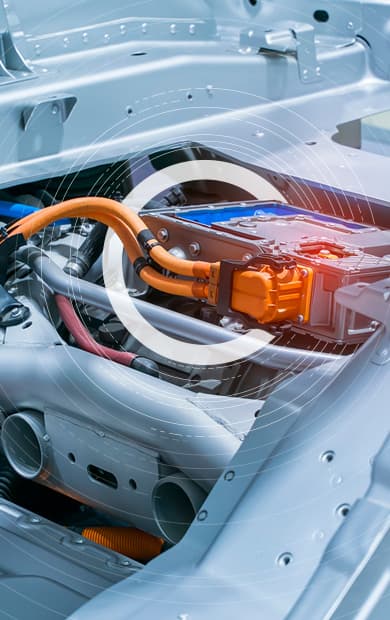
Battery materials
Overview
Growth in global electric vehicles (EVs) and plug-in hybrid (PHEV) production has put a spotlight on battery materials. While lithium-ion batteries dominate the current market, this is a rapidly emerging technology space where improved range or charge times can quicky shift industry sentiment and investment in a different direction.
Argus is at the forefront of battery materials pricing and reporting with coverage of common battery metals (lithium, cobalt, nickel, graphite), industry-grade cathodes and black mass. As experts in specialty metals and rare earths, we future-proof our price assessment portfolio with a range of electronic metals crucial to the manufacture of technology deployed in modern vehicles.
Our Argus Battery Materials and Argus Non-Ferrous Markets services help businesses to understand these complicated supply chains, including price volatility and sustainability challenges around future demand.
Minor metals: Battery metals
As automakers continue to invest in electric vehicle production and power companies explore infrastructure that includes energy storage programmes, the metals contained in lithium-ion batteries supporting these products has attracted interest from investors, institutions and manufacturers alike.
Argus is well positioned to provide insight into price volatility, global supply and responsible material sourcing for all manufacturers and investors in this sector.
Highlights of Argus battery materials coverage
- Understand the context of significant price movements and industry trends with a weekly PDF that highlights the most important market news across lithium, cobalt, graphite, nickel and other common battery materials
- Mitigate risk and perform reliable forward planning with 1-year and 10-year forecasts across different battery metals, chemistries and industries
- Gain a competitive edge with industry-specific tools, such as the Black Mass Calculator that estimates the intrinsic value of different battery chemistries (including cathodes like NCM111, NCM523, LFP, NCA)
- Invest with confidence knowing Argus is IOSCO-compliant with over 50 years of experience delivering trusted price data and market intelligence

Stay ahead of the battery material markets
To be informed of relevant content, sign up to Argus Battery Materials Market Highlights. Each newsletter issue provides key prices, selected news, downloadable insight papers, podcasts, and on-demand videos across all major battery raw materials. Our coverage spans lithium, cobalt, nickel, and more, enabling you to explore end-to-end the battery metals and EV industries.
Sign up nowLatest battery materials news
Browse the latest market moving news on the global battery materials industry.
Rio Tinto raises global copper output, cuts lithium
Rio Tinto raises global copper output, cuts lithium
Singapore, 21 April (Argus) — UK-Australian mining firm Rio Tinto raised alumina and copper output in January-March but reported a sharp drop in lithium production due to weather-related disruptions, it said today. Aluminium and alumina Rio Tinto's attributable primary aluminium output in January-March rose by 1pc on the year, but fell by 2pc on the quarter, to 835,000t. The company's alumina production increased by 6pc on the year to 2.04mn t over the same period. Bauxite production fell by 11pc to 13.28mn t, primarily owing to heavy rainfall at Weipa mine in Queensland, Australia, in January and February and cyclone-related shutdowns at Weipa and Gove mine in Northern Territory, Australia, in March. Rio Tinto's recycled aluminium production declined by 8pc on the year to 61,000t. Rio Tinto has kept its 2026 production guidance unchanged for primary aluminium at 3.25mn-3.45mn t, alumina at 7.6mn-8mn t and bauxite at 58mn-61mn t. Copper Rio Tinto's consolidated copper production rose by 9pc from a year earlier to 229,000t in January-March, driven by the continued ramp-up of copper in concentrates output from Oyu Tolgoi in Mongolia, which increased by 56pc to 102,000t over the same period. Refined copper output at Escondida in Chile rose by 21pc to 16,000t, while concentrates output declined by 14pc to 77,000t in the first quarter compared with a year earlier. Refined copper production at Kennecott in the US fell by 20pc from a year earlier to 34,000t, owing to lower anode inventories following unplanned smelter maintenance and lower concentrator throughput caused by geotechnical constraints. Drilling has also begun at the Resolution Copper project in Arizona following completion of the land exchange in March. Rio Tinto maintained its full-year copper production guidance at 800,000-870,000t. Lithium Rio Tinto's attributable lithium carbonate equivalent (LCE) production fell by 26pc on the year to 12,700t in the first quarter, because heavy rainfall and weather events disrupted operations at its Olaroz and Fenix sites in Argentina. But the continued ramp-up at the Rincón starter plant in Argentina partly offset the production impacts. Rio Tinto maintained its 2026 LCE production guidance at 61,000-64,000t, with first production from Fenix 1B and Sal de Vida on track for the second half of 2026. By Candice Luo Rio Tinto's 1Q26 metals output attributable basis, '000t Production Q1 2026 Q1 2025 y-o-y Q4 2025 Q-o-Q 2026 guidance Iron ore 70,045 62,408 12% 80,515 -13% NA Primary aluminium 835 829 1% 852 -2% 3,250 – 3,450 Alumina 2,038 1,921 6% 1,969 4% 7,600 – 8,000 Bauxite 13,281 14,966 -11% 15,397 -14% 58,000 – 61,000 Copper (consolidated basis) 229 210 9% 240 -5% 800 – 870 Lithium carbonate equivalent (LCE) 12.7 17.2 -26% 15.4 -18% 61 – 64 Source: Rio Tinto Send comments and request more information at feedback@argusmedia.com Copyright © 2026. Argus Media group . All rights reserved.
Japan to boost recycled materials supply
Japan to boost recycled materials supply
Tokyo, 21 April (Argus) — The Japanese government has adopted a circular economy action plan to strengthen recycling of critical minerals, metals and plastics, aiming to expand domestic supply of recycled materials and reduce reliance on overseas resources, it announced today. The plan targets around ¥1 trillion ($7bn) in combined public and private investment by 2030, as Tokyo seeks to enhance economic security and industrial competitiveness. The government positions the shift to a circular economy as an urgent national priority that goes beyond environmental protection. In the metals sector, the plan sets targets for recycled material supply by 2030. It aims for recycled aluminium to account for around 40pc of domestic production of rolled aluminium products. Recycled sources are expected to make up about 30pc of domestically produced electrolytic copper, while around 30pc of materials used in rare earth-based permanent magnets will be supplied through recycling. For steel, the government will expand the availability of high-grade scrap used as feedstock for "green steel", which is produced with lower greenhouse gas emissions. Processing capacity to produce such high-quality scrap will be increased by around 2mn t/yr, while collection of scrap and industrial offcuts will also be strengthened. In plastics, Japan will promote the use of recycled materials to reduce dependence on imported feedstocks such as crude oil and naphtha. The government will require manufacturers to formulate and report usage plans, and will consider phased mandates on recycled content by the 2028 fiscal year. The plan also calls for strengthening recycling infrastructure, including investment in facilities and the development of AI-based sorting technologies to improve quality and reduce costs. It includes support for recycling hubs, networks, and processing, storage and smelting capacity. The move comes on the back of intensifying global competition for resources. Countries are increasingly seeking to secure not only primary resources but also recycled materials. China has tightened export controls on critical minerals while strengthening domestic recycling, and the EU has introduced stricter rules on exports of electronic scrap and expanded the use of recycled plastics. In rare earth supply chains, export controls by certain countries have raised concerns over supply stability, prompting Japan to accelerate efforts to secure domestic resources. The government will incorporate the plan into its upcoming growth strategy and basic policy on economic and fiscal management to be released this summer. By Fumito Nagase Send comments and request more information at feedback@argusmedia.com Copyright © 2026. Argus Media group . All rights reserved.
Mexico EV sales rise 22pc in 1Q
Mexico EV sales rise 22pc in 1Q
Mexico City, 17 April (Argus) — Electric vehicle (EV) sales in Mexico rose by 22pc year-on-year to 25,003 units in the first quarter, according to EV industry group EMA, though the slowing expansion seen late last year extended into early 2026. Sales grew from 20,560 units a year earlier, but were 27pc below the 28,315 units sold in the fourth quarter of 2025. Despite remaining in double-digit territory, Mexico's EV market, like others in Latin America, is beginning to cool as it moves beyond early adopters. EMA head Eugenio Grandio cited "challenges, volatility and uncertainty caused by geopolitical and trade conflicts." But "the reality that more and more Mexicans are adopting vehicles with new technologies is undeniable," Grandio added. The figures include battery electric vehicles (BEV), plug-in hybrids (PHEV) and range-extended electric vehicles (REEV). By category, PHEV sales led growth, rising by 31pc from a year earlier to 14,617 units in the first quarter, though this was 4pc fewer units than sold in the fourth quarter of 2025. BEV sales rose by 10pc to 10,340 units but fell by 32pc from the previous quarter. REEV sales totaled 46 units in the first quarter. This compares with 167 units in the fourth quarter of 2025 and 427 units for full-year 2025. Charging infrastructure expanded alongside sales. EMA reported the public charging network grew by 25pc in the first quarter from a year prior, with 4,378 slots installed, and charging centers expanding by 19pc to 1,663 nationwide. Residential charging sites grew by 21pc to 44,042 installations in the first quarter, while corporate operated slots rose by 56pc to 9,291 and slots operated by agencies grew by 90pc to 1,891. EMA added that fast-charging locations expanded by 14pc from the first quarter of 2025, with the number of slots rising by nearly 25pc. By James Young Send comments and request more information at feedback@argusmedia.com Copyright © 2026. Argus Media group . All rights reserved.
Canada ZEV sales up by 47pc in Feb
Canada ZEV sales up by 47pc in Feb
Houston, 17 April (Argus) — Sales of zero-emission vehicles (ZEVs) in Canada totaled more than 12,600 in February, up by 47pc from a year earlier after the start of federal incentives, according to Statistics Canada. ZEVs are motor vehicles that are able to run without producing tailpipe emissions, and include battery and plug-in hybrid electric vehicles. New ZEVs accounted for 10pc of total new motor vehicle sales in February, compared with 7pc in the same month a year earlier, the data show. Canada launched the federal Electric Vehicle Affordability Programme (EVAP) on 16 February, providing consumers with incentives to buy or lease affordable EVs with a final price of C$50,000 ($36,570) or less. Battery and fuel-cell EVs qualify for incentives of up to C$5,000, while plug-in hybrid EVs qualify for up to C$2,500. The EVAP programme received C$2.3bn in funding over five years. Eligible EVs must be made in Canada or in countries with free trade agreements with Canada to qualify. By Carol Luk Send comments and request more information at feedback@argusmedia.com Copyright © 2026. Argus Media group . All rights reserved.
Spotlight content
Browse the latest thought leadership produced by our global team of experts.

The Coming Battery Supply Chain Shock
How the Iran Conflict Is Impacting Non-Ferrous Markets
Battery Energy Storage: Market Dynamics and Outlook to 2030
Explore our battery materials and related products
Take advantage of the battery materials trend and manage your price risk exposure with reliable market intelligence, industry-specifics tools and outlooks that inform your long-term strategy in EVs, energy storage and other battery spaces.
Key price assessments
Argus prices are recognised by the market as trusted and reliable indicators of the real market value. Explore some of our most widely used and relevant price assessments.