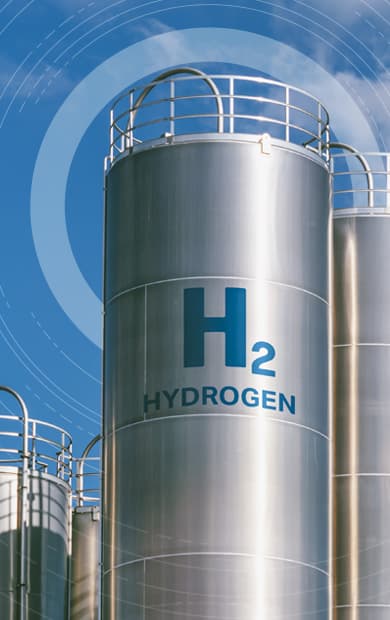
Hydrogen
Overview
Hydrogen is an increasingly important piece in the decarbonisation puzzle. Industrial players are seeking ways to take carbon emissions out of their hydrogen production processes, while green hydrogen producers see the gas as a viable outright alternative to hydrocarbons.
Future production routes range from methane reformation with carbon capture to pyrolysis, waste gasification and electrolysis, powered by renewable energy or fossil fuels. Combinations of processes and energy being used to produce hydrogen presents existing users of industrial heat and key chemicals a challenging landscape to navigate.
The Argus Hydrogen and Future Fuels service has been designed to provide industrial power, chemicals and energy users with crucial information to help them make well informed decisions. It covers the upstream for projects, midstream for transportation and storage, and downstream for ammonia and methanol. It also covers the latest technological developments and policy news on hydrogen from across the globe.
Latest hydrogen news
Browse the latest market moving news on the global hydrogen industry.
Japan's Shikoku exits clean power auction on NH3 lack
Japan's Shikoku exits clean power auction on NH3 lack
Tokyo, 23 April (Argus) — Japanese power utility Shikoku Electric Power decided to withdraw from the country's clean power auction because it failed to procure ammonia for co-firing at its 500MW Saijo No.1 coal-fired power generation unit in Ehime prefecture. Shikoku had planned to upgrade its Saijo No.1 unit and begin 20pc ammonia co-firing from the April 2030-March 2031 fiscal year, following a successful bid in the 2025 clean power auction . The auction aims to spur investment in clean power sources by securing funding for fixed costs in advance to drive the country's decarbonisation by 2050. But Shikoku decided to exit the auction because it does not expect to procure fuel ammonia as planned, the firm said on 23 April. Shikoku did not disclose details of its original plan, including the supply source and procurement schedule. But the utility partnered with domestic trading house Mitsubishi, refiner Taiyo Oil, car maker Mazda and industrial gas supplier Nippon Sanso in April 2023 to explore handling 1mn t/yr of ammonia at Namikata terminal in Ehime. And Mitsubishi agreed to purchase blue ammonia from ExxonMobil's Baytown project in Texas in the US. But ExxonMobil has suspended its plans to build the production facilities because of weaker than expected demand. Shikoku will continue to explore ammonia co-firing at its Saijo No.1 unit. The utility declined to disclose further details, including potential fuel sources and a renewed schedule. The company is unsure if it will join the auction again after securing an ammonia supply. By Nanami Oki Send comments and request more information at feedback@argusmedia.com Copyright © 2026. Argus Media group . All rights reserved.
Allied Biofuels advances Uzbekistan SAF, e-SAF project
Allied Biofuels advances Uzbekistan SAF, e-SAF project
London, 10 April (Argus) — Australian developer Allied Biofuels has signed a binding "project implementation agreement" with the Khorezm regional government in Uzbekistan to develop a $6.08bn complex with a combined 417,400 t/yr sustainable aviation fuel (SAF) production capacity. The agreement is backed by a presidential decree granting the project special economic zone status as well as tax and customs exemptions. The total estimated capital cost has risen from a previously stated $5.5bn. Allied Biofuels will invest the $6.08bn over five years. The firm said in October 2025 that it expects a final investment decision in the fourth quarter of 2026. The plant will produce 160,400 t/yr of bio-SAF, 257,000 t/yr of synthetic e-SAF and 5,040 t/yr of renewable diesel, powered by 4.45GW of renewable generation capacity with 1.6 GWh of battery storage. Allied Biofuels plans a hybrid biogenic and synthetic production complex using sorghum as the primary feedstock. The sorghum will be converted to first-generation bioethanol, which will then be processed into SAF via the ethanol-to-jet pathway. Total agricultural feedstock consumption is estimated at around 5,775 t/d. The firm signed a preliminary agreement with Indian engineering firm Praj Industries in November 2025 to supply its ethanol production technology, targeting 293,700 t/yr of ethanol output. The complex will also capture biogenic CO2 from the same ethanol plant and gasify biomass residues into syngas, combining these with renewable hydrogen from electrolysers to produce e-SAF, likely via the Fischer-Tropsch route. Allied Biofuels signed a binding deal with US firm Plug Power to supply 2GW of electrolysers, which was raised to 2.4GW. Sister firm Allied Green Ammonia is developing a renewable ammonia project in Australia, also using Plug electrolysers. By Chingis Idrissov Send comments and request more information at feedback@argusmedia.com Copyright © 2026. Argus Media group . All rights reserved.
UK backs ITM with £86.5mn for PEM electrolyser factory
UK backs ITM with £86.5mn for PEM electrolyser factory
London, 9 April (Argus) — The UK government has committed £86.5mn ($115.9mn) to electrolyser maker ITM Power to build a new 1 GW/yr manufacturing line at its Sheffield site in South Yorkshire, through £40mn in equity and £46.5mn in grant funding. State-owned energy firm Great British Energy (GBE) will take a 10.4pc stake in ITM through a £40mn share subscription, while the Department for Energy Security and Net Zero (Desnz) has indicated it intends to award a £46.5mn grant in principle, subject to a subsidy control review expected to conclude in June. The grant requires ITM to hire around 250 people in the UK over five years. The new line will manufacture ITM's next-generation Chronos proton exchange membrane (PEM) electrolyser stack. The factory is expected to cost up to £120mn in total, leaving £33.5mn for ITM to fund itself. Commercial operation is targeted for 2028, with a final investment decision planned for June in line with grant contracting. The funds will go towards automated production and testing equipment, which accounts for 63pc of the total, covering catalyst-coated membrane manufacturing, electrode welding, platinum group metal coating and stack assembly. Chronos builds on ITM's existing Trident stack platform. ITM claims Chronos achieves a 40pc manufacturing cost reduction and 10pc efficiency improvement, with more than 50pc cuts in part count, weight and footprint. Stack capacity rose to 2–2.5MW per unit from Trident's 670kW. Chronos also uses 40pc less iridium, in line with ITM's goal of reducing precious metal use . The stack underwent third-party technical and commercial due diligence as part of the funding process. ITM's current plant designs — 2MW, 5MW, 20MW and 50MW — all use the Trident platform, which will remain in production alongside the Chronos line to serve contracted customers and long-term service agreements. ITM already operates a 1GW/yr Trident line at its Bessemer Park facility. GBE's investment follows its plan to start investing in 2026 and marks its first major move into hydrogen, having previously backed renewable generation , grid components and the offshore wind supply chain . ITM is set to supply electrolysers to four of the ten active projects under the UK's first hydrogen allocation round (HAR1) and was selected for Uniper's 120MW bid in HAR2. The wider UK hydrogen sector continues to wait on Desnz to publish its updated hydrogen strategy and make decisions on HAR2 and other subsidy schemes. By Chingis Idrissov Breakdown of expenses for ITM's 1 GW/yr Chronos line Category Percentage of total (pc) Estimated amount (£mn) Manufacturing & testing equipment 63 75.6 Validation 13 15.6 Fitout (clean rooms) 13 15.6 Project delivery 6 7.2 Other (including inflation) 5 6.0 Total 120 ITM Power, Argus Send comments and request more information at feedback@argusmedia.com Copyright © 2026. Argus Media group . All rights reserved.
Australia selects renewable projects for aid scheme
Australia selects renewable projects for aid scheme
Sydney, 9 April (Argus) — The Australian Labor government has selected two renewable energy projects for a fast-track program in a bid to improve the country's long-term fuel security because Iran's effective blockade of the strait of Hormuz raised supply concerns across Australia. The Investor Front Door pilot program will streamline approvals for projects deemed of national significance, including low-carbon liquid fuel company HAMR Energy's proposed Portland Renewable Fuels project in Victoria, the government said today. The project will use local forestry residue to produce 300,000 t/yr of low-carbon methanol. The methanol can be used directly as a shipping fuel or converted into sustainable aviation fuel (SAF) at its proposed 140mn litre/yr methanol-to-jet facility in South Australia. HAMR said its selection for the pilot program will help attract investment and allow the firm to work closely with the government, as it pursues a final investment decision. The second renewable energy project selected was the Murchison Green Hydrogen project in Western Australia (WA). The project is a green hydrogen plant producing large-scale green ammonia using wind and solar. Ardea Resources' Kalgoorlie nickel project in WA — one of the largest nickel and cobalt resources in Australia — and New Energy Transport's Wilton electric freight hub were also selected to support supply chain stability. By Grace Dudley Send comments and request more information at feedback@argusmedia.com Copyright © 2026. Argus Media group . All rights reserved.
Spotlight content
Browse the latest thought leadership produced by our global team of experts.

Explore our hydrogen and related products
Real time access to trusted cost benchmarks, critical market data and analytics, in-depth analysis, and the latest market news. Argus Hydrogen and Future Fuels service is relied upon by intensive users of energy, governments, banks, regulators, exchanges and many other organisations as source of reliable and unique insights into the global hydrogen sector.