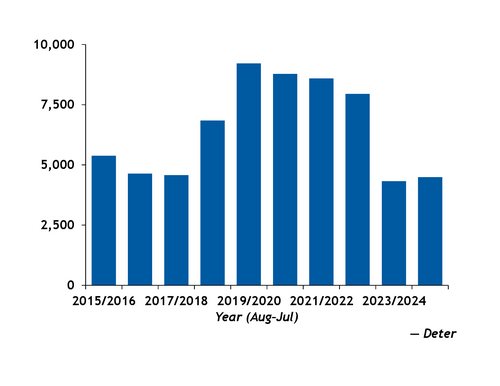
Deforestation in Brazil's Amazon rainforest increased modestly over the past year, driven largely by increased forest fires rather than clear-cutting.
The shifting profile of deforestation underscores challenges for Brazil to meet its 2030 target of eliminating all deforestation, especially as the delicate ecosystem has gotten less rain. Last year, nearly all of the 459 municipalities in Brazil's Amazon basin experienced some drought, according to the national center for natural disaster monitoring, Cemaden.
Deforestation over the 12 months ending in July reached 4,495 km² (1,735 square miles), up by 4pc from the 4,321 km² a year earlier, according to preliminary satellite imagery from Brazil's national institute of space research's real-time deforestation system, Deter.
While clear-cutting still caused most deforestation, at 85pc, climate-related degradation caused 15pc of the forest loss, the ministry said. It was the largest level of degradation-related losses on record and nearly twice the previous record of 8pc in 2016, the environment ministry said. Without the rise in climate-related degradation, deforestation in the Brazilian Amazon would have declined by 8pc in the period, it estimates.
Climate change has made tropical forests more vulnerable to fires, according to environment minister Marina Silva, who stressed that under normal circumstances, humidity levels are high enough to protect the forest from burning.
Still, long-term deforestation is the primary culprit for new weather patterns that have changed the region's climate. A recent study by the University of Sao Paulo concluded that deforestation is largely to blame for the reduction in precipitation in the region. Deforestation has contributed to a 2.1cm reduction in rainfall across the Amazon basin during each year's rainy season, which has intensified the dry season and increased the risk of forest fires, according to the research. The study concluded that maintaining standing forests is a crucial element of protecting the biome. Since 1985, the Brazilian Amazon has lost roughly 14pc of its total native vegetation, equivalent to over 550,000 km², according to MapBiomas.
The shift in the profile of Brazilian deforestation has forced the government to broaden its approach to protecting the biome, including increasing investments in firefighting. Recent legislation will help speed the transfer of federal funding to combat forest fires and will also allow the use of foreign aircraft in firefighting operations. The government has also increased the number of firefighters by more than 25pc and expanded federal funding for this segment.
These investments — coupled with an increase in precipitation — have reduced forest fires in the Brazilian Amazon this year. The number of fire outbreaks across the Amazon was down by over 61pc this August compared with a year earlier, reaching the lowest level for the month on record.
Still, there is growing concern that with climate change, eliminating deforestation will be even more challenging, which in turn will make it even more difficult for Brazil to reduce its emissions. This view is reinforced by scientific evidence that the biome could reach a tipping point beyond which the ecosystem could shift to a permanently altered state.
If fire-related degradation continues to rise, Brazil runs the risk of falling short of reaching its nationally determined contribution (NDC), which aims to reduce greenhouse gas emissions by 59-67pc by 2035, from 2005 levels. This is equivalent to emissions levels of 850mn-1.05bn tons of CO2 equivalent (tCO2e).
Emissions from land-used change — which includes deforestation — reached 1.06bn tons of CO2 equivalent (tCO2e) in 2023, down from 1.39bn t CO2e in 2022.
Despite the increase in deforestation in the Amazon biome, other regions posted sharp reductions. Deforestation plunged in the Cerrado (tropical savanna) biome by nearly 21pc to 5,555 km², down from 7,014 km² a year earlier. And the Pantanal (tropical wetlands) biome also posted a significant reduction in lost vegetation, with deforestation reaching just 319km² compared with 1,148 km² during the previous 12-month cycle.