The bloc is almost on track to hit its 2030 target, but the fastest-warming continent faces rising climate damage, write Georgia Gratton and Dafydd ab Iago
The EU has missed key UN deadlines to submit its climate target and plan for 2030-35, while a report this week from the European Environment Agency (EEA) details the growing challenges that climate change poses for the region.
The EU was expected to outline and submit its climate plan for 2035 — known as a nationally determined contribution (NDC) — to UN climate body the UNFCCC originally in February and then by the end of September. This would have allowed the EU's plans to be factored into a major report, likely to be released just ahead of the Cop 30 UN climate summit in Belem, Brazil, on 10-21 November, which will chart progress made against the Paris Agreement goals. But the bloc failed to meet even the extended deadline, instead submitting a statement of intent with an "indicative" 2035 greenhouse gas (GHG) emissions reduction target. The statement sets a range for GHG cuts in 2035 of 66.25-72.5pc, from a 1990 baseline.
EU climate commissioner Wopke Hoekstra had long insisted that the bloc's 2035 climate target and NDC would be derived from the 2040 goal, once the latter is agreed. The European Commission first proposed its 2040 target — a 90pc reduction in GHG emissions, from a 1990 baseline — in February 2024. But discussions have dragged on and the European Parliament's environment committee in mid-September delayed a planned vote on the proposal.
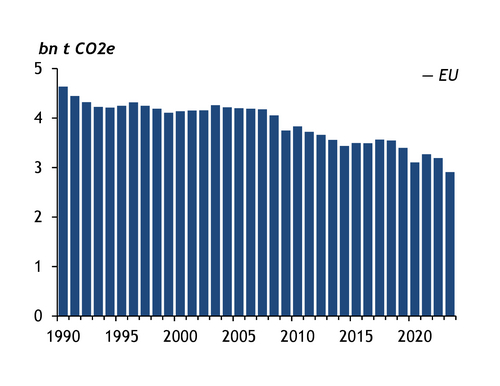
The European Climate Law requires an emissions reduction target to be set for 2040. The EU has set a net zero goal for 2050, with an interim target already in place for 2030 of 55pc GHG cuts, from 1990 levels. The bloc is almost on track to hit its 2030 target, although this is dependent on member states sticking to their climate plans. Plans have worked well so far, data from the EEA's Europe's environment 2025 report show. The EU cut its GHG emissions by 37pc over 1990-2023 and reduced GHGs in its industrial sector by over 35pc from 2005-23.
These emissions reductions have been driven by declining fossil fuel use and measures such as switching from coal-fired power to renewable energy. The share of renewables in the EU's gross final energy consumption rose to 24.5pc in 2023 from 10.2pc in 2005. But much of the further decrease in emissions required will have to come from sectors that are difficult to decarbonise and more fragmented, such as transport. An increase in passenger and freight transport since the early 1990s has outweighed improvements in energy efficiency and technology, meaning "the relative share of GHG emissions from transport in the EU has been growing", the report says.
Cost-of-warming crisis
"The outlook for most environmental trends is concerning and poses major risks to Europe's economic prosperity, security and quality of life," the EEA says. The "greatest challenges" are around Europe's biodiversity loss and ecosystem degradation, it adds. This could hinder the commission's ambitious carbon management strategy, which is partly reliant on natural carbon sinks. Degraded ecosystems, deforestation and poor soil health all weaken capacity for natural carbon capture and sequestration.
Europe is the fastest-warming continent and extreme weather events are becoming more frequent. Extreme weather and climate events caused economic losses of assets estimated at €738bn ($866bn) in the EU over 1980-2023, with €162bn of this from 2021-23 alone, the report says. The "insurance protection gap across Europe is substantial", with "most countries" reporting more than 50pc of losses as uninsured, the EEA says. But sticking to the proposed 2040 target, and 2050's net zero goal, would "ensure predictability" and boost Europe's competitiveness and resilience, the agency says.