South Korea has finalised its 2035 greenhouse gas (GHG) emissions reduction target at 53-61pc from 2018 levels, its presidential committee on carbon neutrality and green growth approved today.
The target is higher than the up to 60pc range proposed by its climate and energy ministry Mcee last week.
The upper limit reflects IPCC guidance on the reductions to keep the temperature rise within 1.5°C from pre-industrial levels, while also considering the potential burden on future generations and domestic industry conditions, Democratic Party chief spokesperson Park Soo-hyun said.
Following the updated goal, South Korea's GHG emissions would fall to 289.5mn-348.9mn t in 2035 from 742.3mn t in 2018. The power and transport sectors face the steepest reductions at 68.8-75.3pc and 60.2-62.8pc from 2018 levels, respectively. But the industry sector has been eased to 24.3-31pc, with additional support through transition finance, reflecting restructuring needs.
Given power polices now set to be aligned with the new nationally determined contribution (NDC), the change is seen placing greater pressure on the power sector, not only in terms of emissions reductions but also in managing the transition and supply stability, market sources noted.
The finalised NDC is set to be approved at a cabinet meeting tomorrow and presented at the UN Cop 30 summit in Brazil later this month.
South Korea's next emission trading scheme (ETS) 2025-30
The South Korean government also confirmed the total emissions cap for the fourth phase of its emission trading scheme (ETS) at 2.5373bn t for 2026-30, 16.8pc lower than the previous phase.
The government will raise paid allocation for the power sector to 50pc gradually by 2030 from the current 10pc — increasing to 15pc in 2026, 20pc in 2027, 30pc in 2028 and 40pc in 2029 — with the revenue directed to support corporate decarbonisation.
In contrast, key export industries accounting for around 95pc of industrial emissions — including steel, petrochemicals, cement, refining, semiconductors and displays — will continue to receive 100pc free allocation, with only the remaining 5pc of industrial emissions seeing paid allocation rise from 10pc to 15pc.
Government speeds up energy transition plan
The decision is expected to accelerate South Korea's transition in its power mix, expanding the share of renewables in line with its 2040 coal phase-out plan.
The country's government aims to increase renewable power capacity by up to 150GW by 2035, from 34GW last year. To support this, it plans to ease solar setback rules and accelerate wind project approvals.
But grid bottlenecks, along with ongoing intermittency and cost challenges in solar and wind, remain key obstacles, potentially pushing the system marginal price (SMP) higher. A faster reduction in coal-fired output could also increase reliance on gas, which is relatively more expensive than coal, adding further pressure on the SMP.
At the same time, some market participants cast doubt over the feasibility of the government's plan, saying it seems unrealistic at the current pace given grid congestion and permitting delays.
Meanwhile, the new targets will be reflected in the country's 12th power supply plan, covering its renewable expansion and coal phase-out roadmap, climate and energy minister Kim Seong-hwan said.
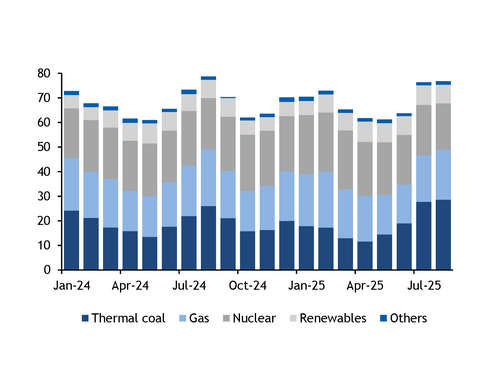
Despite the country's energy transition trends, coal still plays a crucial role in South Korea's power supply, accounting for around 27pc of electricity generation in January-August, more than twice the share of renewables — about 10pc of its total — over the same period, Argus data show.