Corrects name of EUBP secretary general in final paragraph. This story was originally published on 2 December
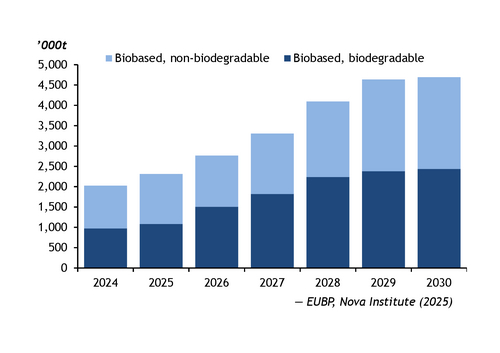
Global bio-based plastic production capacity is set to double to 4.7mn t by 2030, according to the latest report from the industry association European Bioplastics (EUBP).
The organisation published a report with the Nova Institute, which estimated that current production capacity is roughly 2.31mn t and represents 0.5pc of the total plastic production capacity worldwide.
The bioplastics industry in 2025 operated at an overall production utilisation rate of 72pc up from 63pc reported in 2024, meaning that roughly 1.67mn t of bioplastics were produced in 2025.
The association noted that depending on the bio-polymer and production region in question utilisation rates varied massively. In 2025, polylactic acid (PLA) production capacity represented 26.4pc of the total production followed by bio-polyamide production (bio-PA). Bio-polyethylene (bio-PE) production capacity stood at 12.7pc, while bio-polypropylene production capacity stood at 1pc of total global bioplastic production capacity. The report expects bio-PE production capacity to rise to 13.5pc of the total production capacity or roughly 633,000 t/yr with similar figures expected for bio-PP at 13.6pc.
In Europe, the report expected stated that current bio-based production capacity in 2025 was 330,000 t/yr with 28.1pc of this coming from bio-PA, 30.3pc coming from PBAT, 5.2pc coming from bio-PE and 6.7pc coming from bio-PE.
At the EUBP, conference taking place in Berlin on 2-3 December, the report's authors mentioned that they have not included mass-balanced capacities in their figures, preferring to mention only biomass feedstock-only pathways. Currently, EUBP does not recognise the mass-balanced approach as set out in a position paper but it remains under discussion, with differing opinions about the adoption of the definition counting towards bio-based material heard today at the conference. The figures also do not include bio-degradable materials that are produced from fossil fuels.
By 2030, total production capacity of biobased plastics in Europe is set to rise to 800,000 t/yr. This is largely being driven by increases in bio-PE and bio-PP production. Bio-PE capacity is set to rise to 138,400 t/yr in five years time from 22,110 t/yr, while bio-PP production capacity will rise to 238,400 t/yr by 2030, up from 17,316 t/yr in 2025. This is largely set to be driven in Europe by methanol-to-polymers (MTP).
The bio-plastics and chemicals industry in Europe last week reacted to the European Bioeconomy strategy. The latest version of the strategy released indicated that the European Commission would look to introduce bio-plastics as being able to count towards some content requirements. At the Berlin conference today, EUBP Secretary General, Lorenza Romanese, described the strategy as the "the best news" for the industry in Europe in recent years.