Australian growers face higher fertilizer and fuel costs, which are affecting their planting decisions as they approach winter crop planting.
The country's urea imports could also be affected, depending on the war in Iran, which could weigh on topdressing during the growing season. The dynamic could adversely affect yields and quality.
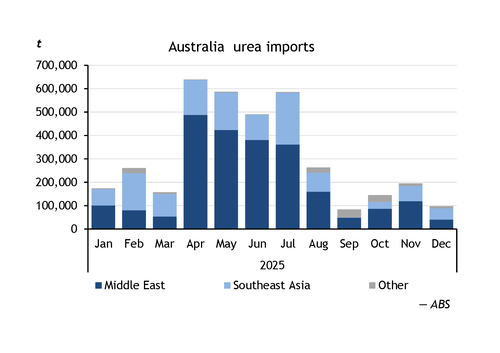
The effective closure of the strait of Hormuz has cut off Australia from its main urea supplier, leaving some farmers exposed as they head into winter crop planting in April-June. Australia sources almost two-thirds of its annual urea imports from the Mideast Gulf (see graph).
There is enough urea in Australia to cover the winter crop's pre-seeding application, but more imports are needed for topdressing applications starting in June, multiple suppliers said.
Topdressing supports yields and quality in crops and typically occurs in June and July for wheat and barley and August for canola. Crop volumes and, importantly, protein levels in wheat, could be reduced if supplies are tight and high fertilizer prices cause farmers to pull back from their typical topdressing.
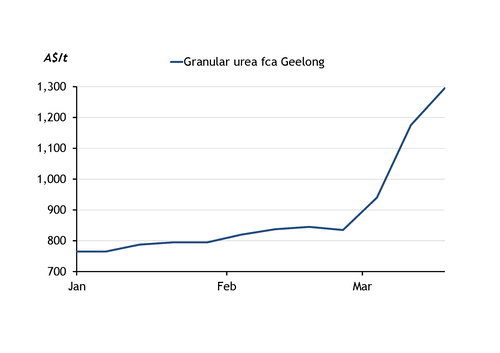
Domestic and international urea prices have surged since the war began, driven by tight supply and higher freight rates. Argus last assessed granular urea at A$1,250-1,340/t ($872-934/t) fca Geelong on 19 March, a 55pc increase from before the war (see graph). Some trades were heard above A$1,400/t fca Geelong this week.
Uncertainty about when — and if — urea supply will return to normal, along with higher expected fertilizer and fuel costs, are being factored into planting decisions.
Barley plantings are likely to rise in place of wheat because of its lower fertilizer requirements and strong prices. Canola plantings could also be dictated by the balance of expected returns from higher oil markets against higher fertilizer and fuel costs.
Some growers in Western Australia are receiving advice from agronomists and fellow farmers to grow more pulses, like broad beans and lentils, because these use less fertilizer than grains like canola and wheat. In northern crop regions, which are already dry, some acres could be left for fallow.
The last vessel carrying fertilizer to Australia through the strait of Hormuz departed on 23 February and is expected in WA on 26 March, vessel tracking data from Kpler show. There will likely be no vessels arriving in Australia from the Mideast Gulf in April because vessels travelling from the region typically take at least three weeks to arrive.
Furthermore, granular urea cannot be easily replaced with alternative nitrogen fertilizers like urea ammonium nitrate (UAN) and ammonium sulphate (amsul). Supplies of UAN, which is mainly used in WA, could be restricted because the main supplier, China, stopped exports as of 13 March. Meanwhile, amsul has around half the nitrogen of urea which increases handling and application costs.