AFEI butane strength is expected to persist even after the war, with increased Indian and southeast Asian buying becoming more influential, writes Frances Goh
Northeast Asian butane prices increased to a record premium to propane last month as a result of India moving from a marginal participant on the spot market to a key buyer and driver of regional pricing given the loss of supply from the Middle East.
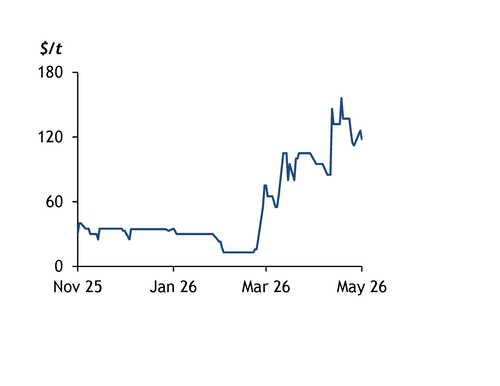
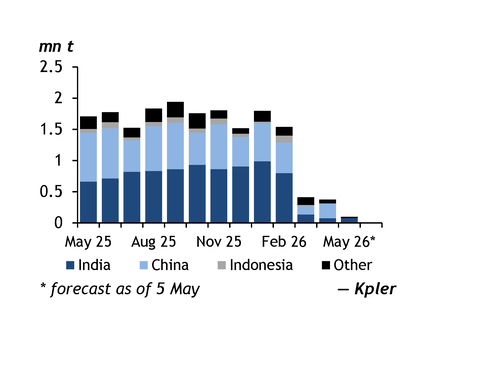
Argus Far East Index (AFEI) butane prices, basis cfr Chiba, jumped to a $45/t premium to propane from $16/t following the outbreak of the US and Israel's conflict with Iran, before surging to $105/t by mid-March as escalating hostilities curtailed exports from the region. The effective closure of the strait of Hormuz abruptly severed India's access to Mideast Gulf LPG exports, which had met more than 95pc of the country's supply in 2025.
Indian and southeast Asian importers reliant on butane-heavy Middle Eastern cargoes have been forced to turn to the next largest global supplier, the US, to plug the massive shortfall. After an initial phase of panic buying at steep premiums, Indian buyers in April slowed their spot purchases for May and June shipments, anticipating a reopening of the strait and redeploying time-chartered vessels to load from the US.
Indian importers IOC and BPCL in mid-April bought at least four evenly split propane-butane cargoes loading from late May to the first half of June in quick succession, at 24-47¢/USG ($125-245/t) premiums to Mont Belvieu hub prices, according to market participants, propelling US Gulf coast fob butane cargo premiums to record levels (see p4). Strong butane demand from India supported higher netbacks for sellers by lifting AFEI prices as northeast Asian buyers competed for the same US supply. The butane AFEI subsequently rose to a $156/t premium to propane on 22 April, the highest on record and above the nine-year high of $124/t seen in February 2017.
The premiums to corresponding delivery month paper for butane cargoes delivered in May and June compared with equivalent propane shipments increased to $60-80/t last month as demand for butane remained strong and propane availability grew. Traders made offers for evenly split US cargoes to buyers in north China, Japan and South Korea based on netbacks to India, while also factoring escalating auction fees at the Panama Canal.
Driving down demand
But rising butane prices have weighed on northeast Asian demand. South Korean crackers that historically transition to butane when it is valued at 90-95pc of naphtha saw offers reach as high as 115-120pc.
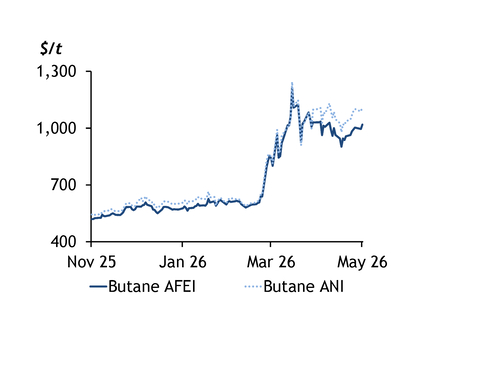
In China, ample oil product supply capped demand for butane as refineries increased production and fuel exports were halted in March. This reduced the need for butane feedstock among the country's MTBE producers, which was compounded by increasing butane prices, with the Argus Ningbo Index (ANI) for butane firming by 72pc to $1,14.50/t by 5 May.
Concerns over a potential MTBE export ban after Beijing stopped oil products exports in March further curbed MTBE demand for butane, while increased refinery output ensured sufficient LPG availability.
The strength of AFEI butane is expected to persist even if the strait opens and LPG shipments from the Mideast Gulf pick up, as damage to multiple oil and gas facilities in the region during the war will continue to constrain supplies for an indeterminate period.
Indian and southeast Asian buyers are also predicted to keep ramping up purchases from the US under supply diversification plans, fomented by energy security concerns after the war, giving this regional bloc greater pricing influence on the AFEI in the coming years.