European monoethylene glycol (MEG) prices edged lower in September, despite global values rising because of geopolitical tensions in the Middle East.
Increased domestic production, steady contractual imports and subdued demand has limited European price gains. Argus assessed bulk cargoes at €600-630/t cif ARA on 23 September, down by €15/t at the midpoint compared with 12 August. Truckload values were €690-720/t fca ARA, compared with €700-720/t as of 12 August.
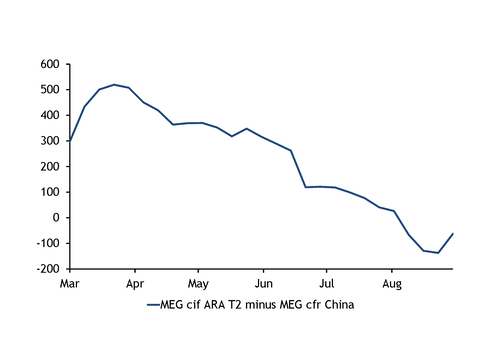
This contrasts with some market expectations of price increases, given tighter global supply and higher Asian prices. Spot prices for MEG in China, the world's largest import market, were $750-780/t cfr on 23 September, below last week's peak but around $115/t above levels of early August.
Arbitrage for European spot imports from the US, the continent's largest MEG supplier, remained unworkable in September as US prices climbed. European cif values rose marginally on a sale for September delivery, before retreating. Yet, European imports are broadly steady, mostly arriving from the US and Saudi Arabia under long-term contracts.
Higher operating rates at some domestic facilities since August ensured sufficient supply. Several European producers increased ethylene glycols output, responding to weak spot demand for upstream ethylene and relatively active demand for bulk MEG cargoes for August and September delivery.
Some MEG consumers relied more heavily on spot purchases than in 2025, creating additional sales opportunities in the third quarter, particularly among antifreeze buyers securing supplies ahead of the winter.
Some customers may favour European supply over imports to mitigate potential disruptions during the US hurricane season, although no significant weather-related disruptions have occurred this year.
European producers remained competitive despite rising naphtha feedstock costs weighing on margins in September. It remains to be seen if margin pressure will prompt ethylene glycols output cuts.
Regional ethylene glycols production is likely to drop in September-October because of planned maintenance at a northwest European producer, lasting six to eight weeks and potentially affecting availability into mid-November.
The effect of the shutdown could be partially offset by scheduled turnarounds at downstream facilities, curbing demand for feedstock MEG in October-November. Lithuanian polyethylene terephthalate (PET) resin producer Neo Group will shut one of three production lines in Klaipeda, with combined capacity of around 500,000 t/yr, from late September for around two months. Indorama Ventures will shut its 230,000 t/yr PET resin facility in Wloclawek, Poland, in early November for one month.
These outages are likely to take around 160,000 t/yr and 390,000 t/yr of PET capacity offline in October and November, implying lost MEG demand of 14,000-15,000t over two months at full capacity. The actual effect on feedstock demand is likely to be lower, as most PET plants in Europe are operating below nameplate capacity because of weak demand and ample supply.
Demand from another key downstream sector, antifreeze and coolants, is healthy and broadly in line with expectations ahead of the peak fourth-quarter season. Some buyers may opt to stay out of the market in the coming weeks after securing early requirements, supporting August demand, during the usual seasonal lull.
European spot prices must realign with global levels to continue attracting imports and support current domestic operating rates. But if regional demand remains subdued, price support is likely to be limited.