Expectations of greater Chinese climate leadership may run ahead of Beijing's own ambitions
China's growing dominance in clean-energy manufacturing and deployment is increasing its influence over the global energy transition. But its expanding coal-fired power fleet sits at odds with expectations that Beijing could assume a larger leadership role at future UN climate conferences.
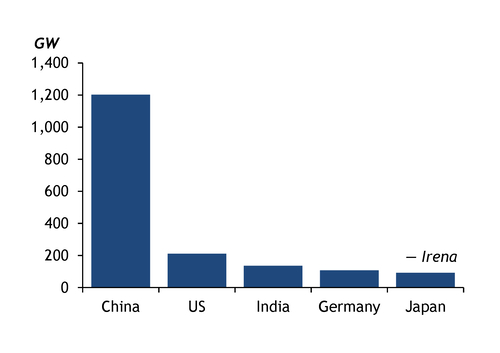
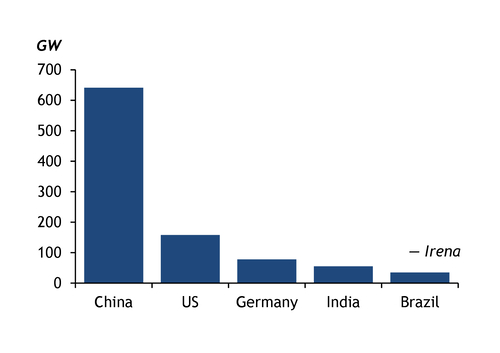
The US' Paris agreement exit and concerns about economic growth in Europe have put the spotlight on China, with global climate goals in peril. Global renewable capacity more than doubled between 2016 and 2025, while renewable generation rose by 67pc, according to the International Renewable Energy Agency. China accounted for more than half of global solar capacity and nearly half of global wind capacity in 2025 — its solar capacity reached 1,202GW and wind capacity 641GW — underscoring its central role in the energy transition.
China's climate contribution extends beyond its emissions trajectory. Its firms are central to supply chains for solar modules, batteries, electric vehicles and renewable fuels, and its manufacturing scale has helped lower the cost of clean tech. But it also operates the world's largest coal-fired power fleet and critics argue that industrial influence alone is not enough. Climate leadership ultimately requires a credible pathway to reducing fossil fuel use and emissions, observers say.
But Beijing has shown little desire for a larger political role in climate governance. While speculation over a bid to host a future Cop has surfaced, China's official messaging still emphasises its developing-country status and the principle of common but differentiated responsibilities. The key test for China is whether clean power growth is sufficient to displace fossil fuel-based generation rather than simply meeting rising energy demand, UK-based think-tank Ember says.
Clean energy met all China's incremental power demand in 2025 and coal-fired output fell, according to the Finland-based Centre for Research on Energy and Clean Air and US-based Global Energy Monitor. But China still added the most coal capacity in a decade, and the expansion continued in 2026, with 30GW commissioned in January-June, up by 43pc on the year. Work began on another 25.4GW, while just 2.7GW was retired, according to the two organisations. But rapidly retiring coal assets would create economic and reliability challenges.
Beijing's path
Beijing's response is not to pursue a European-style coal-retirement strategy. Instead, policymakers are looking to retain a substantial coal fleet while expanding renewables, storage and grid infrastructure. China's 2025-27 coal-fired power upgrade plan calls for greater flexibility to accommodate renewables, and another low-carbon transformation plan promotes biomass and ammonia co-firing and carbon capture, utilisation and storage. Questions remain over whether this pathway is a credible route to decarbonisation, as some analysts warn that ammonia co-firing and other retrofits could prolong the life of coal assets.
Rather than pursuing leadership through international rule-setting or a fossil fuel phase-out agenda, China has sought to shape the transition through investment, industrial capacity and technology deployment. But for some western governments and climate groups, leadership is increasingly measured by political commitments, fossil fuel policies and international diplomacy.
These competing visions in an era where technology deployment, industrial capability and diplomatic ambition do not always move at the same pace may help explain China's lack of enthusiasm for a greater political part. As China's role in the transition expands, the question may not be whether it can become a climate leader without a coal phase-out, but whether it is actually seeking the kind of climate leadership that much of the world increasingly expects it to assume.