Singapore 2026 vintage solar I-RECs have reached their highest levels this year in early November, following a revision to national standards and rising corporate demand.
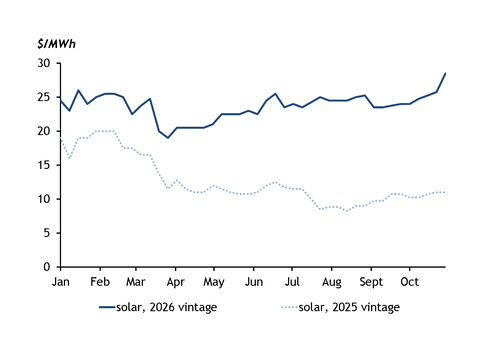
Argus assessed 2026 vintage solar I-RECs at $28.50/MWh on 5 November, above the previous peak of $26/MWh on 22 January. The price has been rising since mid-September on higher demand. But the latest weekly increase, at $2.75/MWh, was the steepest since January (see graph).
Singapore revised its SS673 voluntary national code for renewable energy certificates (RECs) at the end of October, recommending companies to use only certificates from domestic generation or from renewable power imports for scope 2 claims.
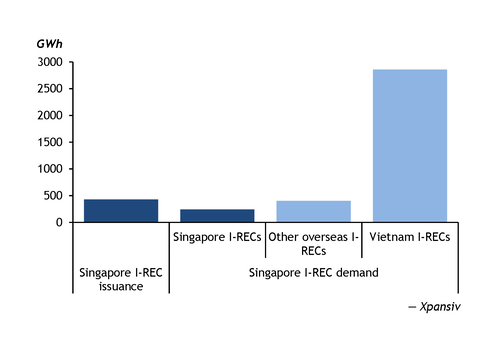
The previous iteration of SS673 from 2021 recognised southeast Asian certificates more broadly, prompting Singaporean companies to use lower-priced regional I-RECs. In January-October this year, 82pc of the 3.5TWh of I-RECs redeemed in Singapore were issued from Vietnamese renewable power generation not contractually supplied to Singapore.
The revised SS673 limits companies adopting the standard to using only Singaporean certificates in the near term. Large-scale renewable power imports into Singapore would likely start from 2029, if projects in southern Malaysia come to fruition. Import projects from Indonesia's Riau Islands were due to start from 2028, but recent political roadblocks will likely delay progress.
Singaporean REC buyers are expected to factor in tighter availability next year and seek to secure supplies early, chief commercial officer at Singapore environmental commodities exchange Climate Impact X Ellery Sutanto told Argus. Offers for 2027 vintage solar certificates are currently around S$45/MWh ($38.96/MWh), above offers of S$40-44/MWh this week for 2026 vintage contracts.
Uncertain trajectory
But the demand trajectory for Singapore I-RECs remains uncertain. SS673 is a voluntary standard and companies are considering future engagement with the revised guidelines, as Singaporean I-RECs are priced at a high premium to regional markets.
Some firms have existing multi-year supply deals for Vietnamese I-RECs, and retaining these contracts could mean delaying procurement of Singaporean certificates. Argus assessed Vietnamese 2026 vintage solar I-RECs at $0.25/MWh on 5 November, over 100 times lower than equivalent Singaporean certificates. The revised SS673 standard does not rule on whether companies can grandfather existing southeast Asian REC contracts.
Nonetheless, some participants say alignment to the revised SS673, and corporate demand for Singapore I-RECs, will rise because of investor pressure to align decarbonisation efforts with sustainability standards.
Companies facing less investor pressure could "think twice" about buying Singapore I-RECs, given they are already being squeezed by higher electricity prices this year, but this represents a small pool of buyers and "will not materially soften demand for Singapore RECs", co-founder of Singapore environmental services firm Reduc, Chuck Chen, told Argus.
"Corporate demand for RECs is mainly driven by reporting requirements and climate commitments, and those have not changed," Sutanto said.
And Singapore recently introduced corporate income tax deductions on voluntary use of RECs aligned with the updated SS673, which could further boost demand. Tax deductions on environmental commodities were previously only applicable for procurement of carbon credits for compliance purposes.
Unique demand patterns
I-REC demand in Singapore has been structurally higher than local supply in recent years, given the high concentration of business headquarters in the city-state, and small land area to deploy renewables at scale.
Singaporean I-REC supply was 429GWh in January-October this year, eight times lower than total domestic redemptions, but consumption of Singaporean I-RECs was just 241GWh considering the high volume of imported certificates (see chart).
Still, several rounds of buy tenders for Singapore RECs have taken place recently, some of which were above 50GWh. These tenders are drawing down supply of local RECs at a time when corporate procurement is accelerating.
In most other southeast Asian markets, I-REC demand is predominantly for locally generated certificates. Most markets are also facing certificate oversupply, as I-REC output outpaces companies setting decarbonisation targets and procuring certificates to make scope 2 emissions reduction claims.