All but one of South Korea's five nuclear reactors that were off line for most of last month have resumed power generation, easing the country's recent heightened reliance on coal and gas.
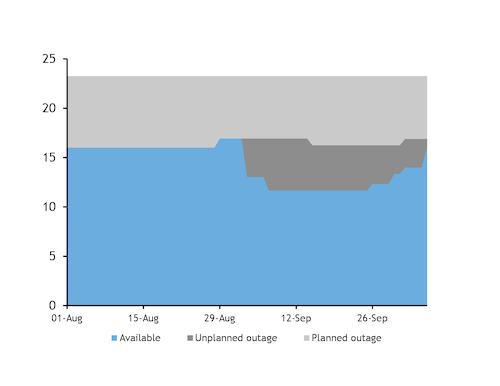
Five South Korean nuclear reactors with combined capacity of 4.6GW were off line for most of September, after inflows of salt water following two typhoons at the start of the month caused the facilities to trip.
But four of the affected units have now returned to service, after operator Korea Hydro and Nuclear Power (KHNP) resumed generation at the 1GW Shin Kori 1 facility and the 950MW Kori 3 plant today.
This followed the restart of the 700MW Wolsong 3 reactor on 26 September and the 1GW Shin Kori 2 reactor on 30 September. Only the operator's 950MW Kori 4 reactor remains off line because of an unplanned outage.
The unplanned outages and scheduled maintenance across other units reduced South Korean nuclear availability to around 13GW in September, according to Argus calculations, down from 14.3GW a year earlier. Power generation using fossil fuels, including coal, is likely to have increased from a year earlier to cover the nuclear shortfall.
But with all but one facility now back on line, South Korean nuclear generation is expected to grow strongly on the year in the fourth quarter, which could reduce coal and gas demand.
Nuclear availability is scheduled to average 18.2GW this month, assuming Kori 4 returns to service this week, which would be up from actual generation of 14.3GW last year. Availability in November-December is scheduled at around 20.4 GW/month, up from average output of 14.5 GW/month in the same period last year.
This outlook includes the scheduled return of the 1GW Hanbit 3 reactor on 18 October, although the unit has been off line for several years and has faced numerous delays to its restart, casting some doubt over whether the unit will resume operations this month. Hanbit 4, which has also been off line for over a year, recently had its restart date pushed back by around six months to mid-March 2021.