A plan among major retailers and manufacturers to only use ships run on "zero-carbon" fuels by 2040 could make significant cuts in annual sales of residual fuel oil and gasoil.
The group of retailers making the zero-carbon pledge, known as Cargo Owners for Zero Emission Vessels (coZEV), includes some of the largest retailers in the world, including tech giant Amazon, Swedish furniture company Ikea, tire maker Michelin, consumer goods firm Unilever, and others.
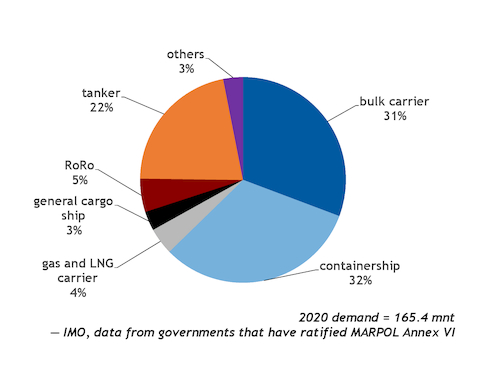
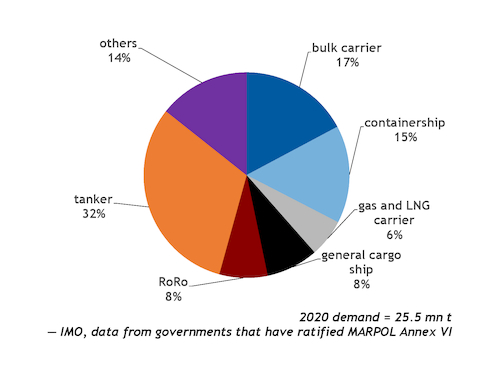
Container ships like those used by the companies burned 52.9mn t of residual fuel oil (resid) in 2020, down from 55mn t in 2019, which accounted for 32pc and 31pc of global resid bunker demand, respectively, International Maritime Organization (IMO) data showed. Container ships also consumed 3.9mn t of marine distillates in 2020, down from 4.6mn t in 2019, which accounted for 15pc and 19pc of global marine distillates demand respectively.
The IMO estimates that the 2020 fuel consumption data collected represents 93.8pc of the 5,000 gross tonnage and above vessels that fall under the scope of its air pollution treaty.
The size and influence of the coZEV group of companies could drive the pace and scale of the shift to cleaner-burning container ships, perhaps even beyond the pace outlined by The IMO.
CoZEV could round up more members by 2040, putting financial pressure on container ship owners and operators to speed up research and development into "zero carbon" marine fuels such as of green ammonia, green methanol, green hydrogen, synthetic LNG and other biofuels.
CoZEV could also deter container ship owners who are considering the use of scrubbers to potentially capture and store CO2 emissions from burning high-sulphur fuel oil, as well as deter them from using voluntary carbon offsets.
Container ships moving to zero-carbon fuels could also put societal and investor pressure on other vessel types: tankers, bulk carriers, and general cargo ships, among others.
CoZEV's initiative surpasses IMO's current target of reducing vessel CO2 emissions by 70pc by 2050 from 2008 base levels. The IMO is also requiring that vessels reduce CO2 emissions by 40pc by 2030 from 2008 base levels. Container ship companies Maersk, CMA CGM, Hapag-Lloyd and Yang Ming already achieved IMO's 2030 goals by 2019 and 2020.
Argus' latest assessments showed green ammonia at $2,666/t very low-sulphur fuel oil-equivalent (VLSFOe), and green methanol at $3,249/t VLSFOe, compared with $600/t for VLSFO in northwest Europe.