Slow monthly imports and little incentive to accelerate buying mean that Morocco is set to fall short of the US Department of Agriculture's (USDA) wheat import forecast of 7.5mn t in 2022-23. It is expected to start the coming marketing year with lower beginning stocks, even after shifting suppliers to make up for a near-total lack of Ukrainian and Argentinian supply.
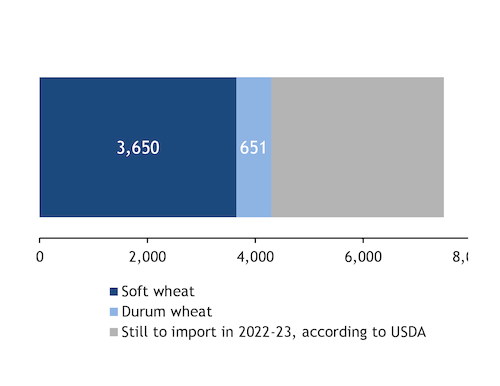
Morocco imported 3.65mn t of soft wheat and 650,000t of durum wheat in June-February, local silo and port data show. The USDA pegs Morocco's wheat imports for the local 2022-23 marketing year (June-May) at 7.5mn t.
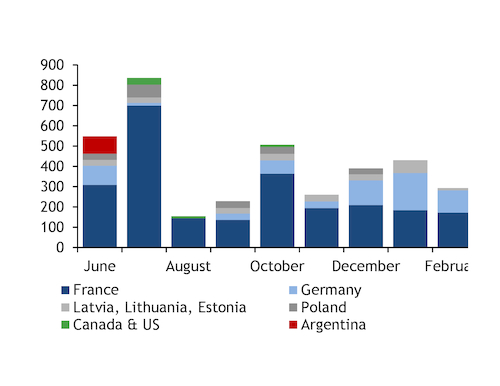
Imports have broadly slowed month on month since the first two months of the marketing year, and latest local silo and port data show that imports continued with little urgency in February. Moroccan ports took 290,000t of soft wheat last month, down from 430,000t in January. The volume of imported French wheat fell on the month but France increased its market share by 16 percentage points to make up two-thirds of Morocco's February imports, owing to lower receipts from Germany and the Baltics.
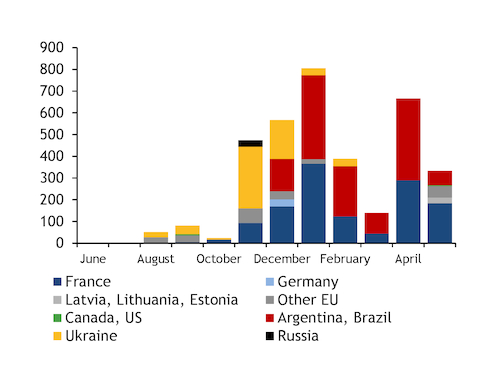
All three European suppliers stepped in to the Moroccan market in force in 2022-23, as Morocco's traditional suppliers excluding France fell away. Drought in Argentina drove the country mostly out of the 2022-23 global wheat market, causing it to fall from being Morocco's second-greatest supplier in 2021-22 with 950,000t of wheat, to shipping less than a tenth of this volume so far in 2022-23. Meanwhile, Ukraine had been Morocco's third-largest supplier, but elusive letters of credit and high freight insurance premiums made imports to Morocco from Ukraine via the newly-established grain corridor impossible.
Little incentive to ramp up imports before 2023-24
Moroccan importers currently have little incentive to accelerate imports for the final three months of the June-May marketing year. Importers are awaiting more advantageous state rebates, and will be able to take advantage of borders remaining open to imports during the upcoming local harvest.
Morocco's state rebates for wheat imports are tied to global market prices, with each month's level calculated from daily market prices over the previous calendar month. Local importers expect the fixed rate to fall from 104.5 dirhams/100kg ($101/t) for February imports to around 98 dirhams/100kg ($94/t) for March. This compares with a rate of 230-260 dirhams/100kg during the first two months of the marketing year, when Morocco's soft wheat receipts peaked at 840,000t for the month of July.
Moreover, importers may wait for clarity on rebates going forward before increasing their purchases. The state currently grants greater rates for European-origin wheat over Black Sea supply, but this system is up for debate. And the gap in rebates between the two origins has been falling for some months, with importers expecting Black Sea-origin wheat to command rebates around 12 dirhams/100kg lower in March, compared with a 50 dirham/100kg difference in June.
It is understood that many importers are still waiting on delayed government rebates to reline their pockets. Government rebates should take six months to arrive with importers, but there are reports of delays and financial issues within the treasury. This means that rebates claimed at the height of the fixed rate in June-July are in some cases yet to be paid.
In light of these factors, there is little pressure to import in the short term. Local market participants estimate that the country currently has around three months' worth of wheat in stock. Importers can afford to buy hand-to-mouth to keep mills turning — consumers use roughly 450,000 t/month, with imported milling wheat feeding about half of domestic consumption in a typical year. And a poor outlook for the 2023-24 crop — the latest data suggests that recent rainfall has failed to counter a two-year drought — meansthat the government is expected to keep borders open to wheat imports even during the local harvest in May-June, as an exceptional measure to combat the effects of drought and ensure continued supply to mills. Government ministries would usually restrict imports from May until as late as December to protect local producers' competitiveness in the domestic market.
Morocco is set to shift its buying pattern to the start of the marketing year for the second year running (see chart).