Australia's federal Labor government will partner with the states of Tasmania and South Australia (SA) to provide a A$135mn ($87mn) rescue package for two smelters processing zinc and lead.
The outlay comes after global metals group Nyrstar said this year it may close the 280,000 t/yr Hobart smelter in Tasmania and 160,000 t/yr lead smelter in the SA city of Port Pirie due to severe challenges to operations as prices drop.
Canberra will contribute A$57.5mn, with SA's Labor government and Liberal party-led Tasmania to spend A$55mn and A$22.5mn respectively, a joint statement on 5 August said.
The cash will transform the smelters into modern facilities capable of producing critical minerals, the statement said, while progressing engineering plans examining whether to rebuild and modernise the operations. Feasibility studies will be undertaken simultaneously to develop "world-leading" critical metals production.
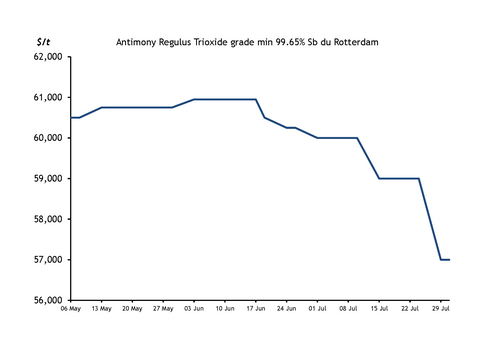
An antimony pilot plant of unknown capacity will be opened at the Port Pirie smelter, which if successful would make it the only producer of antimony metal in Australia and one of a few global producers.
Nyrstar cut output at Hobart by one-quarter in March citing weakening market conditions as independent zinc smelters suffer from low pricing.
The announcement comes a day after China's Weiying New Material started building a project with a capacity of 10,000 t/yr metal content of antimony products in Shaoguan city of Guangdong province.
China produced around 50,000-60,000t of sodium pyroantimonate in 2024, which used 25,000-30,000t of antimony metal, or 25-30pc of China's total antimony consumption of 100,000-110,000t.
Antimony ore imports to China fell by 36pc on the year in the first half of 2025, government data show.
Used in China's giant solar glass industry, sodium pyroantimonate can be produced from either antimony concentrate or antimony oxides. But at least 10 domestic solar glass producers are likely to cut production in July, with some of them already halting partial furnaces in late June, due to slumping solar glass prices in the first half of 2025, which fell by 24pc on the year because of oversupply.
Australia last year launched solar panel manufacturing scheme Solar Sunshot, aimed at making more solar panels domestically, which will receive around A$1bn of federal support over a decade as part of a low-emissions manufacturing agenda.