
Generic Hero BannerGeneric Hero Banner
Latest market news

Australian beef exports hit 1.1mn t in Jan-Sep

  • : Agriculture
  • 25/10/07

Australian beef exports rose by 22pc on the year to 139,012t in September because of a strong national cattle herd and robust international demand, taking total exports in January-September up to 1.13mn t.

Exports in January-September are up by 17pc compared with the same period in 2024 and 45pc higher than volumes recorded in January-September 2023, data from the Department of Agriculture, Fisheries and Forestry (DAFF) show. The uptrend will likely continue because drought conditions in the US will sustain demand for Australian lean beef and reduce American export volumes to key markets such as China, Japan and South Korea.

The US remained Australia's largest export destination for chilled and frozen beef in September at 41,918t, marking the third consecutive month of shipments above 40,000t. Continued drought conditions are amplifying strong US demand for lean beef, while tariffs on Brazilian beef of more than 76pc have made the product uneconomical and bolstered Australia's competitive position.

Exports to Japan rose by 17pc on the month in September and exceeded the 17,104t shipped in September 2024. In contrast, shipments to South Korea dipped slightly to 21,247t. The South Korean safeguard mechanism is likely to be triggered this month, potentially eroding competitiveness because of the higher tariff on Australian beef.

Exports to China fell to 21,320t in September, down by 32pc from the July peak. The decline came on the back of the triggering of the safeguard mechanism under the Australia-China Free Trade Agreement in late July, which replaced the zero-tariff rate with a 12pc tariff. Most of the reduction was in frozen grass-fed beef, while chilled volumes edged up slightly to 5,520t in September, independent firm Meat and Livestock Australia said.

Australian beef imports also grew consistently in other markets, including Canada, Dubai, Thailand, New Zealand, Malaysia and the UK, reflecting the broad-based strength of Australia's export performance.
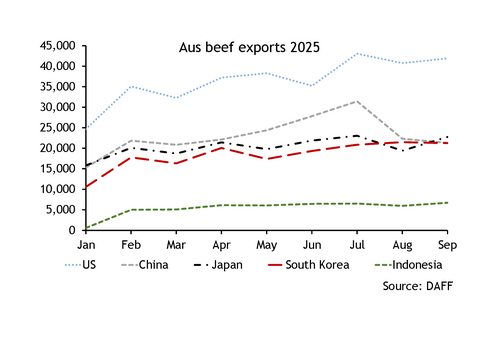
Australian beef exports in Jan-Sept 2025 (t)

Related news posts

Argus illuminates the markets by putting a lens on the areas that matter most to you. The market news and commentary we publish reveals vital insights that enable you to make stronger, well-informed decisions. Explore a selection of news stories related to this one.

25/11/17

US removes tariffs on Australian, New Zealand beef

US removes tariffs on Australian, New Zealand beef

Sydney, 17 November (Argus) — US president Donald Trump removed baseline tariffs on Australian and New Zealand beef on 14 November, returning their tariffs to pre-April levels. The executive order published on 14 November but effective for "goods entered for consumption, or withdrawn from warehouse for consumption" after 12:01am ET on 13 November also reduces tariffs on beef from other major exporters, including Argentina, Uruguay and Brazil . The baseline tariffs introduced on 2 April squeezed margins for US importers and Australian and New Zealand exporters, who were already facing volatile trade conditions and shifting consumer demand . The tariff changes reflect the need to import agricultural products the US cannot produce in sufficient quantities, the White House said. The US cattle herd fell to a 50-year low in July due to drought conditions, according to the USDA, and the ongoing border closure with Mexico is curbing the supply of feeder cattle. Australia, Argentina and Uruguay's 10pc baseline beef tariffs were removed, along with New Zealand's 15pc baseline tariff, but Brazil's 50pc tariff was cut to 40pc for beef and other agricultural products, not including its 26.4pc out-of-quota tariff rate triggered in January. The steep effective tariff rate on Brazilian beef has made it uncompetitive for US importers, driving stronger demand and bids for Australian and New Zealand products. Australian beef exports to the US remained strong despite the 10pc tariff. The country's beef exports to the US climbed by 17pc on the year to 1.27mn t in January-October, data from Australia's Department of Agriculture, Forestry and Fisheries (DAFF) show. Meanwhile, exports of Brazilian beef to the US more than halved on the year to 10,824t in October because of the combined tariffs of 76pc imposed in early August, according to Brazil's development, industry, trade and services ministry. Australia benefitted most under the previous structure, but removing New Zealand's higher tariff now creates a more level playing field among beef suppliers in the region. Australia enjoyed tariff-free in-quota exports to the US, avoiding the 4.4¢/kg in-quota tariff applied to other exporters excluding Mexico and Canada. New Zealand has 60,900t and Australia has 78,700t of US beef export quotas remaining for the calendar year as of 29 September, according to the US Customer and Border Protection. Beef production in New Zealand will likely rise in the coming weeks as summer begins, but values currently offered by New Zealand's processors have been considered too high, traders said, which may change following the tariff cut. New Zealand beef imports into the US have incurred tariffs costs of over NZ$300mn ($170mn) since April, according to lobby group Beef and Lamb New Zealand. Australian and New Zealand beef tallow is excluded from the latest amendments. Tariffs on other exports, including coffee, tea, tropical fruits, cocoa and spices were also reduced. By Grace Dudley and Ed Dunlop Send comments and request more information at feedback@argusmedia.com Copyright © 2025. Argus Media group . All rights reserved.

Trump trims Brazil beef, coffee, fruit tariffs by 10pc


25/11/15
25/11/15

Trump trims Brazil beef, coffee, fruit tariffs by 10pc

Sao Paulo, 14 November (Argus) — US president Donald Trump lifted 10pc tariffs on imports of Brazilian beef, coffee and fruits imposed in April, but 40pc tariffs imposed in August and other quota-tied fees remain in effect. The executive order goes into effect retroactively on "goods entered for consumption, or withdrawn from warehouse for consumption" after 12:01am ET on 13 November. Brazil is a major supplier of these products to the US. Brazil's foreign affairs minister Mauro Vieira and the US secretary of state Marco Rubio have discussed tariffs in recent weeks . Starting in early August, a combination of tariffs equaling 76pc were imposed on US imports of Brazilian beef, cutting those volumes in half . Australia currently fills most US needs for beef, which are subject to a 10pc tariff. While Brazil had a 50pc tariff on in-quota shipments and a 76.4pc tariff on out-of-quota shipments, that has now been reduced by 10 percentage points. US beef imports are forecast at 2.433mn t in 2025, up 16pc from 2024, before easing slightly to 2.245mn t in 2026, according to the US Department of Agriculture. But margins remain tight, squeezed by the volatile tariffs and shifting consumer behavior, importers and exporters said. Tariffs also reduced shipments of Brazilian coffee and orange juice , other key products exported to the US. By João Curi Send comments and request more information at feedback@argusmedia.com Copyright © 2025. Argus Media group . All rights reserved.

EU deforestation law may be delayed further: IPOC


25/11/14
25/11/14

EU deforestation law may be delayed further: IPOC

Singapore, 14 November (Argus) — The European Deforestation Regulation (EUDR) will likely face a second delay this year, said Anri Hadi, Indonesian ambassador to the EU at the 21st Indonesian palm oil conference (IPOC) on 13 November. A 12 November EU vote on whether to extend a six-month grace period for penalties and measures to be applied on medium to large firms — initiated last month — was inconclusive without a majority vote on the proposal, said Hadi. For medium and large enterprises, the EUDR will take effect on 30 December 2025, but a six-month grace period would apply on its enforcement, and for micro and small operators, the EUDR would apply from 30 December 2026 if this proposal were to be accepted. If member states do not agree to a grace period by 15 December, the EUDR would take effect on 30 December 2025 for large and medium companies and on 30 June 2026 for micro and small enterprises. Some member states instead voted to delay enforcement of the EUDR altogether by another year, to December 2026 for medium and large firms and June 2027 for small and micro firms. Under this proposal, there would be no grace period for enforcing the regulation after starting in 2026, Hadi said. Palm oil and some byproducts such as glycerol with 95pc or above purity are listed in Annex I of the EUDR, meaning exporters will have to submit traceability data to relevant government authorities under the EUDR to gain access to the EU market. Sustainability and enforcement guidelines still unclear Hadi called for sustainability standards such as the Indonesian sustainable palm oil (ISPO) certification to be recognised under the EUDR and for government-aligned guidance regarding geolocation data sharing requirements. But providing sustainability data to facilitate EUDR compliance is considered illegal under Indonesian law, said Indonesian vice minister of foreign affairs Arif Havas Oegroseno. Citing Forest Law Enforcement, Governance and Trade (FLEGT) licensing within the timber industry as an example, he said Indonesia could set up a similar licensing unit to provide relevant data to government authorities in the EU while retaining sustainability data domestically. Under proposed traceability requirements, smallholder farmers would be unable to comply with the regulations, Oegroseno added. Farmers subsequently selling product to larger mills would also impact the supply chain as these mills may export palm oil into Europe. By Malcolm Goh Send comments and request more information at feedback@argusmedia.com Copyright © 2025. Argus Media group . All rights reserved.

API pitches revamp of biofuel exemptions: Update


25/11/13
25/11/13

API pitches revamp of biofuel exemptions: Update

Updates throughout New York, 13 November (Argus) — The American Petroleum Institute (API) is pitching the White House and biofuel groups on a total revamp of how the US exempts oil companies from a program that requires biofuel blending, according to three people familiar with the lobbying group's work. API recently withdrew its support for a bill that would authorize 15pc ethanol gasoline (E15) year-round on its frustrations with changes to biofuel policy this year that oil companies see as too friendly to farmers and to some small refining competitors. The US for instance recently granted small oil refiners generous hardship waivers from a biofuel blend mandate and proposed requiring larger companies to blend more biofuels in future years as an offset. API's pitch — shared at a White House meeting this week — would require that companies seeking program exemptions must show that economic hardship stems directly from the biofuel program, a more stringent requirement than today, according to two of the people familiar with the group's work. Exemptions would also be restricted to companies with limited collective refining capacity, cutting off larger enterprises like Delek and Par Pacific that own multiple small units that qualify now. Smaller companies like Ergon and Kern Oil could still request waivers, but the total pool of potentially exempted gas and diesel volumes would be far lower. The oil group then wants the US to prohibit hiking other oil companies' blend requirements to offset those exemptions, a tougher sell to biofuel and crop groups that fear unchecked program waivers curb demand for their products. Larger merchant refiners that do not qualify for small refinery relief have also long pushed lawmakers for updates to the program and would not benefit from this proposal. API's idea is to pass legislation pairing updates to the small refinery exemption program with year-round authorization of E15, generally prohibited in the summer without emergency waivers because of summertime fuel volatility restrictions that do not apply to typical 10pc ethanol gasoline. That's a top priority for ethanol companies, otherwise at risk from an increasingly efficient and electric light-duty vehicle fleet. Congress last year nearly passed narrower E15 legislation, which API supported at the time but no longer does without more changes. Courts have struck down past attempts by federal officials to authorize E15 without emergency declarations and to drastically restrict biofuel exemption eligibility, likely limiting what President Donald Trump's administration can do without new legislation. API made the pitch to the White House this week, the sources familiar with API's work said. The White House is hosting other groups for meetings on fuel policy, including another one on Thursday on E15 that featured biofuel groups. Officials from across Trump's administration, including the US Department of Agriculture, have attended. "Administration officials hosted listening sessions with biofuel groups, agriculture and oil refiners to discuss their proposals on year-round E15", a source familiar with the matter said. It is not clear that biofuel advocates, insistent that the Trump administration entirely offset the impact of recent refinery exemptions, are open to the attempted compromise. The ethanol group Renewable Fuels Association declined to comment on E15 talks. Regulatory tweaks to boost ethanol supply would also do little on their own to help producers of other biofuels like renewable diesel. API declined to elaborate on what was discussed at any meetings with the Trump administration. "We appreciate the administration's leadership in bringing stakeholders together to advance a practical solution on E15 and small refinery exemption reform", API said. "We look forward to continuing to work together to advance a framework that supports fuel choice, strengthens the refining and agricultural sectors, and helps ensure a stable, reliable supply for American consumers." Under the Renewable Fuel Standard, the US requires oil refiners and importers to annually blend different types of biofuels or buy credits from those that do. The administration is late setting new biofuel quotas for 2026 but is expected to do so in the coming months, kicking off a flurry of last-minute lobbying about future volumes, exemptions and potential cuts to credits from foreign fuels and feedstocks. By Cole Martin Send comments and request more information at feedback@argusmedia.com Copyright © 2025. Argus Media group . All rights reserved.

Virada de mix para etanol pode persistir em 2026-27


25/11/13
25/11/13

Virada de mix para etanol pode persistir em 2026-27

Sao Paulo, 13 November (Argus) — Os balanços trimestrais das empresas sucroenergéticas divulgados nesta semana confirmaram a recente virada de mix de produção a favor do etanol em detrimento do açúcar nas usinas – movimento que pode perdurar pela próxima safra. A contínua desvalorização dos preços do açúcar nos últimos meses, diante de uma perspectiva global de superávit de oferta, tornou a produção do biocombustível mais atrativa para usinas do que a do adoçante em diversas praças do país. Os preços do contrato futuro do açúcar com vencimento em março de 2026 negociados na Bolsa de Nova York atingiram 14,52 centavos de dólar por libra (¢/lb) em 12 de novembro, recuo de quase 24pc ante 19,20¢/lb registrados um ano antes. Enquanto isso, o preço do etanol anidro comercializado à vista no Centro-Sul subiu 13pc na comparação anual, para R$ 3,367/m³ na última cotação de 7 de novembro. Os movimentos de preços evidenciam uma mudança de paradigma em relação aos últimos anos, quando o açúcar voltado à exportação remunerava os produtores mais do que o etanol. Essa virada de rentabilidade começou no Centro-Oeste, região que, pela maior distância da costa, enfrenta custos mais altos para transportar a commodity até os portos. Mas até mesmo usinas do estado de São Paulo, que abriga o Porto de Santos – principal terminal de escoamento do açúcar brasileiro para o mercado internacional –, perceberam ultimamente uma maior rentabilidade com a produção de etanol. A São Martinho informou, na teleconferência de resultados do último dia 11 de novembro, que, desde setembro, suas usinas em São Paulo estão direcionando 100pc da produção para o etanol. O diretor financeiro da companhia, Felipe Vichiatto, destacou que o preço do etanol equivalente ao açúcar girava em torno de 15,50¢/lb, enquanto a tela do açúcar ficou próxima a 14¢/lb. Ele disse que, se o mercado continuar operando nesses níveis, é provável que a empresa inicie a próxima safra – que vai de abril 2026-março 2027 – ainda com um mix mais alcooleiro. A produtora Jalles registrou um mix de produção de 49,5pc para o açúcar e 50,5pc para o etanol entre julho-setembro. A fatia do adoçante está abaixo do previsto no guidance da empresa para a safra, de 51,8pc, contra 48,2pc para o biocombustível. Segundo a empresa, desde junho, o anidro começou a remunerar mais do que o adoçante em sua unidade Jalles Machado, em Goiás, e, a partir de setembro, os preços do etanol hidratado também tornaram-se mais rentáveis que o açúcar. A Adecoagro também mudou sua estratégia no segundo semestre da safra, maximizando a produção de etanol em detrimento do açúcar entre julho-setembro, alçando um mix de 58pc para o bicombustível e 42pc para o adoçante. Isso se compara com um mix de 45pc para o etanol e 55pc para o açúcar um ano atrás. Mercado posterga liquidação de contratos Tradings e produtores iniciaram um movimento de rolagem de contratos de açúcar desde meados de maio, na tentativa de liquidar os papéis a preços mais atrativos para a venda – cenário que não se concretizou. O resultado foi uma desvalorização sucessiva dos preços do adoçante, que levou a um acúmulo de perdas para os investidores. Os preços do contrato futuro do açúcar com vencimento em março de 2026 negociados na NYSE desvalorizaram 18,1pc entre 1º de maio-12 de novembro. As expectativas para a próxima safra ainda são de baixa para os preços do açúcar — o que deve fazer os agentes liquidarem os contratos postergados até março de 2026, a fim de evitar maiores perdas, segundo participantes do setor. O mercado espera uma recuperação na qualidade da cana-de-açúcar em 2026-27, devido a condições climáticas mais favoráveis, que deve levar a uma safra maior que a atual. Isso injetaria amplos volumes de açúcar no mercado, mesmo com um mix mais alcooleiro — o que dificultaria uma recuperação dos preços do adoçante. Por Maria Lígia Barros e Maria Albuquerque Envie comentários e solicite mais informações em feedback@argusmedia.com Copyright © 2025. Argus Media group . Todos os direitos reservados.

Generic Hero Banner

Business intelligence reports

Get concise, trustworthy and unbiased analysis of the latest trends and developments in oil and energy markets. These reports are specially created for decision makers who don’t have time to track markets day-by-day, minute-by-minute.

Learn more