Australia is drawing oil products from the US and Europe to replace cancelled Asian cargoes, as regional export curbs, refinery run cuts and conflict-related disruptions tighten supply and extend voyage times for importers.
Six shipments of fuel to Australia had been cancelled or deferred following the outbreak of the US-Iran war as of 22 March, energy minister Chris Bowen said. There have been no further official updates, but several of the lost shipments have been replaced with alternative supplies, he said. Australia imported an average of 79.75 clean product cargoes/month in 2025, including 42.8 gasoil cargoes, 16 gasoline and 7.75 jet fuel shipments, according to Vortexa.
The Export Finance and Insurance Corporation Act passed through the Australian parliament yesterday, giving government agency Export Finance Australia new authority to underwrite additional cargoes of critical imports, including fuel and fertilizer, because rising risk premiums are challenging independent importers.
A surge in demand from panic buying shortly after the war started has added to the urgency to replace cancelled cargoes as service stations across the country have run out of fuel, especially in regional areas.
Australia held 17.1mn bl of gasoil, 10.6mn bl of gasoline and 5.2mn bl of jet fuel on 24 March, equivalent to around 30 days of gasoil and jet fuel consumption and 39 days of gasoline, according to the Department of Climate Change, Energy, the Environment and Water.
Long haul flows rise from the US
At least eight tankers loaded in the US are currently en route to Australia, vessel tracking data from Vortexa show, comprising six gasoil cargoes and two gasoline shipments. Combined, the vessels are carrying more than 2.3mn bl of diesel and just over 600,000 bl of gasoline (see table).
Three of the diesel cargoes were loaded at Phillips 66's 105,000 b/d Ferndale refinery on the US west coast, while one gasoline cargo was shipped from ExxonMobil's 612,000 b/d Beaumont refinery on the US Gulf coast and a gasoil cargo was loaded at Valero's 135,000 b/d Meraux refinery in the US Gulf. Two additional cargoes were loaded at ExxonMobil's 522,500 b/d Baton Rouge refinery with Vortexa showing both carrying gasoil, while Kpler data indicates the Medium Range tanker Nord Ventura is carrying jet fuel from the refinery to Australia. Another cargo was loaded at Chevron's 112,000 b/d refinery in Pasadena, Texas.
Australia draws gasoil from Europe
Australia is set to import a rare gasoil cargo loaded via ship-to-ship transfer in the Amsterdam-Rotterdam-Antwerp (ARA) region to replace lost Asian supply. The Long Range 2 (LR) tanker STI Solace is transporting 707,100 bl of gasoil to Botany Bay near Sydney for early May arrival, having loaded via ship-to-ship (STS) transfer from the 115,000dwt Oslo Star in the North Sea on 19 March according to Vortexa and Kpler.
The STI Solace may have been chartered by ExxonMobil or BP, market sources said. The Oslo Star, also an LR2 tanker, had previously loaded 242,768 bl and 536,647 bl of gasoil from Kuwait's Al Zour and Mina Al Ahmadi refineries. The vessel traversed the strait of Hormuz on 22 February before heading through the Suez Canal toward northeast Europe, where it then discharged 125,796 bl of gasoil into Rotterdam storage prior to making the STS transfer.
Asian supply remains constrained
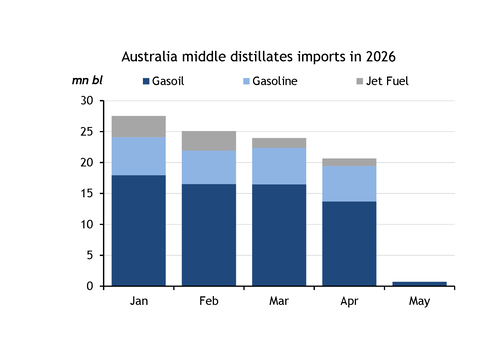
Arrivals of gasoil into Australia fell by nearly 1.47mn bl in March compared with January, Vortexa data show (see graph: Australia middle distillates imports in 2026). Gasoline and jet fuel arrivals were down by 0.25mn bl and 1.85mn bl over the same period. April arrivals are on track to be even lower, with a particularly sharp drop expected in gasoil flows. Some late-April loadings could still reach the east coast before month-end, although sailing times from southeast and northeast Asia typically range between 10-20 days.
Regional availability has tightened sharply since Beijing instructed refiners to halt exports of transportation fuels and Seoul imposed export caps limiting shipments to 100pc of their 2025 monthly levels. Lower refinery run rates across the Asia-Pacific have further reduced spot supply to Australian buyers.
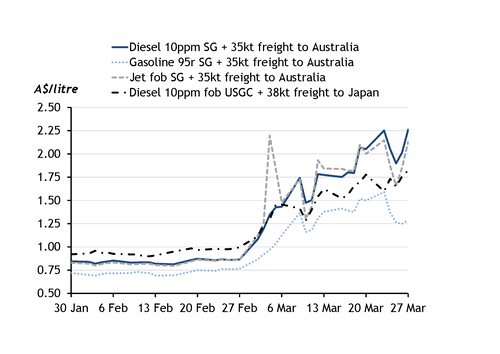
Delivered product prices into Australia have risen since the conflict began, with delivered US Gulf coast gasoil into Japan — an imperfect proxy for Australian delivered pricing from the US Gulf — showing strong gains. Freight costs would add a premium to any US Gulf cargoes bound for Australia.
| Fuel shipments from US and Europe to Australia | bl | ||||
| Product | Volume | ETA | Vessel | Loading point | Discharge port |
| Diesel | 277,500 | 14-Apr | Cape Andiamo | Meraux, US Gulf | Newcastle, NSW |
| Diesel | 175,700 | 19-Apr | Atlantic Sunshine | Ferndale, USWC | Melbourne, Vic |
| Diesel | 293,900 | 20-Apr | Maersk Cyprus | Ferndale, USWC | Brisbane, Qld |
| Gasoline | 300,000 | 20-Apr | CL Zhaoge | Beaumont, US Gulf | Botany Bay, NSW |
| Gasoline | 316,200 | 24-Apr | Hansa Sealancer | Pasadena, US Gulf | Botany Bay, NSW |
| Diesel | 24,600 | 24-Apr | Hansa Sealancer | Pasadena, US Gulf | Botany Bay, NSW |
| Diesel | 323,500 | 27-Apr | Betelgeuse | Ferndale, USWC | Brisbane, Qld |
| Diesel | 707,100 | 29-Apr | STI Solace | STS in ARA region | Botany Bay, NSW |
| Diesel | 300,000 | 5-May | Largo Eagle | Baton Rouge, US Gulf | Port Hedland, WA or Sydney, NSW |
| Diesel or Jet Fuel | 285,000 | 10-May | Nord Ventura | Baton Rouge, US Gulf | Port Hedland, WA |
| Source- Vortexa | |||||