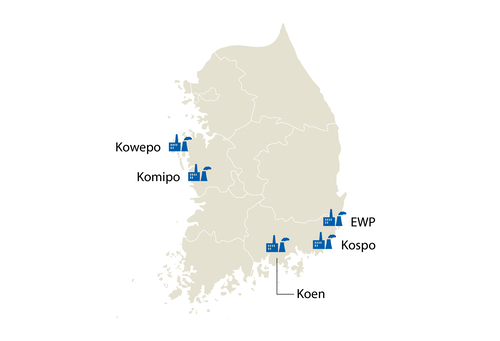
South Korea's five state-owned utilities are expected to be merged into a single utility — a move that could reshape the country's thermal coal procurement strategy.
The country's climate and energy ministry in an interim briefing on Thursday released the findings of a government-commissioned study that identified consolidating five state-run utilities into one utility as the preferred option.
The proposal was based on four key principles — strengthening the implementation of the energy transition, reducing financial risks, improving operational efficiency and facilitating a "just transition". The merger would reduce thermal coal procurement costs through joint purchasing, the study said.
"The restructuring of state-owned utilities is not simply about merging companies but about reorganising them into a more competitive business structure capable of responding to the energy transition," climate and energy minister Kim Sung-hwan said.
Under the current system, the five state-run utilities procure coal independently and compete to secure the lowest-cost fuel supplies. The merger would prioritise supply security and fuel quality over price, market participants said.
Market participants also expect the merger to shift coal procurement towards long-term contracts with major mining companies capable of ensuring stable supply, reducing reliance on spot purchases. Larger tender volumes are also expected to favour large suppliers, they said.
The country's independent power producers (IPPs) are likely to maintain a more flexible procurement strategy, balancing spot purchases and long-term contracts while continuing to prioritise cost-effective fuel supplies, sources said.
But the merger is unlikely to materialise in the near term, market participants said, owing mainly to the complexity of integrating five utilities with operations spread across the country. They cited challenges such as harmonising different operational systems, deciding on the location of the merged utility's headquarters and navigating regional interests. The restructuring would also require enabling legislation, potentially extending the timeline, they added.
South Korea's five state-owned utilities split from parent company Kepco in 2001 as part of power sector reforms aimed at boosting competition and efficiency. They are projected to account for about 83pc of South Korea's thermal coal demand and 89pc of coal-fired output this year, according to Argus' calculations.
The merger would have little immediate impact on thermal coal demand, according to market participants, because it would change who operates coal-fired plants rather than the number of plants in operation.
Coal-fired plant retirements will continue in line with the country's power supply and demand plan regardless. But market participants said the government's commitment to the energy transition and planned coal phase-out could gradually weigh on thermal coal demand over the longer term.
The interim report released on Thursday reaffirmed the South Korean government's target to phase out coal-fired power generation by 2040 and expand renewable capacity to 100GW by 2030. The transition would place greater emphasis on grid balancing, system flexibility and power stability rather than on simply increasing power generation, market participants said.
The energy ministry plans to finalise its plan for reorganising the functions and structure of South Korea's state-owned utilities next month after consulting experts and stakeholders.