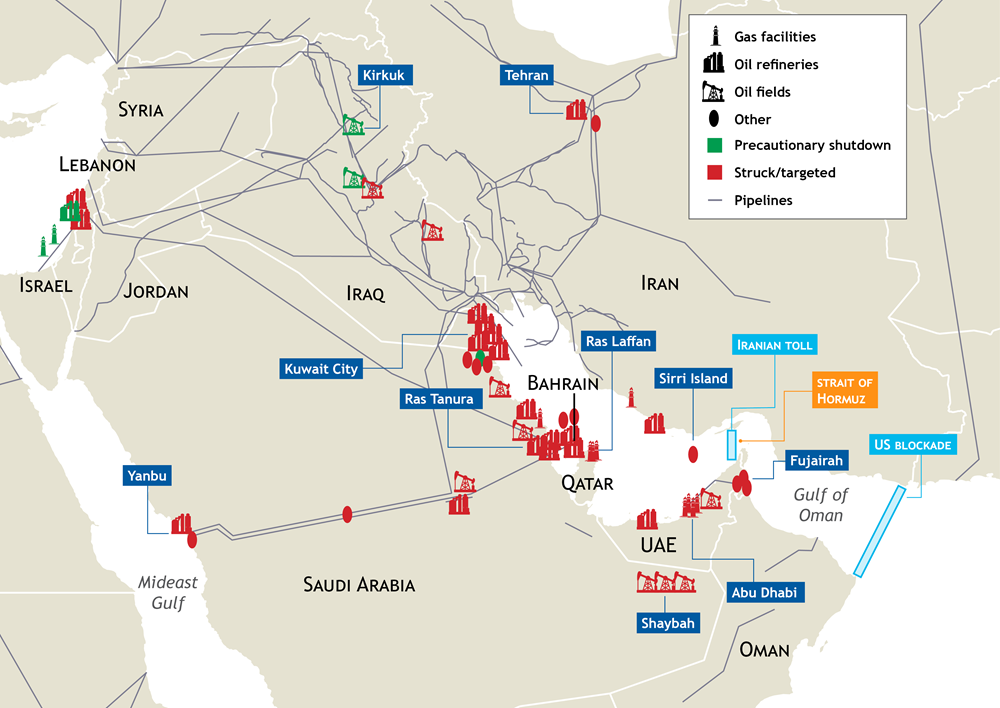
Latest news on the Middle East conflict
Read the latest news stories as they are published.

Trump says Iran will not restart enrichment
Dubai, 25 June (Argus) — US President Donald Trump today said he would "militarily" prevent Iran from restarting uranium enrichment or pursuing a nuclear weapon. It is unclear how much damage to Tehran's nuclear programme was caused by the US recent airstrikes on the Fordow, Natanz and Isfahan facilities. "The last thing they want to do is enrich anything right now," Trump said today. "They want to recover, and we won't let that [enrichment] happen… militarily, we won't." "They're not going to have a bomb, and they're not going to enrich," he said. Trump was responding to remarks by Iran's foreign minister Abbas Araqchi, who said Tehran will not abandon uranium enrichment and that Iran's perspective on the nuclear non-proliferation regime is undergoing a change. Trump brokered a ceasefire to end a 12-day conflict between Israel and Iran, which appears to be holding. On Tuesday, 24 June, he had sharply criticised both countries over what he called early violations of the truce. Trump also said the US could eventually have a relationship with Iran. "I see it. Look I've had a relationship over the last four days," he said. "They agreed to the ceasefire, and it was a very equal agreement [between Iran and Israel]." That followed an earlier upbeat assessment of Iran's economic future. "They're going to get on to being the great trading nation," Trump said. Extent of damage The full extent of damage to Iran's nuclear facilities caused by US bombing has yet to be verified. Trump has said the sites were completely demolished, calling the outcome of the attack "very severe" and "obliteration." UN nuclear watchdog IAEA director general Rafael Grossi said the US strikes had set back Iran's nuclear program "significantly", but did not specify what that meant in terms of months or years. Secretary of state Marco Rubio said Iran's conversion facility, a necessary element for producing a nuclear weapon, had been obliterated. "You can't even find where it used to be because the whole thing… is gone," he said. Iran has yet to comment about the extent of damage. By Bachar Halabi Send comments and request more information at feedback@argusmedia.com Copyright © 2025. Argus Media group . All rights reserved.
Iran’s nuclear programme set back 'significantly': IAEA
Dubai, 25 June (Argus) — US strikes have set back Iran's nuclear programme "significantly", but the location of nearly 900 pounds (408 kg) of potentially enriched Iranian uranium is not known, UN nuclear watchdog (IAEA) director General Rafael Grossi said. Grossi told Fox News that the agency is waiting to see what Iran decides to do and whether the country is going to reconstruct the nuclear facilities. "For example, [if] there is a resumption, as I hope personally, of the negotiation with [US special envoy Steve] Witkoff, where there was an idea that Iran would not be enriching and would perhaps be part of an international consortium," Grossi said. The full extent of the damage to Iran's nuclear facilities following US strikes has yet to be verified, even though US president Donald Trump insisted the sites were completely demolished . "As inspectors, we say what we can check and verify," Grossi said, adding that what the agency currently sees is "a very important degree of damage in all three facilities." Asked about his previous statement on 900 pounds of potentially enriched uranium having been moved to an old site near Esfahan, Grossi said he could not speculate as they do not know where the material is located. He said that Iran told the IAEA that they would be taking protective measures "which may or may not include moving this material". The only way to confirm is "to allow the inspection activity to resume as soon as possible", he said. But Iran's parliament today approved "the generalities of a plan requiring the government to suspend its cooperation with the IAEA," according to state news agency Irna. The motion still requires the endorsement of the Supreme National Security Council (SNSC) — Iran's highest security authority. "According to the resolution, IAEA inspectors do not have the right to enter the country for inspections without the explicit approval of the SNSC," reported Nour News, an Iranian agency linked to Ali Shamkhani, top military and nuclear adviser to supreme leader Ayatollah Ali Khamenei. Iran's current parliamentary speaker, conservative Mohammad Baqer Qalibaf, said today that Iran's peaceful nuclear program "will advance at an even faster pace [than before]." By Bachar Halabi and Nader Itayim Send comments and request more information at feedback@argusmedia.com Copyright © 2025. Argus Media group . All rights reserved.
Israeli gas fields to restart after Israel-Iran truce
London, 25 June (Argus) — Israel's Leviathan and Karish gas fields are preparing to restart production following a near two week-closure caused by the Israel-Iran conflict. The offshore fields have received government approval to restart, Israeli Leviathan partner Ratio Energies and Karish operator, Greek firm Energean, said today. Ratio said Leviathan operator Chevron is working to resume normal operations within hours. Energean said it was working to resume normal operations. The restarts come a day after a US-brokered ceasefire to the conflict between Israel and Iran. The outages at Leviathan and Karish left Israel solely reliant on the Chevron-operated Tamar gas field to meet domestic demand, which is mostly for power generation. They also led to a cessation of gas exports to Egypt and Jordan, which prompted the two countries to shut down key chunks of their industry. The return of Leviathan and Karish should allow regular exports to resume. Leviathan produced 11.3bn m³ last year, Tamar produced 10.1bn m³ and Karish produced 5.8bn m³. By Aydin Calik Send comments and request more information at feedback@argusmedia.com Copyright © 2025. Argus Media group . All rights reserved.
LPG prices plunge on possible Israel-Iran ceasefire
London, 24 June (Argus) — Global LPG prices fell by around 6pc today after Israel and Iran appeared to agree a ceasefire. An end to the 12-day conflict would alleviate fears of supply disruptions, and LPG prices started to retreat after rising on Monday, 23 June . The Asia Pacific Argus Far East Index (AFEI) July paper contract fell by $34.50/t to $555.50/t, and the equivalent European propane paper value fell by $33/t to $477/t. Swap contracts, with liquidity far greater than physical trading, can be a useful indicator of global sentiment. The prompt contract, currently July, can move rapidly and accurately reflect the trajectory of physical price moves. Some market participants are skeptical on the durability of the truce . Iran has yet to confirm its agreement. The hostilities have endangered Iranian infrastructure, ports, terminals and facilities that could affect LPG output. There was also an implied threat from Tehran of closure of the strait of Hormuz. Either scenario would severely affect output from the region. Iran exports about 10mn t/yr of LPG, most of it to China, and 40mn t/yr passes through the strait of Hormuz, equivalent to 27pc of global seaborne exports. Any disruption to Middle East flows would force China, the biggest LPG buyer, to seek more product from the biggest seller, the US. This would leave less product for European buyers and would necessitate higher European price premiums to compete with Asia-Pacific buyers, which typically offer better netbacks to US sellers. By Efcharis Sgourou Send comments and request more information at feedback@argusmedia.com Copyright © 2025. Argus Media group . All rights reserved.