
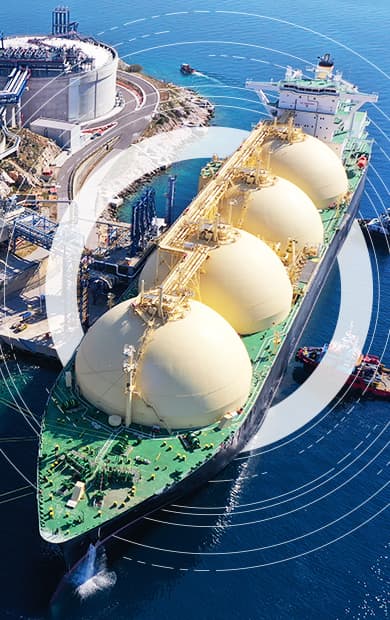
LNG
概要
LNGは、投入コストと炭素排出の両方を管理するのに役立つため、重要な原料としての位置を確立しています。重工業ユーザーによるネットゼロ目標達成の推進は、LNGの使用方法と使用場所に新たな局面をもたらしています。全体として、使用量は増加すると予想され、最も成長率の高い化石燃料になると予測されています。
アーガスは、国際的なLNG市場に関する詳細かつ信頼性の高い視点を専門的に提供します。お客様は重要なデータセットや分析、包括的な分析、市場を動かす業界ニュースへのライブアクセスを得ることができます。アーガスのLNGサービスは、世界中の主要なLNG取引ハブに拠点を置く市場専門家によるものです。
160カ国の企業、商社、政府が、より賢明な意思決定、状況分析、リスク管理、取引の円滑化、長期計画の立案をサポートするために、当社のデータを信頼しています。
Latest LNG news
Browse the latest market moving news on the global LNG industry.
Iran says Hormuz closed; US says flows intact
Iran says Hormuz closed; US says flows intact
London, 20 June (Argus) — The US and Iran issued conflicting accounts of conditions in the strait of Hormuz on 20 June, with Tehran saying it has closed the waterway, while Washington said commercial shipping continues to transit. Iran's claim — carried by the IRGC-affiliated Tasnim news agency and citing the Khatam al-Anbia Central Headquarters — said the strait had been closed to vessel traffic in response to continued Israeli strikes in southern Lebanon following a ceasefire with Lebanese militia group Hezbollah, which it said breached commitments under the recent memorandum of understanding with the US. The headquarters characterised the move as a "first step" and warned further measures could follow if hostilities persist. But US Central Command (Centcom) indicated no disruption to flows, saying 55 merchant vessels transited the strait during the day, carrying more than 17mn bl of oil to global markets. Safe passage through the waterway "remained intact", it said, with US forces operating in the area to support freedom of navigation. No shipping incidents were reported in the region on 20 June. Ship-tracking data also show vessel traffic via the strait of Hormuz continues. The 26,361dwt LPG tanker Pacific Star I continued its passage, and no U-turns were detected as of 23:00 BST (22:00 GMT) on 20 June. Some vessels may have switched off their Automatic Identification System (AIS) signals, while others may have stopped. The 56,880dwt bulk carrier KSL Qingyang halted earlier on 20 June after almost crossing the strait eastwards, Kpler data show. Some tankers appear to be favouring a southern route closer to Omani shores. The VLCC Angola B , sailing from Zirku Island in the UAE, crossed the strait near Omani waters earlier, but may have switched AIS off afterwards. The ballast VLCC Bahrain Prosperity passed westwards through the strait near Omani shores into the Mideast Gulf on 20 June, according to Kpler data. Two more VLCCs, Monaco Loyalty and Gulf Sunrise , were approaching the entrance to the strait near Oman but may have switched AIS off around the time Tasnim reported the closure, Kpler data suggest. US president Donald Trump has not commented directly on the reported closure of the strait but addressed the issue of tolls in a post on the Truth Social platform, saying there would be no charges during the 60-day negotiating period and none afterwards unless the US chose to impose them if no final deal with Iran is reached. Iranian state media reported that a delegation had arrived in Switzerland ahead of talks with US negotiators, led by vice-president JD Vance. "I think we're going to hopefully make progress on the nuclear issue, make progress on the Lebanon ceasefire issue," Vance said before boarding his flight. Israel carried out a strike on Hezbollah on 19 June despite the ceasefire, prime minister Benjamin Netanyahu said. Israel's foreign ministry accused Hezbollah of "violating the ceasefire and attacking Israeli civilians". By Andrey Telegin Send comments and request more information at feedback@argusmedia.com Copyright © 2026. Argus Media group . All rights reserved.
Japan's Cosmo Energy mulls LNG-fired power plant
Japan's Cosmo Energy mulls LNG-fired power plant
Osaka, 19 June (Argus) — Japanese energy firm Cosmo Energy is considering building a gas-fired power plant, given that domestic electricity demand is projected to continue rising. No details of the project framework have been decided. The company unveiled the considerations in its business plan to 2035, which was released on 18 June. The firm is mulling a gas-fired power plant while aiming to develop its renewable energy capacity, including wind and solar. LNG-fired generation can counter imbalances in renewables output. The firm aims to raise renewable capacity to 490MW by the April 2028-March 2029 fiscal year, up from 364MW in 2025-26. It also plans to increase power sales by 35pc to 3.1TWh over the same period. But power sources need to balance economic viability with decarbonisation, without being limited to green energy, the company said. Cosmo is also looking to expand its upstream exposure to natural gas beyond its traditional crude oil business. Details, such as location and timeline, have yet to be decided as the plan remains under consideration. The company may explore such opportunities in the UAE, where it plans to expand oil production . It remains unclear whether Cosmo will also move into liquefaction and LNG trading, even if it expands into upstream gas production and gas-fired generation. Fellow energy firm Idemitsu decided in March to invest in MidOcean Energy, an LNG company backed by US investment firm EIG, with the possibility of engaging in LNG trading. By Motoko Hasegawa Send comments and request more information at feedback@argusmedia.com Copyright © 2026. Argus Media group . All rights reserved.
S Korea’s Hanwha to build FLNG project in Canada
S Korea’s Hanwha to build FLNG project in Canada
Singapore, 17 June (Argus) — South Korean shipbuilder Hanwha Ocean has signed a Memorandum of Understanding (MoU) with developer Kanata Clean to develop a floating LNG (FLNG) export project near the port city of Prince Rupert in British Columbia on 16 June. The project in its entirety is expected to have a capacity of up to 12mn t/yr, and will cost about $15.7bn. But it is still subject to final engineering and regulatory approvals. Under the MoU, both firms will co-operate across several areas including engineering and construction of the FLNG and related facilities, long-term LNG purchase agreements and other solutions such as LNG carriers and LNG bunkering vessels (LNGBVs), among others. This project will add to a growing list of Canadian LNG export projects already in the pipeline. Germany utility Uniper has signed a letter of intent with Canada's proposed 12mn t/yr Ksi Lisims LNG earlier this month, which could be converted into a binding sales and purchase agreement (Spa) for 2mn t/yr of LNG, the utility said. The 12mn t/yr Ksi Lisims LNG also signed an agreement with Germany's Sefe back in late-May, to sell 1mn t/yr of LNG for up to 20 years from the early 2030s. Securing LNG from Canada has increasingly emerged as an important step for importers to diversify their supplies. This is especially after the start of the US-Iran war in end-February and resultant Iranian missile attacks which wiped out about 12.8mn t/yr of Qatar's original 77mn t/yr of nameplate capacity. But Asian importers may be wary of too much exposure to Canadian exports, given the country's reputation for over-regulation, India's top envoy to Canada said last week. By Rou Urn Lee Send comments and request more information at feedback@argusmedia.com Copyright © 2026. Argus Media group . All rights reserved.
Workers to end strikes at Australia's Ichthys LNG
Workers to end strikes at Australia's Ichthys LNG
Sydney, 17 June (Argus) — Workers at the 9.3mn t/yr Ichthys LNG project based in Australia's Northern Territory have agreed on a new pay deal, ending weeks of strikes across three facilities that delayed some cargoes. More than 400 staff endorsed the enterprise bargaining agreement (EBA) on 17 June, the Offshore Alliance union said, calling the new EBA "the best in the oil and gas industry" with improved job security, pay and career progression. Unions have notified Ichthys operator, Japan's Inpex, that strikes will cease by 6pm Australian Western Standard Time (10am GMT) today. Workers voted to endorse protected industrial action in May and began minor strikes on 2 June , escalating to loading bans and eight-hour stoppages on 11 June. Australia's workplace court the Fair Work Commission on 14 June rejected an application by Inpex to halt the strikes due to economic impacts , despite finding that industrial action threatened to cause a full production stoppage at Ichthys. Unions responded by promising to extend the strikes past 23 June. By Tom Major Send comments and request more information at feedback@argusmedia.com Copyright © 2026. Argus Media group . All rights reserved.
Spotlight content
Browse the latest thought leadership produced by our global team of experts.


Explore our LNG products
Real time access to our independent and trusted benchmarks, critical market data and analytics, in-depth analysis, and the latest market news. Argus LNG is relied upon by energy companies, governments, banks, regulators, exchanges and many other organizations as source of reliable and unique insights into the global markets.
Key price assessments
Argus prices are recognised by the market as trusted and reliable indicators of the real market value. Explore some of our most widely used and relevant price assessments.