The industry aims to lift its use of natural gas in its production processes, but it must first deal with high gas prices and underdeveloped pipelines, writes Rituparna Ghosh
In a bid to reduce their carbon footprint, Indian steelmakers have been calling for measures aimed at boosting natural gas use in the sector. But they face challenges in the form of high prices and a lack of infrastructure in key areas of the country.
The looming introduction of the EU's carbon border adjustment mechanism, which takes effect on 1 January 2026, has prompted Indian steel producers to hold a series of meetings with the ministry of steel to seek ways to reduce the carbon footprint of their exports. While the EU imports only a tiny fraction of India's crude steel exports, it is the largest market for the country's finished steel products, having accounted for 43pc of total steel exports in the April 2023-24 fiscal year, according to the most recent official figures. India recorded net steel exports of 7.49mn t in 2023-24, a 12pc increase from the previous year, provisional data from the steel ministry's joint plant committee show.
But steelmakers have remained sceptical of decarbonisation strategies based on natural gas, given its still-high carbon intensity and the limited availability of domestic supplies, which would leave firms highly dependent on expensive LNG imports. Producers have been lobbying for increased allocation of domestic gas to the sector, as well as a customs duty waiver on LNG imports and government subsidies to bring prices within what they consider to be an "affordable" range of $7-8/mn Btu. At present, all Indian steelmakers buy their supply from state-run gas distributor Gail at $12/mn Btu.
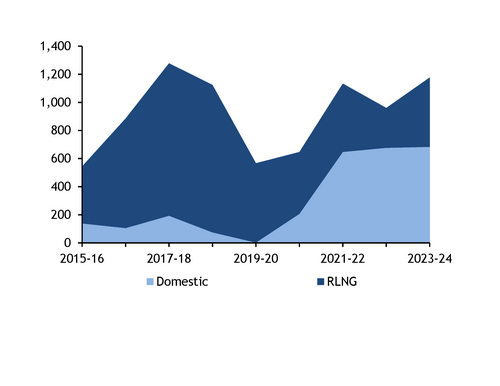
There has been already an increase in allocations of domestic gas production to steelmakers since 2020-21, which has not increased overall gas use in the sector, but instead only curbed its reliance on LNG imports.
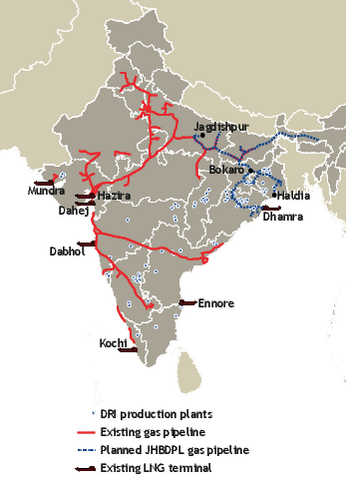
India's underdeveloped gas pipeline network running up to major steel hubs also curtails access to gas supplies and discourages investment in plant conversions. The commissioning of Gail's Jagdishpur-Haldia-Bokaro-Dhamra pipeline, which is part of a larger project to supply gas to the steel belts in Jharkhand, Odisha and West Bengal and originally was scheduled for completion in 2021, has been delayed further to March 2025. Once operational, the pipeline will ship regasified LNG from the 6mn t/yr Dhamra terminal and supply gas to two steel clusters in Jharkhand and West Bengal. The commissioning of the line might open up large pockets of demand, but steelmaking plants in the region would need to make substantial investments in order to switch to gas.
Scope for greater gas use
In theory, there is substantial scope for stronger gas use in Indian steelmaking. The sector's combined gas consumption rebounded by 23pc to 1.18bn m³ in the 2023-24 fiscal year, but was still short of the 2017-18 peak of 1.28bn m³, oil ministry data show.
Gas can be used in steelmaking either as a feedstock for the production of direct reduced iron (DRI) — or "sponge iron", which is then blended with steel scrap in electric arc furnaces — or as a fuel in rolling mills that produce finished steel. India is the world's largest DRI producer, with its 2022 output of 42.3mn t having accounted for about a third of global DRI production of 125.1mn t, according to the most recent figures from the World Steel Association.
But most Indian steelmakers traditionally use cheaper thermal coal in rotary kilns instead of the gas-based processes used in a vertical shaft furnace. Coal-based processes accounted for about a quarter of global DRI production in 2019, located mainly in India, according to the International Iron Metallics Association.
Even assuming highly efficient plants using about 10GJ of gas to produce 1t of DRI, India would need 9.8bn m³ of gas to produce the same amount of DRI as in 2022. Instead, Indian steelmakers used only 922mn m³ that year, including gas used as fuel for rolling mills.
Efficiency measures might offset higher gas demand
In any event, potential increases in gas demand from DRI producers switching to gas might be offset to an extent by efficiency measures in production processes.
ArcelorMittal Nippon Steel India (AMNS) is the largest gas consumer, with 65pc of output at its 8.8mn t/yr west India's Hazira plant based on gas. The firm plans to more than double the plant's production capacity to 20mn t/yr, but it is also looking to reduce gas consumption across its production processes — it aims to replace 70-90pc of its gas purchases with blast furnace gas, according to the firm's 2022-23 annual report.
AMNS has a supply deal with TotalEnergies for about 500,000 t/yr of LNG that is set to expire in 2026, and in May it signed a 10-year supply contract with Shell for a similar amount, starting in 2027. Similarly, Indian steelmaker JSW Steel has already reduced gas demand at its 10mn t/yr Dolvi plant in west India's Maharashtra state by about 81mn m³/yr, by replacing it with coke oven gas.
Other primary producers such as Tata Steel and JSPL are looking at alternative options for reducing their carbon footprint, such as injecting hydrogen into blast furnaces and carbon mitigation technology such as carbon capture, utilisation and storage. But natural gas injections can also be used in blast furnaces to reduce coaking coal consumption, which is estimated to save 35-37kg of CO2/t of hot metal produced.
India is also the second-largest crude steel producer in the world, with output of 125mn t in 2022, 54pc of which was produced by an electric process. But scope to expand gas-based electricity in steelmaking might be limited as most of India's gas-based power plants are situated away from steel production hubs such as Punjab, Raipur and Maharashtra.