Ancillary services to resolve technical constraints in the Portuguese power grid have increased substantially since the blackout on the Iberian peninsula on 28 April, calling on gas-fired generation in particular.
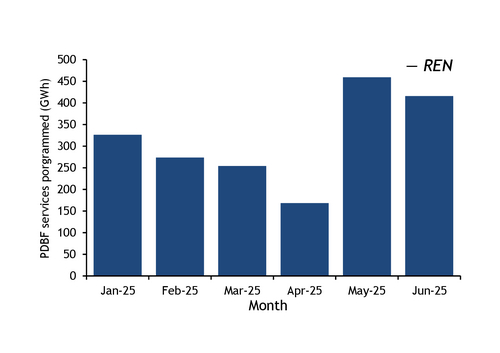
Before the widespread outage, base day-ahead operating schedule (PDBF) technical constraint solutions were relatively limited. Monthly totals programmed averaged 256GWh in January-April, with April calling upon 168GWh of PDBF ancillary services.
PDBF ancillary services then more than doubled from April to May, to a total of 459GWh. The average monthly total since the blackout is 438GWh, with transmission system operator (TSO) REN not yet having released July data.
These figures were also up substantially on the year, with the Portuguese TSO listing no PDBF ancillary services for May 2024 and just 1.4GWh for June. The average across 2024 was 133GWh, with no months coming close to figures this year since the blackout.
The vast majority of these services scheduled by the Portuguese TSO — more than 99pc — came from three separate combined-cycle gas turbine (CCGT) complexes. These were Portuguese utility EDP's Lares complex, consisting of two CCGTs with a total capacity of 862MW; EDP's 1,200MW Ribatejo complex of three CCGTs; and Spanish utility Endesa's 836MW Pego site with two CCGT units. The sites are located in the Central, Tagus Valley and Lisbon regions of Portugal. A pumped storage site made up the remainder of services.
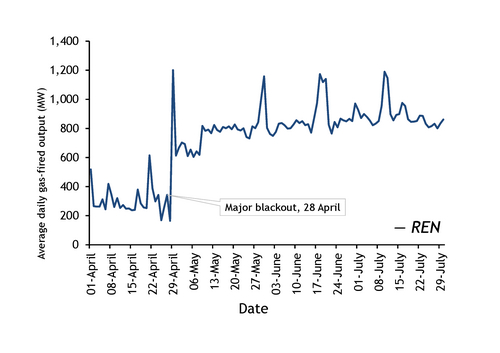
Gas-fired output in Portugal in April averaged 535MW before the blackout. This rose sharply following the outage, with gas-fired generation averaging 882MW since then. The lowest daily average of 164MW came on the day of the blackout, with a sharp thereafter, peaking at 1.2GW the following day as the TSO called on gas-fired generation to bring stability to the grid.
REN operates a number of programmes to resolve technical constraints in its grid, such as potential safety issues and imbalances in generation and demand. These resolution mechanisms exist as both planned day-ahead schedules and intra-day mechanisms to react to real-time issues and changes in climate.
Resolutions can include the dispatching of flexible generation to meet surges in demand or voltage control issues, resolving issues resulting from outages and curtailment of generation, such as renewables, to help with grid stability.
Portugal's TSO establishes the PDBF following market close each day, taking into account expected demand and generation, climate conditions and cross-border exchanges. Adjustments to this in the form of technical constraint resolutions ensure the safety of the grid and account for any outages or potential issues with voltage control, inadequate reserves and ramping.
Technical constraint resolutions for PDBF often come in the form of CCGTs in Portugal, owing to their quick ramp up or downtimes and rapid response to dispatch signals to ensure grid stability. Strategic location of CCGTs in Portugal also helps to provide these ancillary services, where needed.
Spanish utility Naturgy announced in its results last week that a rise in ancillary services accounted for its 71pc rise on the year in earnings before interest, tax, depreciation and amortisation from thermal generation in the first half of 2025. The utility explained that the strong rise in gas-fired output was because of "support voltage control and contingency response, and to compensate for [solar photovoltaic output] drop-off in the evening, at peak demand".