
Generic Hero BannerGeneric Hero Banner
Latest market news

NWE biopropane premium drops to two-year low

  • : Biofuels, LPG
  • 25/10/01

Demand for biopropane will remain weak without government-mandated use, writes Evelina Lungu

Northwest European biopropane premiums to equivalent propane prices at the Amsterdam-Rotterdam-Antwerp (ARA) hub declined in the third quarter to their lowest since Argusbegan assessing the market in October 2023 on weaker demand and soft propane values.

Used cooking oil-based biopropane prices averaged $1,361.25/t fca ARA in the third quarter, down from $1,393.25/t in the second quarter and $1,519.50/t in the first, and from $1,599/t a year earlier. This was partly owing to lower propane prices, with large cargo cif ARA below $500/t for most of June-August. Northwest Europe has absorbed increased flows of US LPG even during periods of lacklustre demand, while Chinese demand eased and US-China tariff uncertainty persisted.

The biopropane premium to propane large cargoes at ARA slipped by $24/t on the quarter and $117/t on the year to just over $900/t in July-September. Biopropane is predominantly produced as a by-product of hydrotreated vegetable oil (HVO) and hydrotreated esters and fatty acids synthetic paraffinic kerosene (HEFA-SPK) sustainable aviation fuel (SAF) output. Global SAF and HVO output capacity has expanded over the past two years, while European refineries are increasingly co-processing renewable feedstocks. These have boosted biopropane supply but demand is limited without mandated use. Some producers have opted to recycle biopropane in refining processes to improve greenhouse gas savings in final HVO and SAF output. Divergent buying and selling positions have kept premiums from following the recent rise in northwest European HVO and SAF prices.

Some governments are introducing legislation that could support adoption. The EU's Packaging and Packaging Waste Regulation sets packaging reduction targets of 5pc by 2030, 10pc by 2035 and 15pc by 2040, with all packaging to be recyclable. The EU will decide in 2028 whether to let bio-based plastics count toward recycled content targets, a change that could substantially increase biopropane demand.

In heating, the Irish government has approved a renewable heat obligation scheme requiring suppliers to replace a share of fossil heating fuels with renewables. Although primarily designed to support biomethane, biopropane uptake could rise under the measure, which runs in 2026-45, starting with a 1.5pc obligation in 2026 and 3pc in 2027. LPG association Liquid Gas Ireland released a goal of transitioning the industry to 100pc renewable supply by 2050 last month.

Germany's buildings energy act requires new buildings to install heating systems using at least 65pc renewable energy while Sweden exempts biopropane from energy and CO2 taxes when used in motor fuel and heating. Transport remains the main area for renewable mandates, but some countries, such as France, are moving toward sector-specific targets.
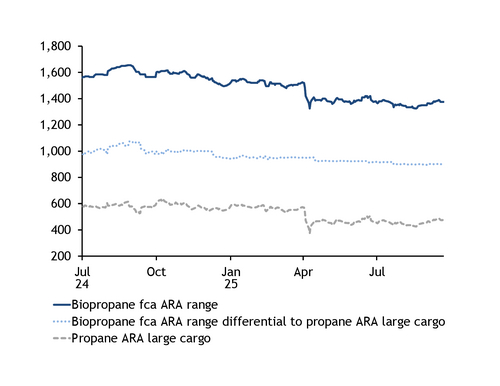
Biopropane vs propane in northwest Europe $/t

Related news posts

Argus illuminates the markets by putting a lens on the areas that matter most to you. The market news and commentary we publish reveals vital insights that enable you to make stronger, well-informed decisions. Explore a selection of news stories related to this one.

25/11/14

Cop: 10 countries pledge to align transport with 1.5ºC

Cop: 10 countries pledge to align transport with 1.5ºC

Belem, 14 November (Argus) — A group of 10 countries led by Chile called for a global effort to cut energy demand from the transport sector by 25pc by 2035, aligning it with the Paris Agreement goal of limiting global warming to 1.5°C above pre-industrial levels. The coalition was formed at the UN Cop 30 climate summit, which is underway in Belem, northern Brazil. Brazil, Colombia, Costa Rica, the Dominican Republic, Honduras, Norway, Portugal, Slovenia and Spain are the other signatory countries so far. "We are committed to making transport a key pillar of climate action, agreeing a shared framework for resilient and low emissions transport systems", Chile's transport minister Juan Carlos Munoz told journalists at Cop 30. Cutting energy demand from transport — the second-largest emitting sector — allows for "a clear measurable direction towards a net zero scenario in the transport sector in 2050", he added. Chile is a natural leader for the coalition as it is a global leader in efforts to electrify its public transport fleet. The country's capital Santiago is the city with most electric buses outside of China, Munoz said. It had around 3,000 electric buses in 2024, according to a report by Agora Verkehrswende, a non-governmental organisation focused on climate neutrality in transport. But it will have 4,400 by March, Munoz added. The coalition will now work to create a roadmap to reach the pledge's goal and measure progress for future Cops, according to Slocat, a global partnership that promotes sustainable, low-carbon transport. Sustainable fuels, renewable sources Although the pledge will heavily rely on electrification, it also calls on countries to shift one-third of energy powering transport to sustainable biofuels and renewable sources. Brazil is the second-biggest biofuel producer globally, trailing only behind the US. But it will consider any route that both decarbonizes its fleet and drives national industry, Brazilian minister of cities Jader Barbalho Filho told Argus , mentioning specifically liquid nitrogen and biomethane. Including existing and expected projects, Brazil could have 2.4mn m³/d of biomethane capacity by 2027, data from hydrocarbons regulator ANP show. The shift to sustainable biofuels and renewables sources plays well into Brazil's Belem 4x pledge , which calls for a global effort to quadruple global output and use of sustainable fuels by 2035, Filho added. "The Chilean government looked for us [to present the transport pledge] exactly because we already have [Belem 4x]", he said. The Belem 4x pledge now has 23 country signatories, Cop 30 chief executive Ana Toni said today. By Lucas Parolin Send comments and request more information at feedback@argusmedia.com Copyright © 2025. Argus Media group . All rights reserved.

Australia’s Jet Zero, Townsville port sign biofuels MoU


25/11/14
25/11/14

Australia’s Jet Zero, Townsville port sign biofuels MoU

Sydney, 14 November (Argus) — Australian bioenergy developer Jet Zero and the Port of Townsville have signed an initial agreement to assess the feasibility of developing new biofuel storage and blending infrastructure at Queensland's third-largest port. The biofuels firm and port operator will explore design and construction options for a potential liquid storage facility to support the movement, blending, import and export of sustainable fuels from Jet Zero's nearby proposed Project Ulysses , Jet Zero said on 13 November. Project Ulysses will produce 113mn litres/yr sustainable aviation fuel (SAF) and renewable diesel (RD) using the alcohol-to-jet method at north Queensland's Townsville State Development Area, 2km south of the Port of Townsville. Jet Zero recently completed front-end engineering and design with alcohol-to-jet technology provider LanzaJet. The project could produce one-sixth of the domestic airline industry's 2030 SAF commitment, but a date for first output has not been disclosed. Project Ulysses aims to meet mandated and voluntary demand for SAF and RD in the aviation and marine sectors, and the Port of Townsville will play a critical role in facilitating trade and supporting regional industry growth, the companies said. By Grace Dudley Send comments and request more information at feedback@argusmedia.com Copyright © 2025. Argus Media group . All rights reserved.

API pitches revamp of biofuel exemptions: Update


25/11/13
25/11/13

API pitches revamp of biofuel exemptions: Update

Updates throughout New York, 13 November (Argus) — The American Petroleum Institute (API) is pitching the White House and biofuel groups on a total revamp of how the US exempts oil companies from a program that requires biofuel blending, according to three people familiar with the lobbying group's work. API recently withdrew its support for a bill that would authorize 15pc ethanol gasoline (E15) year-round on its frustrations with changes to biofuel policy this year that oil companies see as too friendly to farmers and to some small refining competitors. The US for instance recently granted small oil refiners generous hardship waivers from a biofuel blend mandate and proposed requiring larger companies to blend more biofuels in future years as an offset. API's pitch — shared at a White House meeting this week — would require that companies seeking program exemptions must show that economic hardship stems directly from the biofuel program, a more stringent requirement than today, according to two of the people familiar with the group's work. Exemptions would also be restricted to companies with limited collective refining capacity, cutting off larger enterprises like Delek and Par Pacific that own multiple small units that qualify now. Smaller companies like Ergon and Kern Oil could still request waivers, but the total pool of potentially exempted gas and diesel volumes would be far lower. The oil group then wants the US to prohibit hiking other oil companies' blend requirements to offset those exemptions, a tougher sell to biofuel and crop groups that fear unchecked program waivers curb demand for their products. Larger merchant refiners that do not qualify for small refinery relief have also long pushed lawmakers for updates to the program and would not benefit from this proposal. API's idea is to pass legislation pairing updates to the small refinery exemption program with year-round authorization of E15, generally prohibited in the summer without emergency waivers because of summertime fuel volatility restrictions that do not apply to typical 10pc ethanol gasoline. That's a top priority for ethanol companies, otherwise at risk from an increasingly efficient and electric light-duty vehicle fleet. Congress last year nearly passed narrower E15 legislation, which API supported at the time but no longer does without more changes. Courts have struck down past attempts by federal officials to authorize E15 without emergency declarations and to drastically restrict biofuel exemption eligibility, likely limiting what President Donald Trump's administration can do without new legislation. API made the pitch to the White House this week, the sources familiar with API's work said. The White House is hosting other groups for meetings on fuel policy, including another one on Thursday on E15 that featured biofuel groups. Officials from across Trump's administration, including the US Department of Agriculture, have attended. "Administration officials hosted listening sessions with biofuel groups, agriculture and oil refiners to discuss their proposals on year-round E15", a source familiar with the matter said. It is not clear that biofuel advocates, insistent that the Trump administration entirely offset the impact of recent refinery exemptions, are open to the attempted compromise. The ethanol group Renewable Fuels Association declined to comment on E15 talks. Regulatory tweaks to boost ethanol supply would also do little on their own to help producers of other biofuels like renewable diesel. API declined to elaborate on what was discussed at any meetings with the Trump administration. "We appreciate the administration's leadership in bringing stakeholders together to advance a practical solution on E15 and small refinery exemption reform", API said. "We look forward to continuing to work together to advance a framework that supports fuel choice, strengthens the refining and agricultural sectors, and helps ensure a stable, reliable supply for American consumers." Under the Renewable Fuel Standard, the US requires oil refiners and importers to annually blend different types of biofuels or buy credits from those that do. The administration is late setting new biofuel quotas for 2026 but is expected to do so in the coming months, kicking off a flurry of last-minute lobbying about future volumes, exemptions and potential cuts to credits from foreign fuels and feedstocks. By Cole Martin Send comments and request more information at feedback@argusmedia.com Copyright © 2025. Argus Media group . All rights reserved.

Virada de mix para etanol pode persistir em 2026-27


25/11/13
25/11/13

Virada de mix para etanol pode persistir em 2026-27

Sao Paulo, 13 November (Argus) — Os balanços trimestrais das empresas sucroenergéticas divulgados nesta semana confirmaram a recente virada de mix de produção a favor do etanol em detrimento do açúcar nas usinas – movimento que pode perdurar pela próxima safra. A contínua desvalorização dos preços do açúcar nos últimos meses, diante de uma perspectiva global de superávit de oferta, tornou a produção do biocombustível mais atrativa para usinas do que a do adoçante em diversas praças do país. Os preços do contrato futuro do açúcar com vencimento em março de 2026 negociados na Bolsa de Nova York atingiram 14,52 centavos de dólar por libra (¢/lb) em 12 de novembro, recuo de quase 24pc ante 19,20¢/lb registrados um ano antes. Enquanto isso, o preço do etanol anidro comercializado à vista no Centro-Sul subiu 13pc na comparação anual, para R$ 3,367/m³ na última cotação de 7 de novembro. Os movimentos de preços evidenciam uma mudança de paradigma em relação aos últimos anos, quando o açúcar voltado à exportação remunerava os produtores mais do que o etanol. Essa virada de rentabilidade começou no Centro-Oeste, região que, pela maior distância da costa, enfrenta custos mais altos para transportar a commodity até os portos. Mas até mesmo usinas do estado de São Paulo, que abriga o Porto de Santos – principal terminal de escoamento do açúcar brasileiro para o mercado internacional –, perceberam ultimamente uma maior rentabilidade com a produção de etanol. A São Martinho informou, na teleconferência de resultados do último dia 11 de novembro, que, desde setembro, suas usinas em São Paulo estão direcionando 100pc da produção para o etanol. O diretor financeiro da companhia, Felipe Vichiatto, destacou que o preço do etanol equivalente ao açúcar girava em torno de 15,50¢/lb, enquanto a tela do açúcar ficou próxima a 14¢/lb. Ele disse que, se o mercado continuar operando nesses níveis, é provável que a empresa inicie a próxima safra – que vai de abril 2026-março 2027 – ainda com um mix mais alcooleiro. A produtora Jalles registrou um mix de produção de 49,5pc para o açúcar e 50,5pc para o etanol entre julho-setembro. A fatia do adoçante está abaixo do previsto no guidance da empresa para a safra, de 51,8pc, contra 48,2pc para o biocombustível. Segundo a empresa, desde junho, o anidro começou a remunerar mais do que o adoçante em sua unidade Jalles Machado, em Goiás, e, a partir de setembro, os preços do etanol hidratado também tornaram-se mais rentáveis que o açúcar. A Adecoagro também mudou sua estratégia no segundo semestre da safra, maximizando a produção de etanol em detrimento do açúcar entre julho-setembro, alçando um mix de 58pc para o bicombustível e 42pc para o adoçante. Isso se compara com um mix de 45pc para o etanol e 55pc para o açúcar um ano atrás. Mercado posterga liquidação de contratos Tradings e produtores iniciaram um movimento de rolagem de contratos de açúcar desde meados de maio, na tentativa de liquidar os papéis a preços mais atrativos para a venda – cenário que não se concretizou. O resultado foi uma desvalorização sucessiva dos preços do adoçante, que levou a um acúmulo de perdas para os investidores. Os preços do contrato futuro do açúcar com vencimento em março de 2026 negociados na NYSE desvalorizaram 18,1pc entre 1º de maio-12 de novembro. As expectativas para a próxima safra ainda são de baixa para os preços do açúcar — o que deve fazer os agentes liquidarem os contratos postergados até março de 2026, a fim de evitar maiores perdas, segundo participantes do setor. O mercado espera uma recuperação na qualidade da cana-de-açúcar em 2026-27, devido a condições climáticas mais favoráveis, que deve levar a uma safra maior que a atual. Isso injetaria amplos volumes de açúcar no mercado, mesmo com um mix mais alcooleiro — o que dificultaria uma recuperação dos preços do adoçante. Por Maria Lígia Barros e Maria Albuquerque Envie comentários e solicite mais informações em feedback@argusmedia.com Copyright © 2025. Argus Media group . Todos os direitos reservados.

US LPG loses market share in Brazil


25/11/13
25/11/13

US LPG loses market share in Brazil

Houston, 13 November (Argus) — US LPG suppliers lost market share in Brazil to imports from Argentina despite a decline in US Gulf coast propane and butane prices. Brazil imported 982,240t of LPG year-to-date October this year, Vortexa data shows. Argentinian supplies comprised 49.5pc of Brazil's imports at 486,400t for the 10-month period, up 17.8 percentage points from a year earlier. Brazil took 47.2pc of its LPG from the US at 463,700t year-to-date October, down by 18.3 percentage points from the same period a year earlier. Brazil's shift toward Argentinian-sourced LPG comes even as prices decreased for full-propane and split butane/propane cargoes loading at the US Gulf coast. US propane export cargo prices slid to $429.1/t year-to-date October this year, from $487.7/t in the same months a year earlier. US split butane/propane loaders dipped to $442.8/t from $499.2/t in the same time period. Brazil's shift away from lower priced US supplies suggests Argentinian cargoes may be more price competitive. Part of the price competitiveness may stem from more economically favorable freight rates for short-haul distances given Argentina's geographical advantage that allows Brazil to offtake Argentina's growing LPG supplies. Brazil may continue to import more LPG from neighboring Argentina as domestic demand there is expected to grow between 5-8pc with the government's incoming Gas do Povo subsidy scheme, according to LPG association Sindigas president Sergio Bandeira de Mello. The subsidy scheme will distribute vouchers for free LPG cylinders to more than 15mn qualifying low-income homes in remote areas of Brazil in an effort to push families away from cooking with firewood and charcoal. The country's four main distributors — Copa Energia, Nacional Gas, Supergasbras and Ultragaz — account for nearly 90pc of the domestic market and have already confirmed that demand under the program will be met by LPG imports. This will come from countries other than the US, most notably from nearby Argentina. By Giovann Rosales Send comments and request more information at feedback@argusmedia.com Copyright © 2025. Argus Media group . All rights reserved.

Generic Hero Banner

Business intelligence reports

Get concise, trustworthy and unbiased analysis of the latest trends and developments in oil and energy markets. These reports are specially created for decision makers who don’t have time to track markets day-by-day, minute-by-minute.

Learn more