Electrification is likely to boost electricity demand in Switzerland's chemical and pharmaceutical industry, but high power prices and US trade policy could accelerate offshoring, according to experts from chemical and pharmaceutical industry association Scienceindustries.
Power demand from the chemical and pharmaceutical sector accounts for around 10pc of Switzerland's total industrial power demand and around 5pc of total Swiss demand, Sciencesindustries environment and sustainability head Anna Bozzi told Argus. Power demand is comparable between the two sub-sectors.
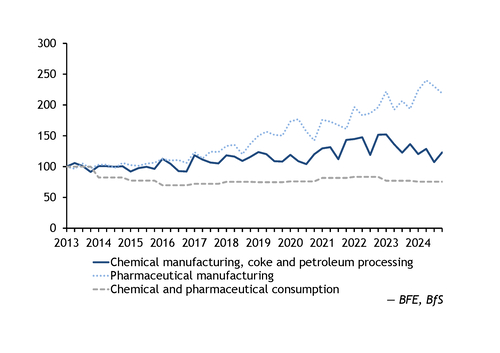
Demand from the two sectors rose by almost 20pc over 2016-22, before falling by around 10pc in 2022-24, according to the latest data from Swiss energy office BFE. Rising electrification and increasing energy efficiency have "shaped" the sectors' demand over the past 10 years, Bozzi said.
Power prices big issue for chemicals
But there is an "acute" danger that high power prices will cause chemicals production to relocate abroad, in particular to the US and China, the association's deputy director and energy head, Michael Matthes, said. Power prices play a less decisive role in overall production costs for pharmaceuticals.
Power prices in Switzerland have fallen significantly since the energy crisis of 2022, but industry is still feeling its impact, most notably in the increase in the country's power reserve tariff, Matthes said. This was introduced in 2024 to finance Switzerland's winter energy reserve and protect against power shortages. It equates to an additional 0.01 Swiss francs/kWh (1.3¢/kWh) in grid costs, or SFr3mn/yr (€3.25mn/yr) for a company with 300 GWh/yr of power consumption, Bozzi said.
A successful power agreement with the EU could stabilise prices by improving market integration, increasing grid efficiency and opening up access to a broader range of grid reserve capacities, she said. The agreement was signed and submitted to parliament last month, but will likely go to a public referendum if passed.
But geopolitical tensions in the Middle East are adding uncertainty to global energy markets, which "reinforces" existing challenges for the chemical and pharmaceutical industry, including "persistently elevated energy costs" and uncertainty surrounding long-term investment and location choices, Bozzi and Matthes said.
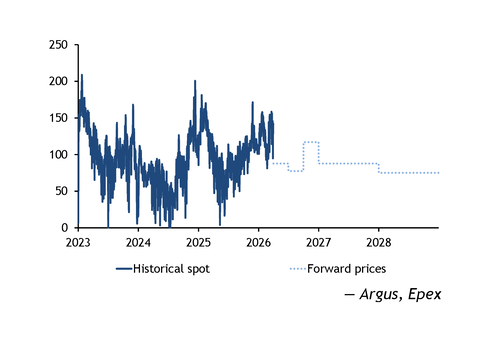
Swiss spot prices averaged €95.95/MWh over 2023-25, but jumped to around €120/MWh following the start of the Iran war — the highest for the period since 2022. Prices for 2027 have risen by around 11.5pc since 27 February — the last session before the outbreak of the conflict — but remain around €12/MWh above 2028 prices. And 2028 prices are around €5/MWh above recent trades for 2029, according to the latest assessment. This backwardation in the forward years reflects expectations of growing renewable energy capacity and increased LNG supply availability in the coming years.
The median final power price for businesses decreased over 2024-26, according to federal power regulator Elcom, and transmission system operator Swissgrid tariffs will fall on the year in 2027, owing partially to a reduction in the power reserve tariff. But the tariff for solidarity-based costs — covering grid enhancements, among other things — will rise next year, and Swissgrid expects the power reserve tariff to increase in future years because of the country's new reserve power plants set to be commissioned over 2027-30.
Peak shaving not on the cards, but storage possible
Large-scale chemicals production cannot be shifted to nighttime or weekends, Matthes said. Sites tend to either run at full capacity or not at all, some for 48 weeks a year, and only smaller companies have processes where shifting production in time is possible.
Halting production would destroy the micro-organisms and bioactive substances involved in biotechnological process, and any subsequent restart could take weeks and incur enormous costs, Bozzi explained.
Nevertheless, storage solutions such as power-to-chemicals — synthetic methane or methanol, for example — could help increase system flexibility in the longer term by allowing electricity storage in chemical form, she said.
Empty threats?
Power prices are a structural "push factor" and play a key role in long-term location decisions. But threats of punitive export tariffs from the US add an "additional source of uncertainty", Matthes said.
The US was the largest single destination of Scienceindustries member company exports last year, accounting for SFr36.7bn (€39.8bn) of exports.
US tariff threats will not lead to an overnight shutdown of Swiss production, but will harm the investment climate and could accelerate relocation trends that would have happened anyway, Matthes said.
Chemicals sector production, indexed to 2021, was largely flat over 2004-24, the latest data from federal statistical office BfS show. Pharmaceuticals sector production rose sharply over this time, peaking in the first quarter of 2025 (see chart).
Some companies have announced long-term investment plans and are committed to remaining in Switzerland. The US labour market also faces constraints and finding the skilled personnel for production processes could be "challenging", Matthes said.
Technological developments trump Trump
Technological developments point to a "slight upward trend" in future industrial power demand, Bozzi and Matthes said.
The "next steps" for the chemical and pharmaceutical industry involve the electrification of processes, Bozzi said. Switzerland's focus on new and highly energy-intensive carbon capture technologies will add further strain to power demand.
In a worst-case scenario, production could move away from Switzerland, but this "disruptive" factor is something that cannot be assessed yet, Matthes said. Technological developments will produce a "larger, more dominant effect" that would lead to a slight increase in power demand, he said.