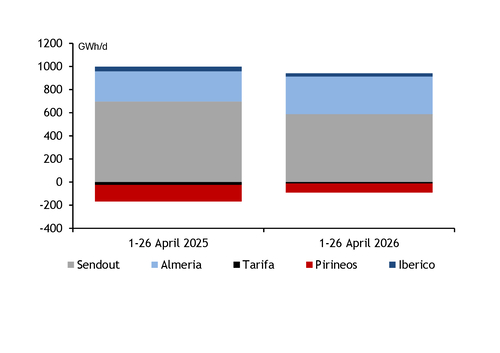
Spanish firms have increased pipeline gas imports to reduce dependence on LNG in response to the nearly two-month effective closure of the strait of Hormuz, helping the wider region to balance.
Pipeline gas more than doubled its share of Spain's gas supply to 33pc on 1-26 April, from 15pc a year earlier. Net pipeline imports to Spain climbed to 259 GWh/d from 133 GWh/d, offsetting a drop in LNG sendout to 588 GWh/d from 697 GWh/d. LNG's share of the total had reached 90pc on some days in April 2025.
It has been more than eight weeks since the effective closure of the strait of Hormuz blocked a fifth of the world's LNG supply. The loss of Qatari and UAE cargoes and stronger competition from Asian buyers for Atlantic-basin supply have slowed down Europe's LNG imports.
Spain has ramped up pipeline gas imports at the expense of LNG, which has helped the wider region to balance. Spanish LNG receipts slowed to 13.5TWh on 1-26 April, from 22.4TWh a year earlier, according to data from Spanish system operator Enagas. This slowdown was roughly similar to the outright drop in Europe's LNG imports over that period, judging by Kpler ship tracking data.
The PVB front month averaged a €0.47/MWh discount to the Belgian ZTP, a €0.70/MWh discount to the UK's NBP and was flat to the French Peg in March, reducing the attractiveness of Spanish LNG terminals relative to markets in northwest Europe.
Firms have instead ramped up pipeline imports from Algeria. Deliveries to Almeria through the Medgaz pipeline averaged 325 GWh/d on 1-26 April, close to the pipeline's nameplate technical capacity of 337 GWh/d. This represents a jump from 261 GWh/d a year earlier.
And gas exiting the Spanish grid to Morocco edged down to 12 GWh/d from 25 GWh/d, further boosting net imports from north Africa. No maintenance has been reported, suggesting that the reduction in flows is market-driven. Coal is still dominant in Morocco's power mix, leaving potential for fuel switching away from gas in response to higher global gas prices.
Outflows to France through the Pirineos interconnection point have also fallen on the year, which has helped to retain more gas in the Spanish grid. Net northbound exports have averaged 78 GWh/d so far in April, just over half of the 143 GWh/d a year earlier.
May outlook
Spain may be more heavily reliant on pipeline gas imports into May, given that the global LNG balance is poised to remain tight.
The effective closure of the strait of Hormuz will limit global LNG supply into May. While a loaded LNG carrier has now passed through the strait of Hormuz — the 137,000m³ Mubaraz carrying a UAE cargo — the vessel is much older than the remaining carriers trapped west of Hormuz, and the greater value may make operators less likely to risk damage by attempting the journey.
Market participants now also consider the arbitrage between the Atlantic and Pacific basins for uncommitted Atlantic-basin loadings open, which may draw cargoes away from Europe. Pakistan entered the spot LNG market last week and may issue more tenders to replace lost Qatari cargoes under term contracts.
That said, total Spanish demand typically ticks down from April to May, which could reduce overall import needs. The five-year average for aggregate demand in April is 848 GWh/d, compared with 801 GWh/d for May.
But gas demand can still climb in spring if cooling demand is high or low renewables generation requires firms to ramp up output from combined-cycle gas turbines. And maximum temperatures in Madrid were forecast today to hover around 28°C — or 3°C above seasonal norms — next month, which suggests cooling demand could lift gas use in the power sector. Similarly, daily highs were projected at 26°C and 25°C in Ourense and Zamora, respectively, which equates to 1°C and 2°C above the long-term averages for those cities.