The UK will not ring-fence any of the 230,000 t/yr of capacity in the first round of its sustainable aviation fuel (SAF) revenue certainty mechanism (RCM) for e-SAF made from electrolytic hydrogen, leaving developers to compete head-on with cheaper bio-based routes.
The department for transport (DfT), in its subsidy contract allocation strategy, said the first round will focus on "deliverability" and "value for money", rejecting industry calls for a carve-out for power-to-liquid (PtL) e-SAF.
This means e-SAF developers will bid into the same pot as other "advanced" biogenic pathways. Some e-SAF plants could compete on this basis, DfT said.
DfT will revisit ring-fenced support in a second round, due about a year after it awards first-round contracts from the fourth quarter of 2028.
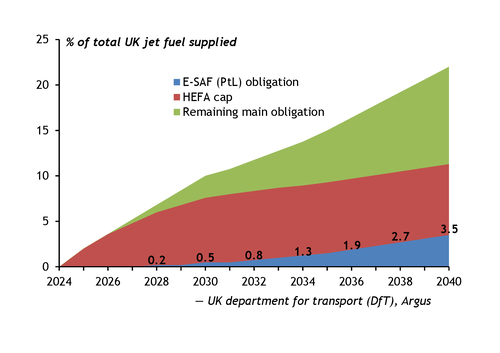
Respondents to an earlier consultation had warned that scoring bids on a normalised strike price would in effect exclude e-SAF from awards, undermining the sector's ability to meet the SAF mandate's PtL quota (see chart).
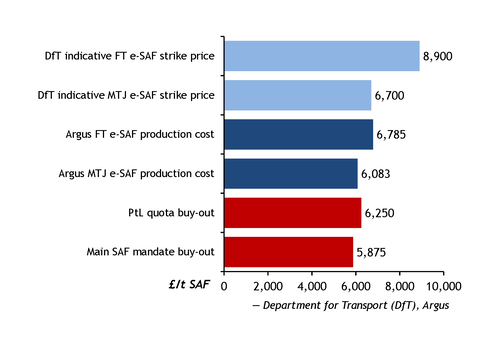
DfT will not award contracts to projects where the strike price exceeds the mandate's "maximum cost of compliance", referring to the PtL buy-out price of £6,250/t ($8,359/t). Argus assesses e-SAF production costs at about £6,100/t for methanol-to-jet (MTJ) and £6,800/t for Fischer-Tropsch (FT) routes, including capital expenditure. Costs at or above the threshold, before any developer margin, imply e-SAF will struggle to compete.
DfT's indicative modelling of the scheme assumes strike prices of £6,700/t and £8,900/t for the MTJ and FT routes (see chart).
DfT may pick "lower-scoring" projects to correct "portfolio imbalances" across technology, feedstock, timing, size and location. It said e-SAF feedstocks such as renewable hydrogen or e-methanol may be imported, noting costs are highest for plants using purely domestic supply. But that could also discourage UK renewable hydrogen output and favour plants using imported e-methanol and biomethanol, such as EET's planned Stanlow SAF project.
A single strike price could leave hybrid plants short of revenue if they lean on costlier e-methanol, or in surplus if they use less. DfT is weighing multiple strike prices and caps on fuel-type ratios and will set out its approach in the application guidance.
The strategy is "extremely disappointing", said lobbyist Transport and Environment's UK aviation and shipping policy manager Tom Taylor. He said e-SAF risks being priced out of early contracts, and awarding contracts only after the PtL quota starts leaves less time to commission plants and meet targets.
But PtL remains "important" for UK aviation decarbonisation, the DfT said, pointing to the PtL quota and around half of the £63mn Advanced Fuels Fund allocated for e-SAF projects.