India's coal-fired generation is on course for a record July because a weak monsoon has boosted power demand, but this has not significantly supported demand for seaborne coal because the country holds ample domestic supplies.
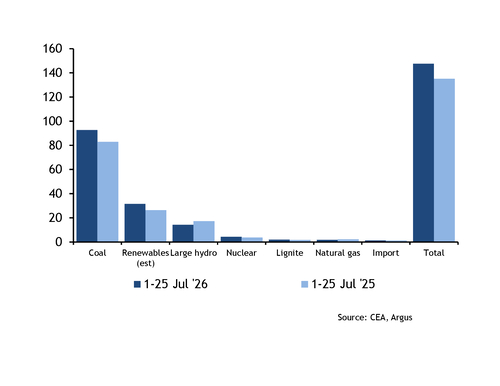
Coal-fired generation reached 92.6TWh over 1-25 July, up by 12pc from 82.81TWh a year earlier, according to Central Electricity Authority (CEA) data, putting July on track to hit all-time high provided subdued seasonal rains continue to keep power demand elevated. The previous July record of 105.84TWh was set in 2024. The uptick in coal-power output in July, supported by a weak monsoon, elevated temperatures and increased cooling-demand, followed a trend in April-June, with peak demand hitting a record 270.82GW on 21 May.
But the stronger coal burn has not translated into higher seaborne coal demand. Thermal coal imports have remained well below year-earlier levels, according to Kpler, because utilities have drawn on ample stocks and domestic supplies were supported by mine-head inventories accumulated over the previous fiscal year. India's thermal coal imports are estimated at 11.3mn t so far in July, down from 12.02mn t a year earlier, Kpler data show. Imports fell by 15pc on the year to 74.5mn t in January-June, according to data from shipbroker Interocean.
The weak buying interest from the world's second-largest coal importer is adding pressure to a seaborne market already weighed down by weak Chinese demand, leaving suppliers competing for a shrinking pool of buyers and weighing on seaborne coal prices. The Argus-assessed GAR 4,200 kcal/kg coal market has remained under pressure since mid-June, when prices hit a three-year high.
The sluggish prices prompted some buyers to seek competitively priced cargoes. There has been an uptick in post-monsoon enquiries, and some Indian traders bought cargoes from Chinese traders at price points they considered lucrative. But other Indian traders are now pencilling in a slower-than-anticipated demand recovery and are offering cargoes to non-India markets, a Singapore-based trader said, pointing to weak interest in seaborne coal especially from utilities — the largest coal consumer in India. An uptick in freight rates due to escalations in the Middle East conflict has also weighed on demand for imported coal.
Domestic supply to utilities remained strong despite lower production, reflecting the drawdown largely from inventories at power plants and mine pitheads.
Coal production fell by 5.9pc on the year to 232.49mn t in April-June, largely because of lower output from state-controlled Coal India (CIL), which meets nearly 80pc of India's demand. Combined dispatches to the power sector from CIL, Singareni Collieries (SCCL), and captive and commercial producers rose by 4.6pc on the year to 70.92mn t in June, with most producers trimming their stocks.
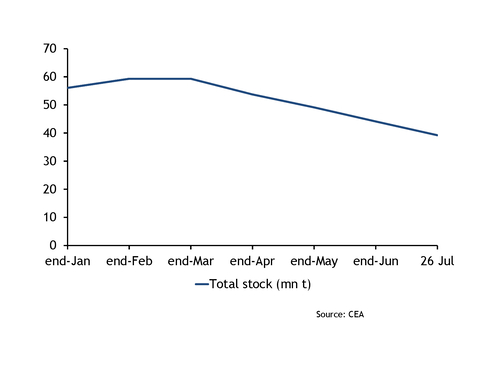
CIL began the fiscal year on 1 April with around 130mn t of pithead stocks and liquidated 28.3mn t in April-June, leaving just over 100mn t at pitheads by the end of the quarter. Combined inventories at power plants stood at 39.22mn t as of 26 July, down by 28pc on the year and equivalent to about 13 days of consumption, according to CEA data. The stocks are down from about 55mn t a year earlier and from 44.11mn t by end of June, indicating steady drawdown to meet utility demand. Inventories at 29 of 190 monitored plants hold critical stock levels compared with 14 a year earlier.
Authorities are actively monitoring the stock drawdown, anticipating that the erratic monsoon would lead to higher load on coal-fired power plants to meet bulk of the demand. A government directive to all utilities to raise imports to support higher generation looks unlikely, unless the combined stocks fall be 30mn t, an official at a utility said. The government had earlier this year ordered Tata Power to boost generation at its Mundra 4GW plant, although bulk of the capacity of the plant is underutilised even during the peak summer period, according to a market participant. This points to evolving power mix that has helped to partly meet the peak power demand.
Grid-scale generation excluding renewables rose by 6.8pc on the year to 116.04TWh over 1-25 July, according to CEA data. Large hydropower output fell by 18pc to 14.15TWh because below-normal rainfall curtailed reservoir inflows. Renewable generation, which is excluded from the CEA data, is estimated to have reached around 31TWh in the period, up from about 26TWh a year earlier. Solar power output has helped to meet day-time peak power demand, easing some pressure on the coal-powered fleet. But coal remained a swing fuel since solar output fades in the evening. Rating agency ICRA expects power demand growth of around 5pc in 2026-27 financial year ending in March 2027, although the outlook remains exposed to weather conditions, said its vice president Ankit Jain.
Weather conditions
Cumulative rainfall was about 15pc below normal on 1 June-25 July, while June rainfall was 39pc below the long-period average, according to the India Meteorological Department (IMD). Levels in India's 166 major water reservoirs stood at 38.4pc of capacity as of 23 July — about 36pc below a year earlier — according to Central Water Commission data.
But extreme weather is expected in the wider region with the onset of El Nino weather phenomenon. The IMD has warned of extremely heavy rainfall over coal-bearing states in central and east India this week, threatening opencast mining.
Erratic rainfall is adding uncertainty to power demand and coal consumption forecasts.
It is difficult for traders to assess demand outlook and execute deals in such an environment, an India-based trader said.