US oil refineries are focusing the highest run rates in 22 years on diesel production as two wars increase overseas demand, a move that has tightened domestic supplies of gasoline and aromatic blending components.
Prices for aromatics blended into gasoline stand at multi-year highs, with the ethylbenzene (EB) assessment reaching levels reaching a record-high of 503¢/USG on 8 September. EB feedstock benzene and toluene and xylenes prices all reached four-year highs in September. Benzene peaked at 547¢/USG on 15 September and toluene and xylenes both peaked at 564¢/USG on 16 September, Argus data show.
The rise in aromatics prices has been driven by increased blending of low-octane, light-naphtha into US gasoline supplies, as blending naphtha boosts demand for high-octane aromatic blendstocks to raise gasoline's octane rating to retail specifications.
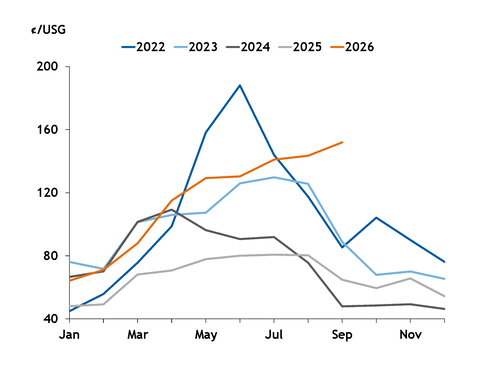
Naphtha blending demand is rising because of high gasoline prices that have increased gasoline's premium to naphtha, known as the naphtha-gasoline spread, into September, bucking seasonal trends. The spread normally narrows after peak high-octane blending demand in June (see chart). But the naphtha-gasoline spread widened to 157¢/USG in September, up by 22¢/USG from June, Argus data show.
The unseasonably wide naphtha-gasoline spread can be traced to higher gasoline prices, rather than a particularly weak naphtha market that caused supply builds in prior years. The naphtha-gasoline spread stands above levels seen during the fall of 2022 and 2023, when falling naphtha exports boosted US supplies. Naphtha exports in 2022 and 2023 were 258,000 b/d and 281,000 b/d, respectively, while naphtha exports so far this year have averaged 402,000 b/d.
Also contributing to this year's unseasonably high prices for aromatics blendstocks toluene, xylenes and EB are plant turnarounds at two aromatics producers in September and October that have tightened supplies further.
The US has also received fewer aromatics imports than in the past four years because of feedstock supply issues in Asia-Pacific that have capped refinery run rates in the region. That has forced Asian petrochemical producers to prioritize supplying their regional trading partners, even with open arbitrage opportunities to the US in spite of import tariffs.
Focus on diesel
Aromatics demand for gasoline blending has also been supported by US refiners' decision to prioritize diesel production, tightening supplies of gasoline and blending components. With the harvest season boosting domestic diesel demand and wars in Ukraine and the Mideast Gulf creating supply constraints that have boosted export demand, the Nymex ultra-low sulfur diesel (ULSD) contract settled at a record high this week.
Refiners' focus on diesel at the expense of gasoline has outweighed the seasonal shift to winter-grade gasoline, which this year was allowed to begin on 1 September, two weeks earlier than usual. The shift to winter specifications permits lower cost, higher-vapor pressure blendstocks like butane to enter the gasoline blend pool, which typically reduces demand for aromatic blendstocks.
Gasoline prices also remain unseasonably high. Conventional 87-grade gasoline prices stand $1.68/USG higher than year-earlier levels and $0.97/USG higher than the five-year rolling average for the month of September, Argus data show.
Meanwhile, premium 93-grade gasoline prices, which include additional high-octane blendstocks, stand $1.83/USG higher than a year earlier and $0.98/USG higher than the five-year rolling average for September.
Higher gasoline prices stem from the overseas conflicts that have reduced inventories and increased global crude prices. Gasoline inventories totaled 207.7mn bl and motor gasoline blending components totaled 193.1mn bl in the week ended 11 September, down from a year earlier by 9.9mn bl and 9.6mn bl, respectively, according to US Energy Information Administration (EIA) data. Inventories of gasoline and blendstocks are poised to tighten further, pushing prices higher, as refiners prioritizing diesel production.
Meanwhile, crude prices have surged since the start of the US-Iran war, with WTI Houston crude closing at $107.78/bl on 15 September and crude prices peaking this year on 6 April at $119.66/bl, Argus data show.
Refinery rates at 22-year highs
US refiners are running all out to capture record high margins, particularly for diesel. Refinery operating rates have averaged 97.3pc so far in September, the highest average monthly rate since June 2004 and well above the roughly 90-95pc range of recent years, EIA data show.
As US refinery run rates increase, so has diesel output. ULSD production last week was up by 7.7pc from a year earlier at 5.04mn b/d, according to EIA data. In August, ULSD production rose to 5.01mn b/d, the highest output since December 2025.
US diesel production has climbed since the beginning of the Mideast Gulf war to help meet European demand for fuels typically sourced from the Middle East and Russia. US Gulf coast ULSD exports to Europe climbed to 590,000 b/d in the week ended 11 September, up by 490,000 b/d from the prior week, according to Vortexa vessel-tracking data, and the highest exports to the continent in Vortexa records dating to January 2016.
Record high US diesel exports have contributed to a draw down in inventories, which totaled 107.9mn bl in the week ended 11 September, down by 16.8mn bl from the year prior. US refiners in September usually build diesel stocks ahead of seasonal turnarounds, when they shift away from maximum diesel yields. If diesel inventories remain low in October, gasoline and aromatic blendstock prices could gain further support.
With tight diesel and gasoline inventories and aromatic chemical prices near multi-year highs, the market has little room for disruption. Any major refinery outage or major Gulf coast storm could quickly drive fuel and aromatic petrochemical prices higher.