Mexico plans to nearly double its solar and wind power capacity to about 7.1GW by 2030, according to state utility CFE's sustainability plan, though it will still likely trail regional peers.
The targeted asset push expands CFE's wind and solar footprint by 92pc against its combined wind and solar generation capacity baseline at the end of 2025, but dominant natural gas-fired generation is set to surge as well.
Mexico's regulatory framework seeks to pivot from higher-emission fuels by targeting 15.2GW of total new clean energy capacity additions by 2030.
This buildout ensures that clean energy accounts for 40pc of the total 38GW in new generation capacity slated to come on line under the current administration, according to the sustainability plan.
Utility-scale solar and wind installations anchor the expansion. CFE's five-year development portfolio features nine solar plants totaling 4.67GW and seven wind farms totaling 2.47GW.
The state also holds a 9.1GW pool of unallocated capacity under the plan. This includes 4.5GW of solar, 2.2GW of wind, 1.7GW of cogeneration and 0.8GW split across geothermal, solar thermal and hydrogen technologies.
Despite the multi-GW solar and wind additions, total generation from all renewable and clean sources will grow by only 9pc by 2030 from a 2025 baseline, according to the sustainability plan.
Slowing the curve
This low growth rate reflects near-term fiscal tightening. The proposed federal budget places an inflation-adjusted 8.5pc cut on CFE's physical investment cap, Mexican public policy think tank (IMCO) said in an analysis.
The federal proposal restricts CFE's direct physical investment budget to Ps61bn ($3.05bn), forcing the utility to shift approximately 55pc of its generation and grid capital expenditures to private-sector financing mechanisms.
To preserve the required 54:46 public-private equity split, CFE will rely on $16.7bn in mixed-participation contracts with the private sector to shoulder utility-scale renewable deployment outside the federal budget.
This reliance on complex financing structures slows the deployment curve of renewable energy. Gross clean energy output is projected to rise to 40.3TWh next year from 39.9TWh this year, according to the sustainability plan.
Output will then climb to 44.5TWh two years later and peak at 46.6TWh in three years before dropping to 46.2TWh at the end of the decade, according to CFE's five-year plan.
The state utility projects the drop-off will even out as construction delays push commercial start dates for a portion of the asset pool beyond 2030. The data baseline does not account for future tenders.
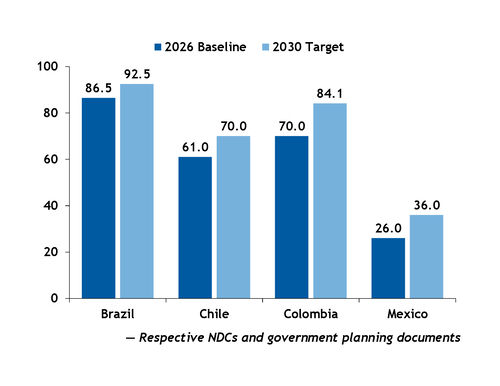
But resulting lag widens the gap against regional peers chasing green manufacturing capital. Mexico targets a 36pc clean energy share in its total power matrix by 2030, according to the five-year plan.
In contrast, Brazil already operates an electricity matrix that is 86.5pc from renewable energies today, while Colombia sits at 70pc, both replete with massive hydropower capacity, respective government plans show. Chile's is at 61pc, about split between hydropower and variable renewable energy.
But by 2030, frameworks may have pushed Brazil to 92.5pc, Colombia to 84.1pc and Chile to 80pc cleaner power.
Gas-fired generation endures
To support this transition, state-owned Pemex is also coordinating with CFE to switch traditional thermal generation to natural gas-fired combined cycle technology from petroleum.
This includes at CFE's Tula power plant, a major pollution contributor for nearby Mexico City, and its Salamanca, Altamira and Mazatlan plants.
While traditional coal and fuel oil are scaled back, the net surge in natural gas generation outpaces the 15.2GW clean energy additions.
Under the sustainability plan, combined-cycle gas turbine generation surges by 72pc over its 2025 baseline by 2030, representing 115.08 TWh of output. Clean energy generation rises only 9pc/yr, demonstrating that the grid remains structurally anchored to gas infrastructure.