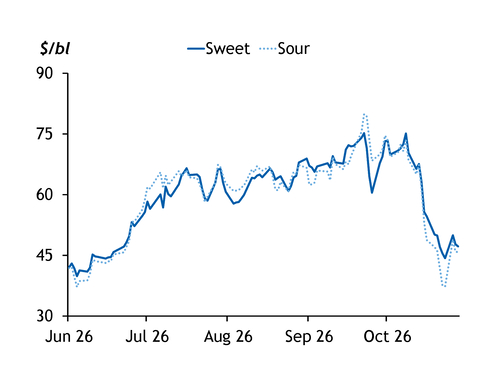
US independent refiners ran refineries at near capacity and margins tripled in the third quarter, as they reaped the benefits from war-related supply disruptions.
Refinery crack spreads have eased in recent weeks, but refiners expect the respite to be temporary as high global freight rates exacerbate steep heavy crude discounts, pressuring crude prices relative to products.
Some of the downward pressure on margins is really related to headlines around strategic reserve releases and easing sanctions on Russia, among others, Valero chief operating officer Gary Simmons says, but he suggests that supply remains tight. "When you digest the data and you look at how much volume is actually coming out, and then lifting of sanctions is more just a change in trade flows, I think we'll see a recovery in cracks moving forward," he says.
Phillips 66 expects high refining margins to continue for most of next year on lingering global supply shortages as well as higher freight rates, executive vice-president of marketing and commercial Brian Mandell says.
Freight rates should be stronger in the fourth quarter than in the third, with the very large crude carrier market tight and some products vessels being used for crude, he says. At the same time, US gasoline demand has declined by about 2.5pc and diesel demand by about 1.5pc, but this is not enough to balance the market, Mandell says.
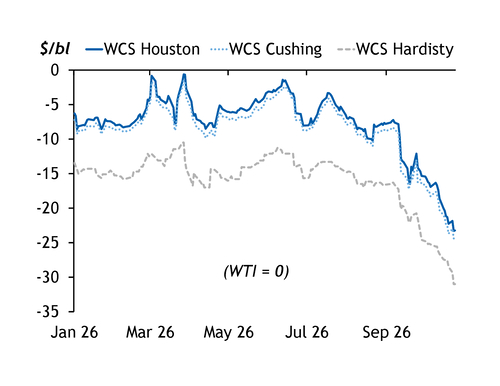
High global freight rates combined with more Venezuelan crude reaching the US Gulf coast market are weighing on Canadian heavy sour grade WCS. Canadian output is also outpacing the capacity of pipelines to carry it to market, further pressuring heavy crude prices, US independent refiner HF Sinclair says.
Current WCS discounts of $25-30/bl to the WTI benchmark should eventually moderate while remaining wider than average "at least through 2027", HF Sinclair chief operating officer Steven Ledbetter says.
Phillips 66 ran its refineries at 98pc of capacity in the third quarter, with distillate yields at 41pc, a record quarterly high. The refiner plans to keep runs high in the mid-90pc range across its system in the fourth quarter. Phillips 66 reported refining margins of $38/bl in the third quarter, more than three times higher than a year earlier. Valero also ran at near-record rates in the third quarter and its margins nearly tripled on the year to $39.24/bl.
Light and shade
Valero does not plan to restart its idled 145,000 b/d Benicia refinery in California despite new White House plans for recently closed facilities to reopen, the company says. The refinery has been idled since April and there are no plans for it to resume operations, Valero general counsel Rich Walsh says. "It's just a tough environment to operate in the west coast and we don't see the potential for that," Walsh says. But Valero has agreed to buy an idled refinery in Houston, Texas, from LyondellBasell and restart production by the end of 2027. The US administration is looking for opportunities to help reopen and expand refineries in an effort to reduce diesel and gasoline prices. But any refinery restart would take a while, making it "very difficult for them to help the prompt situation", Valero chief executive Lane Riggs says. The idea "that you can just sort of walk in and flip the lights" and a refinery starts running is not exactly the case, he says.
Refiners are also sceptical that Russian diesel will help ease prices in the near term. Trump on 9 October said he had reached a deal with Russian president Vladimir Putin for some exports of Russian diesel to resume to the US and global markets. "We don't think that Russia has enough distillate to make much of a difference," Mandell says.