

Golden Triangle cracker defied uncertainty, set to start up
How the Golden Triangle Polymers cracker overcame pandemic delays, inflation and global market shifts to reach startup on the US Gulf coast.
Author

Michael Carmada
At a glance
- The first new US Gulf Coast ethane cracker in more than four years is preparing for startup, marking a major milestone for the North American petrochemical industry.
- Despite pandemic disruptions, inflation, trade uncertainty, and global oversupply concerns, the $8.5 billion Golden Triangle Polymers project pushed ahead when others paused.
- Backed by Chevron Phillips Chemical and QatarEnergy, the world-scale facility will add 2.08 million tonnes/year of ethylene capacity and 2 million tonnes/year of polyethylene production.
- The project reflects continued confidence in the long-term competitiveness of US ethane-based production and export markets.
- As global petrochemical markets adapt to shifting trade flows and geopolitical volatility, Golden Triangle's startup could help shape the industry's next chapter.
The US Gulf coast is set to see its first ethane cracker startup in over four years. Back in the late 2010s, Gulf coast cracker startups seemed almost like an everyday occurrence. But since 2020, a pandemic, a Chinese buildout that surpassed the US in capacity, trade wars and even hot wars have all added enough to the mix of uncertainty to bring the US’s buildout to a halt. So why, at the end of this year, will the US be adding a cracker and new polyethylene for export? The US Gulf coast’s first cracker startup in four years is itself a story of navigating all the market volatility that has characterized the 2020s and taking a risk, despite it all.
Back in the depths of the Covid-19 pandemic July 2020, Chevron Phillips Chemical delayed its plan from 2019 to build a new cracker on the US Gulf coast. “In light of uncertainty created in the wake of the COVID-19 pandemic, our company intends to defer a final investment decision while it revisits market conditions and project fundamentals,” the company said. “As with other capital-intensive activities, we are closely monitoring economic developments and moderating timing to preserve optionality on this project.”
Just two years earlier in 2018, the company had added a new world-scale ethane cracker in Cedar Bayou, Texas with a baseline capacity of 1.5mn metric tonnes (t)/yr which, through optimized engineering, was able to expand to 1.725mn t/yr of ethylene capacity. Another massive capacity addition, just as a brave new world of lockdowns and unprecedented disruption to life on this planet seemed far from ideal timing to announce a new multibillion dollar build.
Those companies whose crackers were still under construction when the pandemic hit would go on to finish them. But the pandemic caused many to pull back on possible announcements. By 2022, the US ethylene market had ended its major, multi-year cracker expansion wave that had begun in the late 2010s. At the start of 2022, the US Gulf coast saw the startup of Exxon-Sabic’s 1.8mn metric tonne (t)/yr ethane cracker near Corpus Christi, Texas. By mid-year 2022, Total-Borealis’ “Baystar” 1mn t/yr cracker in Port Arthur, Texas, began production. And on November 15, Shell started up 1.6mn t/yr ethane cracker in distant Monaca, Pennsylvania—ending the multi-year wave of new crackers in the US.
But literally the next day, Chevron Phillips Chemical (CP Chem) took a final investment decision on a new 2.08mn t/yr cracker in Orange, Texas, with two derivative 1mn t/yr high density polyethylene units set to export pellets to the world. The announcement of the Golden Triangle Polymers came in the form of a joint venture with QatarEnergy, much like ExxonMobil’s JV cracker with Sabic. It would be another pairing of and American major with a Middle Eastern state oil company for a world scale cracker with integrated derivative units.
Four years later, that cracker is now on the verge of starting up. On September 22, the Golden Triangle Polymers announced it was undertaking activities to prepare the $8.5bn facility for completion. By the last week of September, thermal cameras were showing heat for the cracker, with test runs already starting, market participants told Argus. From all indications, the cracker is set to start up by late December or early January, with market sources close to the unit indicating the unit could even be slightly ahead of its current schedule.
What caused CP Chem to go ahead with their new cracker while several other projects delayed by the pandemic have yet to receive a final investment decision? It was the same bet on structurally inexpensive US ethane that had driven the earlier wave of crackers, but this time with a company that felt equipped to take on additional risks that were emerging in the 2020s.
An even greater risk was China’s massive buildout of crackers and polyethylene units in the 2020s. This began to take its toll on global polyethylene margins. In Europe and Asia ex-China, shutdowns and rationalization have increased. While it may seem like a different era, just at the start of 2026, LyondellBasell was lamenting the collapse of even its otherwise cost-advantaged North American integrated-PE margins, which averaged $580/t in 2025, $250/t below the historical average of $830/t. Into this environment, the Golden Triangle Project seemed to be entering at the start of the year.
The global petrochemical industry has yet to emerge from its trough and may just be in a new normal and not fully realize it. And for the Golden Triangle Polymers, underlying capital recovery questions will linger for some time, but the project will be starting up in a more advantaged global environment than it did a year ago.
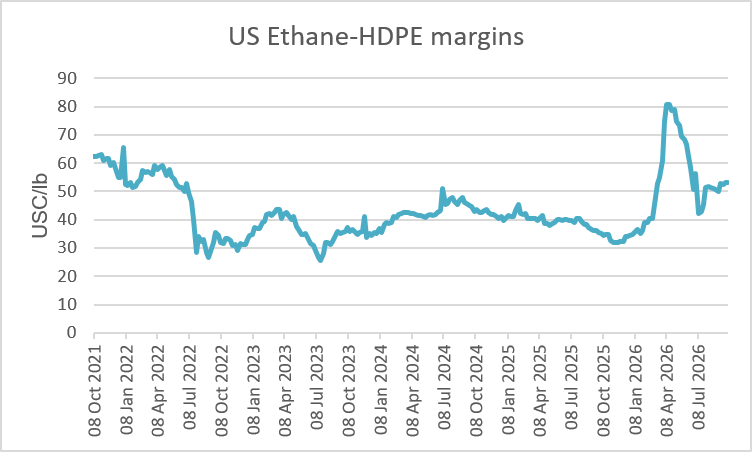
Source: ArgusMedia
At a glance
- The first new US Gulf Coast ethane cracker in more than four years is preparing for startup, marking a major milestone for the North American petrochemical industry.
- Despite pandemic disruptions, inflation, trade uncertainty, and global oversupply concerns, the $8.5 billion Golden Triangle Polymers project pushed ahead when others paused.
- Backed by Chevron Phillips Chemical and QatarEnergy, the world-scale facility will add 2.08 million tonnes/year of ethylene capacity and 2 million tonnes/year of polyethylene production.
- The project reflects continued confidence in the long-term competitiveness of US ethane-based production and export markets.
- As global petrochemical markets adapt to shifting trade flows and geopolitical volatility, Golden Triangle's startup could help shape the industry's next chapter.


