

Urea Market Outlook: Middle East Supply Disruptions
Middle East tensions disrupt urea exports, lifting prices as Brazil, India and Europe face supply challenges. See how trade flows and affordability are shifting.
Author
Global urea supply remains volatile following disruptions in the Middle East, tightening availability and lifting prices across key markets. Brazil, India and Europe still face significant procurement needs, while China’s export policy adds uncertainty to the outlook. In the Black Sea region, logistical challenges and shifting trade flows highlight the complexity facing buyers. For agriculture, affordability and timing have become pivotal as growers balance fertiliser costs against rising crop values.
Middle East conflict disrupts urea trade flows
The global fertiliser market remains volatile as the conflict in the Middle East disrupts urea export flows. The region supplies about 20mn t/yr of urea, close to a third of global exports, making it critical for agriculture and fertiliser supply chains.
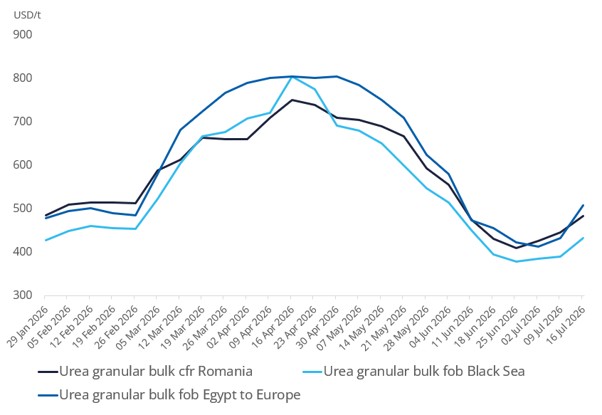
The effective closure of the strait of Hormuz has left more than 800,000t of urea stranded in the Mideast Gulf. Outages at plants, particularly in Iran, reduced supply further during March and had pushed prices to nearly $780/t fob by mid-April, creating affordability challenges for key importing regions.
Urea price volatility and affordability challenges
Prices surged to unaffordable levels, and demand collapsed through May and June. Expectations of China’s return to the export market then pushed values below pre-war levels — to around $330/t fob. But renewed US-Iran hostilities are supporting prices again as buyers resume enquiries for cargoes from Egypt and Africa.
Prices should stay supported while Middle East exports remain restricted. Brazil, Europe, the US and India still have significant procurement ahead, which could underpin firmness through the third quarter. China is the key swing factor, as the country opened its export window in June with potential shipments of up to 2.6mn t, so supplies should be sufficient to meet Brazil’s seasonal demand in the third quarter, and buying west of Suez into the fourth quarter.
Fertiliser affordability remains critical for growers and distributors. Argus tracks this through its Global Fertiliser Affordability Index, which compares fertiliser prices with major grain benchmarks, including wheat, maize, soybean and rice. An index level below one signals affordability stress, an important indicator for agricultural producers planning application strategies.
Black Sea urea market: Active trade, rising risk
In the Black Sea region, urea trading has been active but cautious. Deals included cargoes into Turkey at $405/t fob and Romania at $440-445/t, while higher offers at Georgia’s Batumi near $475/t drew no interest. Azerbaijan’s Socar recently closed a tender with bids at approximately $500/t, below seller expectations.
Tensions in the Black Sea are adding significant logistical risk. Incidents at Ukrainian ports — including Pivdenny, Odesa and Chornomorsk — have resulted in damage to vessels carrying grain and fertiliser. While ports officially remain open, higher freight premiums and renegotiated contracts are introducing additional costs and uncertainty for importers and downstream buyers.
Australia buoys urea supply through diversification
Australia, meanwhile, has stabilised its urea supply after second-quarter shortages caused by the US-Iran conflict. Increased volumes from southeast Asia and the first Nigerian cargoes have boosted availability. The government has authorised credit agency Export Finance Australia to underwrite imports of key commodities, securing 340,000t of additional urea for leading distributors CSBP, Incitec Pivot and Summit. More than 380,000t is currently in transit, including shipments successfully routed through the strait of Hormuz in late June.
Impact on agriculture and fertiliser buyers
For farmers and agricultural buyers, nitrogen costs remain closely tied to crop economics. Recent gains in wheat prices could offset some of the impact of higher urea prices, supporting investment in fertiliser ahead of the next planting cycle. Procurement timing and exposure to freight risks have become critical considerations as global supply chains adjust to geopolitical uncertainties.
The outlook for the global fertiliser market will hinge on a resolution to the Middle East crisis and any further changes in China’s fertiliser export policy. Both factors could shift price trajectories rapidly in the months ahead.
Global urea supply remains volatile following disruptions in the Middle East, tightening availability and lifting prices across key markets. Brazil, India and Europe still face significant procurement needs, while China’s export policy adds uncertainty to the outlook. In the Black Sea region, logistical challenges and shifting trade flows highlight the complexity facing buyers. For agriculture, affordability and timing have become pivotal as growers balance fertiliser costs against rising crop values.


