
Argus Battery Materials
Independent price assessments, forecasts and market intelligence across global battery materials markets, from lithium and cobalt to graphite and nickel.
Overview
Argus Battery Materials is a price reporting and intelligence service that delivers over 200 independent price assessments, 10-year supply, demand and price forecasts, and expert market analysis across the global battery materials supply chain. The service covers lithium, cobalt, nickel, graphite, manganese and other materials critical to battery and electric vehicle production, published daily, weekly and monthly.
At a glance
- Over 200 price assessments from mine to battery.
- Covers lithium, cobalt, nickel, graphite and more.
- Identifies price trends with 10-year forecasts.
- Supports supply chain planning and procurement.
- Black mass calculator and project trackers included.
- Daily news and expert analysis on market developments.
Speak to a specialist
Experience the difference with our industry-leading solutions. Submit your details and one of our specialists will contact you to discuss your requirements. You may also qualify for an exclusive, no-cost trial.
Key features

Price assessments
Over 200 independent price assessments covering lithium, cobalt, nickel, graphite, manganese and other battery materials, published daily, weekly and monthly across all regions.

10-year forecasts
Long-term supply, demand and price forecasts updated biannually, covering electric vehicles, energy storage, lithium-ion battery demand, recycling volumes and production capacity.

Black mass calculator
A dedicated tool to calculate black mass prices from underlying Argus assessments, fully customisable by battery chemistry and grade to support recycling decisions.

Downloadable datasets
Comprehensive data covering production capacity, projects, demand, trade and recycling volumes, available for direct integration into analytical and commercial models.

Project and supply trackers
Regular updates on key mines, processing facilities, cathode active material plants and gigafactories, covering locations, statuses, capacities and projected output.

Global news coverage
Breaking news and expert analysis from across the battery materials industry, published in real time via the client portal and within weekly and monthly reports.
How Argus assesses battery materials
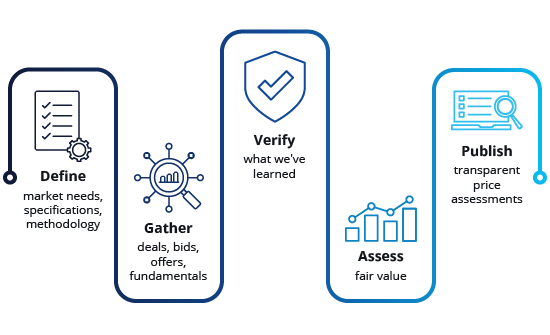
- Specialist reporter survey
Specialist reporters gather data from producers, consumers, traders and intermediaries by phone, email and instant messaging. - Transaction verification
Deals are verified for price, volume, specifications and counterparty before inclusion in the assessment process. - Illiquid market assessment
Where trades are absent, reporters apply judgment using bids, offers, exchange prices and supply-demand fundamentals. - Assessment specifications
Each assessment defines minimum lot sizes, delivery, timing and quality specifications to ensure market-reflective price accuracy. - Transparent publication
Prices are published in the Argus Battery Materials report with deal tables, enabling subscribers to cross-check assessments against market data.
Who uses this service
Cell manufacturers and automakers
- Secure battery material supply chains using independent price benchmarks.
- Optimise procurement decisions with 10-year supply and demand forecasts.
- Monitor feedstock cost trends to protect cell production margins.
Miners and materials producers
- Evaluate project economics using long-term price and demand forecasts.
- Align capacity expansion plans with independent market intelligence.
- Benchmark production costs against independently assessed market prices.
Traders and recyclers
- Identify regional arbitrage opportunities using independent price assessments.
- Assess black mass value using the Argus black mass calculator.
- Inform sourcing and capacity strategies with recycling volume forecasts.
Financial institutions and government agencies
- Support investment decisions with unbiased price and demand projections.
- Assess market risk using 10-year supply, demand and price forecasts.
- Identify geopolitical and supply chain risks across battery material markets.
Frequently asked questions
Key price assessments
Argus Battery Materials publishes over 200 price assessments across lithium, cobalt, nickel, graphite and manganese. Prices serve as benchmarks in supply contracts and support commercial decisions across the global battery materials supply chain.