
Generic Hero BannerGeneric Hero Banner
Latest market news

US oil industry braces for more job cuts amid downturn

  • : Crude oil, Natural gas
  • 25/09/15

Thousands of US oil and gas jobs have been cut this year and more redundancies are likely to be on the way as companies seek to tighten their belts amid a downturn caused by price volatility and rising costs.

ConocoPhillips was the latest producer to announce sweeping layoffs recently, outlining plans to reduce its global workforce by up to 25pc — or as many as 3,250 positions — with the majority of the reductions taking place this year. "We are always looking at how we can be more efficient with the resources we have," a company spokesman says. Chevron said earlier this year that it was shedding up to 20pc of employees, while cuts have also been announced by others, including BP.

The sector is having to contend with a 12pc slide in oil prices since the start of the year, while US president Donald Trump's trade wars have buffeted the market, with tariffs on steel and aluminum imports pushing up costs. At the same time, a looming worldwide glut risks being exacerbated by Opec+'s decision to hasten the return of supplies as members of the alliance seek to regain market share. In response, US producers have sought to cut spending and slow drilling activity — the national rig count has fallen to a four-year low — as prices teeter around levels needed to profitably drill (see graph).

"Breakevens differ from operator to operator, so some will be forced to let people go while others hold steady," upstream monitor Primary Vision's chief executive officer, Matt Johnson, says. "As we approach capex depletion, layoffs are a natural part of this cycle, especially with a weaker price deck." The number of workers employed in oil and gas extraction slipped by 2pc in August to a two-year low, according to preliminary data from the Bureau of Labor Statistics.

Some companies are just coming up for air after a wave of consolidations over the past few years, and are looking to restructure their operations, with efforts to reduce headcounts a key part of that. ConocoPhillips snapped up Marathon Oil for $17.1bn last year in just one of a series of blockbuster deals that has redrawn the US shale map.

Shale productivity gains, and an efficiency drive that has taken on greater urgency — given the uncertain economic backdrop as companies seek to insulate investor payouts — have also played a part as executives seek to do more with less. Analysts expect oil prices to extend recent losses, while US crude output is forecast to decline next year for the first time since 2021.

Jam tomorrow

"In the short term, we're going to continue to see a downward trend in employment," Texas Independent Producers and Royalty Owners Association president Ed Longanecker says. Over the longer term, the outlook is more favourable, boosted by the sweeping changes to tax policy, energy regulations and federal leasing practices from Trump's recent spending and tax package that will deliver a combined multi-billion dollar windfall for the industry, he says.

And while the energy services sector saw a decline of around 6,000 jobs last month, the Energy Workforce and Technology Council says the headline numbers do not capture the full picture. "Companies remain disciplined, making targeted adjustments where needed while continuing to invest in their workforce," the trade group's president, Molly Determan, says.

But the jobs outlook for the wider oil and gas industry faces additional headwinds from the growing use of artificial intelligence, which is still at an early stage of deployment. And offshoring efforts by some of the biggest producers — moving highly skilled jobs in fields such as engineering to lower-paying countries — will also weigh on future opportunities.
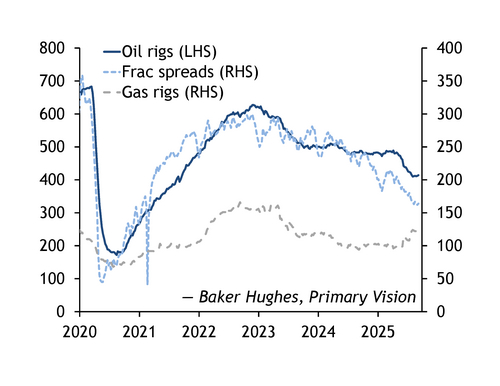
Rigs and frac spreads

Related news posts

Argus illuminates the markets by putting a lens on the areas that matter most to you. The market news and commentary we publish reveals vital insights that enable you to make stronger, well-informed decisions. Explore a selection of news stories related to this one.

25/11/07

Petrobras increases spending by 24pc in 3Q: Update

Petrobras increases spending by 24pc in 3Q: Update

Updates with investment plans in paras 3-4 and explorations plans in paras 8-9 Rio de Janeiro, 7 November (Argus) — Brazilian state-controlled Petrobras' investments increased by 24pc in the third quarter from a year earlier, as the firm continues to focus on production in the offshore pre-salt. Petrobras spent $5.5bn in capital expenditure (capex) in July-September, of which $4.7bn was for exploration and production. Of this investment in exploration and production, $2.7bn went to developing production of the pre-salt cluster in the Santos basin, particularly the construction of seven new floating production, storage and offloading units that will serve the Buzios, Atapu and Sepia fields. A further $900mn went to developing production in the Campos basin's pre- and post-salt, and $500mn went to exploration. Total investments over the first nine months of the year were $14bn, a 29pc increase on the same period last year. The company has speeded up investment execution due to projects being brought forward, rather than higher costs, and is on track to meet guidance by year's end, directors said. Capex guidance for 2025 as outlined in Petrobras' 2025-2029 business plan is $18.5bn. The firm is due to present an updated plan at the end of November. There are no plans to cut investments next year, said the director for engineering, technology and innovation, Renata Baruzzi. Petrobras posted a profit of R32.7bn ($6bn) in the third quarter, a 0.5pc increase on the same quarter last year and 23pc more than in the previous quarter. Higher crude production as well as stronger crude exports and domestic sales of diesel drove the third quarter result, Petrobras said. It also cited a small rallying of oil prices, with the price of Brent growing by 2pc compared with the second quarter, and lower operational costs, as contributing factors. The company's board approved a payout of R12.16bn ($2.3bn) to shareholders, or R0.9432/share, down from R1.3282/share a year earlier. Dividends will be paid in two installments, in February and March. Exploration going forward Petrobras celebrated receiving regulatory approval last month to drill an exploratory well in the Foz do Amazonas basin off Brazil's northern coast. This is the most coveted area in the equatorial margin, a new oil frontier which could contain reserves similar to those found off Guyana. The company hopes to find oil in this first well, named Morpho, but if not it will continue exploration, director for exploration and production Sylvia Anjos said. "We are already planning for eight wells in the region," she said. By Constance Malleret Send comments and request more information at feedback@argusmedia.com Copyright © 2025. Argus Media group . All rights reserved.

US EPA grants more waivers from biofuel quotas


25/11/07
25/11/07

US EPA grants more waivers from biofuel quotas

New York, 7 November (Argus) — President Donald Trump's administration today granted small refiners even more exemptions from federal biofuel blend mandates, raising the stakes of a debate about whether larger oil companies should shoulder more of the burden. The US Environmental Protection Agency (EPA) granted two full exemptions from the program's annual blend requirements, halved obligations in response to 12 petitions, and denied two others. The agency requires oil refiners and importers to annually blend biofuels or buy credits from those who do, though small facilities that process 75,000 b/d or less can request program waivers that can save them tens of millions of dollars. The agency used the same methodology as its sweeping August decision , which responded to a historic backlog of petitions and granted most refiners some relief from years of mandates. New petitions poured in afterwards, including from refiners that had not requested waivers in years. And more decisions could come soon, with EPA committing Friday to "address new petitions as quickly as possible" and to try to meet a legal requirement to decide requests within 90 days. Farm and biofuel groups fear that widespread waivers curb demand for their products and have lobbied the Trump administration to follow through on a plan to make oil companies without exemptions blend more biofuels in future years to offset past exemptions for their smaller rivals. Particularly for higher-cost products like renewable diesel and biogas, any dip in demand can prompt biorefineries to slash output. The debate has intensified in recent weeks after a refiner granted generous exemptions in August announced plans to convert a renewable diesel unit back to crude. "The impact on biofuel and agriculture markets will be devastating" without compensating for these exemptions in future biofuel quotas, said Geoff Cooper, president of the ethanol lobby Renewable Fuels Association. EPA already planned on estimating future exemptions from 2026-2027 requirements when finalizing biofuel mandates those years. But the agency has added more work to its plate with a subsequent plan to force large oil refiners to compensate for either all or half of the biofuel volumes lost to actual and expected exemptions from 2023-2025 requirements. The impact of older exemptions is less significant since the credits are expired. The challenge for EPA is that small refiners can submit new or revised petitions at any time, including for years-old mandates. That makes it hard for EPA to accurately forecast future exemptions, and biofuel groups have feared that the agency could muddle the effects of its "reallocation" plan by underestimating volumes ultimately lost to program waivers. Indeed, EPA with its Friday decisions has already waived more requirements than it predicted earlier this year. The agency last forecast that exemptions from 2023 and 2024 mandates would amount to around 1.4bn Renewable Identification Number credits (RINs) of lost demand — but now, the waivers have already reduced obligations those years by 1.92bn RINs, according to program data. If EPA sticks to its plans, that means large refiners will have to blend an even greater share in future years than expected. But if the Trump administration waters down its reallocation idea, biofuel demand could sink more than previously forecast too. There is also the risk that EPA underestimates exemptions for the 2025 compliance year. EPA last forecast that exemptions from those requirements will amount to 780mn RINs of lost demand but has not yet decided any of the 12 pending petitions for that year. Many more requests are likely. Small refiners add to their winnings The August exemptions were a windfall for some oil companies. HF Sinclair, which owns multiple small refineries, last week reported $115mn from lower compliance costs as well as a $56mn indirect benefit from "commercial optimization" of its RIN credit position. And HF Sinclair won more Friday, winning full waivers from 2023 and 2024 biofuel mandates for the "east" section of a larger 125,000 b/d complex in Tulsa, Oklahoma that before September had not previously requested relief in at least three years. The company also won partial relief for two other units from 2021 mandates. Phillips 66 won four years of partial relief for its 66,000 b/d Montana facility, as did Big West Oil for its 35,000 b/d Utah plant. Silver Eagle won exemptions from 2023 blend mandates for two smaller units it owns in Wyoming and Utah. The only Friday denials were for Chevron's 45,000 b/d Utah refinery, which applied for the first time in years just last month. But the increasingly generous relief for small refiners is likely to provoke further backlash from larger oil companies, which argue that making them blend more biofuels is anticompetitive and illegal. EPA is months behind schedule on setting biofuel mandates for 2026 and 2027 and has a deadline Friday to tell a court more about how its reallocation plan affects its timeline. Biofuel groups have asked the court to force the agency to finalize program updates by year-end. By Cole Martin Send comments and request more information at feedback@argusmedia.com Copyright © 2025. Argus Media group . All rights reserved.

Opec+ eight apply brakes to output rises


25/11/07
25/11/07

Opec+ eight apply brakes to output rises

London, 7 November (Argus) — Eight core Opec+ members have put the brakes on their monthly production increases, giving them time to assess the impact of new US sanctions on Russia. Saudi Arabia, Iraq, Kuwait, Russia, the UAE, Algeria, Oman and Kazakhstan will make one last production target increase worth 137,000 b/d in December before pausing the hikes in January-March. The pause ends nine consecutive months of production target increases, during which the eight have fully unwound a 2.2mn b/d set of cuts and in October started to unwind another set of cuts worth 1.65mn b/d. The group has agreed to three monthly increases worth a combined 411,000 b/d up to December, leaving 1.24mn b/d to unwind. The eight officially attributed the pause to "seasonality", referring to expectations of lower oil demand in the first quarter of 2026. But more importantly, the pause will allow them to gauge the impact of recent US sanctions on Russian oil producers Rosneft and Lukoil. Whether Russia can maintain its crude output and exports under the new restrictions remains uncertain. If Rosneft and Lukoil cannot find workarounds to the sanctions and buyers for their crude, they may have to start reducing production. In such an event, Opec+ may feel the need to step in to replace lost Russian output. "I think everyone is monitoring the Russia sanctions and it's difficult for them to actually predict how those sanctions will go," trading firm Mercuria's chief executive Marco Dunand says. "I think they are pausing because there is a lot of oil on the water... I think it's about 60mn bl, but I'm not sure." The eight countries said their decision reflects a "cautious approach", but they reiterated their "full flexibility" to accelerate, pause or reverse the monthly output hikes, depending on market conditions. "The group wants to adopt a more cautious approach, exactly like it did at the beginning of 2025, when it decided to delay the unwinding process of the initial 2.2mn b/d voluntary cut until April," one delegate told Argus. No consensus But views on the oil market remain sharply divided. The IEA forecasts a significant supply surplus in the fourth quarter and in 2026, while Opec expects a more balanced market, underpinned by strong demand this year and next. Speaking at the Adipec conference in Abu Dhabi, UAE energy minister Suhail al-Mazrouei said he "can't see or justify" an oversupply scenario. "All of what we are seeing is more demand," he said. European oil majors are also divided on market fundamentals. While Shell chief executive Wael Sawan sees a "highly credible scenario" for oversupply in 2026, BP and TotalEnergies have pushed back against a near-term oil glut , arguing that demand remains resilient and non-Opec+ supply growth is likely to taper off next year. "The determination of what happens really sits around three factors — Opec+ choices, China's stockpiling behaviour and the sanctions environment," BP chief executive Murray Auchincloss says. Oil prices rebounded from multi-month lows of around $60/bl after the US unveiled its sanctions on 22 October, with Ice front-month Brent now around $65/bl. But this is still below where many Opec+ members would prefer. Production by the eight members had increased by 2.1mn b/d in October from when they started unwinding their cuts in April, according to Argus estimates. Production by the 18 members of the alliance that adhere to output targets rose by 30,000 b/d on the month to 36.2mn b/d in October — the group's highest production since April 2023 (see table). By Aydin Calik, Nader Itayim and Bachar Halabi Opec+ crude production mn b/d Oct Sep* Oct target† ± target Opec 9 23.05 22.95 23.19 -0.14 Non-Opec 9 13.15 13.22 13.27 -0.12 Total Opec+ 18 36.20 36.17 36.46 -0.26 *revised †includes extra cuts agreed in Apr 23 and Nov 23 Opec wellhead production mn b/d Oct Sep* Oct target† ± target Saudi Arabia 10.01 9.98 10.02 -0.01 Iraq 4.11 4.08 4.24 -0.13 Kuwait 2.57 2.52 2.56 +0.01 UAE 3.36 3.38 3.39 -0.03 Algeria 0.97 0.97 0.96 0.01 Nigeria 1.52 1.51 1.50 +0.02 Congo (Brazzaville) 0.26 0.25 0.28 -0.02 Gabon 0.21 0.21 0.18 +0.03 Equatorial Guinea 0.04 0.05 0.07 -0.03 Opec 9 23.05 22.95 23.19 -0.14 Iran 3.39 3.45 na na Libya 1.32 1.37 na na Venezuela 1.00 1.05 na na Total Opec 12^ 28.76 28.82 na na *revised †includes extra cuts agreed in Apr 23 and Nov 23 ^Iran, Libya and Venezuela are exempt from production targets Non-Opec crude production mn b/d Oct Sep* Oct target† ± target Russia 9.41 9.37 9.49 -0.08 Oman 0.80 0.79 0.80 -0.00 Azerbaijan 0.45 0.44 0.55 -0.10 Kazakhstan 1.68 1.83 1.56 +0.12 Malaysia 0.36 0.36 0.40 -0.04 Bahrain 0.18 0.18 0.20 -0.02 Brunei 0.10 0.08 0.08 0.02 Sudan 0.01 0.02 0.06 -0.05 South Sudan 0.16 0.15 0.12 +0.04 Total non-Opec 13.15 13.22 13.27 -0.12 *revised †includes extra cuts agreed in Apr 23 and Nov 23 Send comments and request more information at feedback@argusmedia.com Copyright © 2025. Argus Media group . All rights reserved.

Brazil’s Renovabio upheld by supreme court justice


25/11/07
25/11/07

Brazil’s Renovabio upheld by supreme court justice

Sao Paulo, 7 November (Argus) — Brazilian Supreme Court justice Nunes Marques has issued two votes rejecting constitutional challenges to Renovabio's biofuels program. The cases — ADI 7596, filed by the Democratic Renewal Party (PRD) in February 2024, and ADI 7617, filed by the Democratic Labour Party (PDT) in April 2024 — questioned the legality and fairness of mandatory carbon reduction targets imposed on fossil fuel distributors. In both decisions, the minister dismissed claims of discrimination and disproportion, affirming that Renovabio complies with constitutional principles such as equality, free enterprise, and environmental protection. He emphasized that the program's costs are ultimately borne by fuel consumers, not distributors, and that the policy aligns with Brazil's climate commitments under the Paris Agreement. Marques also rejected arguments that Renovabio's program was improperly designed to benefit private interests or lacked legislative legitimacy. He defended the program's structure, including the use of Cbio decarbonization credits, as a market-based mechanism to incentivize biofuels without public subsidies. With the votes now public, the Supreme Court will deliberate the merits of both cases. A majority ruling is required to confirm or overturn the constitutionality of the program. By Rebecca Gompertz Send comments and request more information at feedback@argusmedia.com Copyright © 2025. Argus Media group . All rights reserved.

Petrobras increases spending by 24pc in 3Q


25/11/07
25/11/07

Petrobras increases spending by 24pc in 3Q

Rio de Janeiro, 7 November (Argus) — Brazilian state-controlled Petrobras' investments increased by 24pc in the third quarter from a year earlier, as the firm continues to focus on production in the offshore pre-salt. Petrobras spent $5.5bn in capital expenditure (capex) in July-September, of which $4.7bn was for exploration and production. Of this investment in exploration and production, $2.7bn went to developing production of the pre-salt cluster in the Santos basin, particularly the construction of seven new floating production, storage and offloading units that will serve the Buzios, Atapu and Sepia fields. A further $900mn went to developing production in the Campos basin's pre- and post-salt, and $500mn went to exploration. Total investments over the first nine months of the year were $14bn, a 29pc increase on the same period last year. Capex guidance for 2025 as outlined in Petrobras' 2025-2029 business plan is $18.5bn. Petrobras posted a profit of R32.7bn ($6bn) in the third quarter, a 0.5pc increase on the same quarter last year and 23pc more than in the previous quarter. Higher crude production as well as stronger crude exports and domestic sales of diesel drove the third quarter result, Petrobras said. It also cited a small rallying of oil prices, with the price of Brent growing by 2pc compared with the second quarter, and lower operational costs, as contributing factors. The company's board approved a payout of R12.16bn ($2.3bn) to shareholders, or R0.9432/share, down from R1.3282/share a year earlier. Dividends will be paid in two installments, in February and March. By Constance Malleret Send comments and request more information at feedback@argusmedia.com Copyright © 2025. Argus Media group . All rights reserved.

Generic Hero Banner

Business intelligence reports

Get concise, trustworthy and unbiased analysis of the latest trends and developments in oil and energy markets. These reports are specially created for decision makers who don’t have time to track markets day-by-day, minute-by-minute.

Learn more