


The higher cost of natural gas due to the US-Iran war could limit production of fertilisers and chemicals in Poland, weighing on the industry's power consumption.
Polish chemicals company Grupa Azoty — which has a 48pc share of the Polish fertiliser market — is still running at capacity, unlike during the energy crisis of 2022, the firm told Argus. But high gas prices could eventually weigh on production.
Chemical industry power use
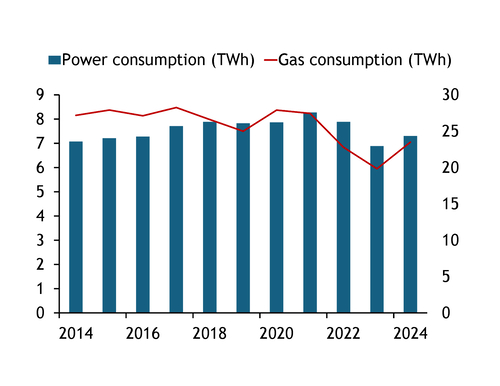
Poland's chemical industry — covering fertilisers, oil products, petrochemicals and other products — consumed 7.3TWh of electricity in 2024, accounting for 4.42pc of Polish demand, according to the latest data from Statistics Poland.
Consumption rose by 2pc/yr in 2014-21, reaching 8.27TWh in 2021. But production dropped in 2022, when the energy crisis hit, falling by 5pc and then by a further 13pc in 2023. And while consumption increased in 2024, it only recovered to 2016 levels.
The increase in oil and gas prices because of the Middle East conflict since late February has pushed up producers' fuel and raw material costs. Energy can account for 50–80pc of chemical sector production costs, according to industry chamber PIPC.
Nitrogenous fertilisers — which made up 75pc of Polish fertiliser production in 2021-25 — use gas as a feedstock and a fuel.
The TTF everyday price has risen by 37pc since the start of the conflict and was 23pc up on the year in March. And the price of German CAN fertiliser — indicative of nitrogenous fertiliser prices in the region — has risen by €95/t to €437.50/t since 26 February.
Continued disruption could curb demand if farmers use less fertiliser on crops in the face of rising costs, Grupa Azoty said.
In 2022, Polish fertiliser output fell because of surging energy prices. Nitrogenous fertiliser production fell by 17pc in 2022 and by 15pc in 2023.
But Polish producers might now be in a stronger position, as they face less competition from imports made with cheaper gas owing to new EU tariffs. And since the start of 2026, the EU's carbon border adjustment mechanism adds a carbon charge to imports of fertilisers.
Poland's fertiliser output was up by 2pc on the year to 411,000t in January-February, although output is still lower than pre-2022 levels. March figures have yet to be released.
Little change in production methods
Electricity demand in energy-intensive sectors, such as the manufacture of fertilisers and basic chemicals, is "expected to increase" in the longer term, driven by electrification and hydrogen production, PIPC told Argus, although it noted that Poland is constrained by a lack of "affordable renewable electricity and supporting infrastructure".
So far, Grupa Azoty says there have have been no changes to production that would "materially" increase its electricity consumption. For now, it is focusing on efficiency improvements that could reduce gas use.
Grupa Azoty is "analysing" the viability of partial electrification and adoption of low-emission and green ammonia in operations, but stressed that changes are contingent on "competitively priced" renewable energy.
Wind and solar accounted for a combined 27pc of Polish generation last year. But 68pc was from gas, coal or lignite.
Outlook for hydrogen in Polish fertilisers
Hydrogen — a key component in ammonia — can be produced from natural gas or by electrolysis.
Producing ammonia with hydrogen from electrolysis increases power input requirements to 9–12MWh per tonne, compared with roughly 1MWh needed for natural gas-based hydrogen, according to IEA estimates.
Poland aims to build 2GW of electrolysis capacity by 2030.
But none of Poland's industrial sectors has adopted electrolysis at scale yet, the climate and environment ministry has told Argus. Electrolysis capacity currently stands at 7.5MW.
National development bank BGK agreed subsidies in October for five projects with a combined electrolysis capacity of 343MW. But no renewable hydrogen project has reached a final investment decision in Poland to date.
Renewable power supply, grid infrastructure and storage capacity might not be sufficient to meet existing targets, PIPC told Argus. And the higher cost of renewable hydrogen relative tofossil-based hydrogen could further "weaken the competitiveness" of Poland's chemical industry.
323042026043312.jpg)


