A swift recovery in Saudi Arabian crude exports has eased supply concerns that pushed benchmark Dubai to a six-month high in September.
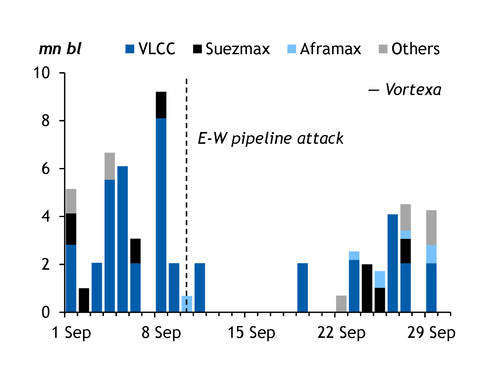
Asia-Pacific refiners mostly say they expect key Mideast Gulf producers to offer competitive pricing for November-loading cargoes as more prompt crude becomes available. Mideast Gulf crude prices rose sharply in September after drone attacks forced Saudi Arabia to close its 7mn b/d East-West crude pipeline on 10 September, halting exports from the Red Sea port of Yanbu. Concerns of a prolonged supply crunch eased as tanker loadings resumed in earnest from Yanbu around 23-24 September (see graph). Saudi Aramco also moved quickly to increase exports through the strait of Hormuz, selling at least 90mn bl of crude loading at its main Ras Tanura terminal within the Mideast Gulf, either as delivered cargoes or by ship-to-ship transfer off Sohar in Oman. Aramco's trading arm has also increased sales of medium sour Khafji crude.
Saudi crude loadings rose to nearly 9mn b/d over 22-28 September, the highest weekly level since late 2022, Vortexa data show. The wave of Saudi sales — together with the steady return of other Mideast Gulf producers' exports to near pre-war levels — has left Asian refiners with plentiful prompt supplies. Chinese refiners, in particular, have been buying in volume. Aramco is likely to keep its term crude prices competitive as a result, Asian refiners say.
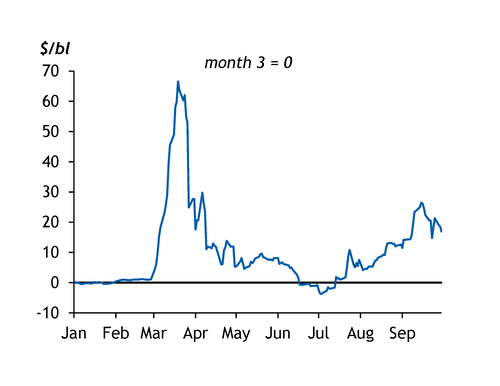
Aramco typically uses the monthly change in the Dubai month 1-month 3 spread to determine contract pricing for its Asian term customers. Houthi attacks and the Hormuz blockade pushed prompt Dubai to a nearly $20/bl premium to the third-month contract in September, a more than $10/bl increase on August and the highest since the outbreak of the US/Israel-Iran war (see graph). But Aramco may instead temper potential increases to its November pricing as part of efforts to regain market share through encouraging customers to lift higher volumes, Asian refiners say. Some customers say they expect Aramco to raise its Asian prices by up to $2/bl for November-loading Arab Light, while others say Aramco could even keep its prices unchanged on the month, as it did for October cargoes despite general expectations of a larger price increase.
European refiners also say Aramco will need to lower November pricing to remain competitive given the prospect of a glut of medium crude in the market. European refiners are eyeing a possible influx of sour crude from the US after the energy department offered to loan 40mn bl from the Strategic Petroleum Reserve in Texas for November and December.
Murban mystery
Asia-Pacific refiners are also keenly watching how the UAE's state-owned Adnoc will determine the first set of Dubai-linked official selling pricesfor November-loading exports. The firm had previously set pricing based on the Ifad exchange's Murban futures contracts. Market participants say the change will align Adnoc's crude pricing with that of other Mideast Gulf producers, allowing buyers to make easier comparisons across regional grades. This could prompt Adnoc to also set its November pricing competitively as part of efforts to maintain or gain market share. The UAE's exit from Opec in May has given it the freedom to increase crude production and exports.
But most Asian refiners say they have little certainty on how Adnoc might set the differential in formula pricing for Murban, its main export crude, given the shift in methodology. This uncertainty had also discouraged some market participants from offering November Murban cargoes in the September spot trading cycle, market sources say.