The waning threat of a ban on US diesel exports offers little relief for a US distillate complex facing peak heating demand just as domestic inventories slump to historical lows and global supplies tighten.
US president Donald Trump on 30 September tempered his endorsement of a diesel export ban because of concerns that it could push up gasoline prices, as his administration raised expectations of price relief from new diesel supplies in Europe. Trump said he was still "thinking about" an export ban, but believes the US is in a "good place" because of a recent drop in crude prices and a "tremendous" amount of oil coming out of the strait of Hormuz.
US energy secretary Chris Wright expects diesel prices to "move meaningfully down in the coming weeks and days", in part because of additional supplies from Europe. "You will hear announcements from our friends in Europe about new diesel supplies that'll come to the market that'll meaningfully push diesel prices down," Wright says. The G7 announced a 100mn bl oil stocks release on 2 October, to begin immediately.
Market participants are closely watching Trump's evolving comments on the possible ban. Such a measure could help rebuild low domestic distillate inventories and improve supply security during the harvesting season and ahead of winter. But limiting exports could weigh on Nymex ultra-low sulphur diesel (ULSD) futures, reduce arbitrage opportunities and pressure refinery margins, potentially diminishing refiners' incentives to maximise distillate production.
Trump's latest comments come as supply tightens even further in the US northeast ahead of the peak heating season, in part because of refinery maintenance that started in September and will continue until mid-November at Irving Oil's 320,000 b/d St John refinery in New Brunswick, Canada, one of the largest sources of imported diesel for the region. Ultra-low sulphur distillate inventories in the New York region were the lowest in more than four years at 8.9mn bl in the week to 25 September, more than 37pc below a year earlier.
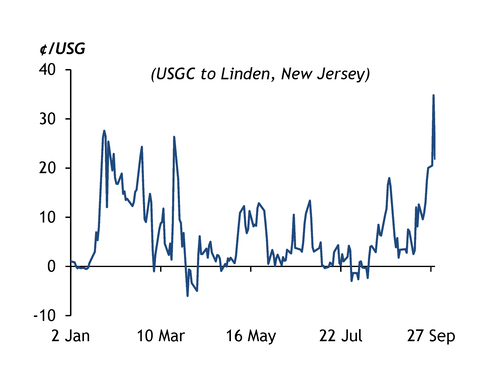
This has boosted demand for deliveries to the region. Gulf coast diesel is moving to the northeast along the Colonial Pipeline as well as arriving by sea, tightening tanker availability, increasing demand for pipeline space and raising transport costs. The arbitrage from the Gulf coast to New York Harbor hit its widest in nearly four years on 29 September, as the Gulf coast ULSD premium to Linden, New Jersey, along the Colonial Pipeline rose to 34.81¢/USG, its highest since November 2022 (see graph).
Cracking spreads
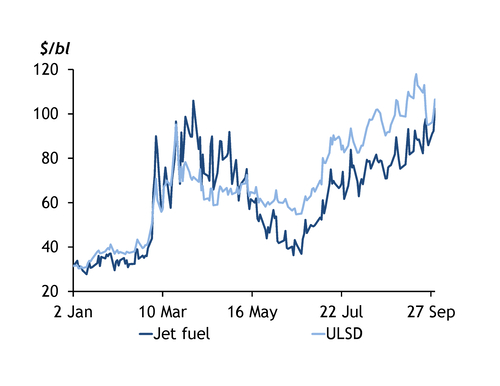
Some support could come from refinery economics that continue to favour diesel over jet fuel. The Nymex ULSD 1:1 crack spread against WTI crude averaged $105.57/bl over 16-30 September after hitting a historical high of $117.92/bl on 16 September. The US jet fuel crack spread averaged $91.07/bl over the same timeframe (see graph). The stronger diesel margin will probably prompt refiners capable of shifting yields towards distillate production to continue prioritising ULSD over jet fuel during the autumn.
Gulf coast diesel prices rose on strong demand and low inventories. ULSD inventories in the region dropped to 35.9mn bl in the week to 25 September, down by 1.4mn bl compared with a year earlier. The region has become a key alternative supplier in the face of lower exports from the Mideast Gulf and Russia. The region's diesel exports surged by 41pc to 1.41mn b/d in September from a year earlier and were the highest for any September since at least 2016, according to oil analytics firm Vortexa.