
Overview
Europe is moving to E10 as the standard for regular grade gasoline. Stay ahead of the curve by moving your gasoline pricing to Argus non-oxy (E10). As of, 1 January 2024, Argus has changed the Eurobob oxy (E5) index to a premium or discount to the non-oxy (E10) benchmark. The non-oxy (E10) price will continue to be based on a volume-weighted average of spot market transactions.
EU-wide targets driven from mandates such as the EU’s Renewable Energy Directive, have increased the need for ethanol-blended gasoline across Europe. In most European countries, gasoline must now contain either up to 5pc or 10pc ethanol. Due to its higher bioethanol content, E10 gasoline is being rolled out across more countries in Europe as a means for governments and companies to help meet greenhouse gas (GHG) emissions targets.

European gasoline is moving to E10
Elliot Radley, editor of Argus European Products, provides the tools and insight to navigate one of the biggest changes to the European gasoline market in over a decade.
Watch nowArgus Eurobob gasoline barge spread
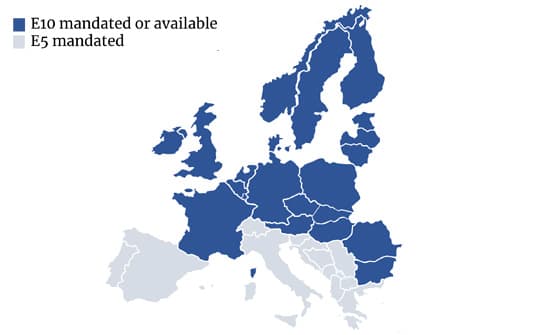
European gasoline - E5 vs E10
Europe is moving to E10 gasoline usage, impacts will include the UK’s CO2 emissions cut by 750,000 t/yr, the equivalent to removing 350,000 cars off the road, and the use of E10 gasoline will reduce GHG emissions of a gasoline powered car by ~2%.
Key price assessments

Newsletter: Argus Oil Market Highlights
Never has it been more essential to understand the crude and oil products market to stay ahead of the curve. Keep up with the latest market developments with our valuable insights, including news, podcasts, and events.
Sign upSpotlight content
Argus Eurobob transition to E10
The Argus Eurobob oxy assessment is a diff to the Argus Eurobob non-oxy assessment. Get a detailed overview into this change and what’s to come.
PodcastDriving Discussions: Is Europe's gasoline abundance a problem?
The last few months have seen a massive pile-up of gasoline supply accumulating in Northwest Europe. Listen to our oil market experts discuss why this has occurred and what might happen to all this gasoline currently sitting in tanks in the Amsterdam-Rotterdam-Antwerp (ARA) region.
Market insight papersNo Margin for Error: Seismic Shifts in the Global Refining Industry
Challenges facing the oil refining industry have become more numerous and are set to intensify in the coming years. Read this report for a deep dive into the global refining, diesel and gasoline markets. Includes valuable forecasts for 2025, to help you inform and plan your strategic efforts.
Latest European gasoline news
NWE gasoline cracks near-record for month of October
London, 3 November (Argus) — Benchmark northwest European non-oxy gasoline barge cracks to front-month Ice Brent crude futures in October were the second-highest on record for the month, underpinned by planned and unplanned refinery maintenance and by increased buying interest from other regions. Non-oxy barge cracks to Brent averaged $17.05/bl last month, more than double the $8.37/bl of a year earlier and surpassed in October only by 2022, when the roll-back of Covid-19 restrictions supported a recovery in refined product demand. In Europe, a trader said fluid catalytic cracker (FCC) and reformer unit maintenance weighed on gasoline availability, and said the closures of Petroineos' 150,000 b/d Grangemouth and Prax's 105,700 b/d Lindsey refinery are affecting supply. Norway's state-controlled Equinor has put the 44,000 b/d FCC at its 203,000 b/d Mongstad refinery under maintenance , according to sources, and Essar Oil said at the start of September it was carrying out unplanned maintenance on a secondary unit at its 195,000 b/d Stanlow refinery in northwest England. European gasoline barge loadings slowed considerably over the course of October, with traders noting barge availability had been curtailed by delays around the port of Amsterdam and by strikes at Belgian ports. This helped contribute to subsequent weekly declines in independently-held gasoline stocks at the Amsterdam-Rotterdam-Antwerp (ARA) hub in October, according to data from consultancy Insights Global. Beyond northwest Europe, gasoline supply tightness appeared to emerge in central Europe following a fire at Hungarian Mol's 161,000 b/d Szazhalombatta refinery on 20 October. Market participants told Argus that barges of oil products were being sent from Romania's oil products import hub of Constanta to Serbia, trains were being loaded from Bulgaria's 115,000 b/d Burgas refinery, and gasoline and diesel truck volumes were being booked from Croatia. Further support was lent to benchmark non-oxy cracks from an uptick in Atlantic basin gasoline buying interest, which also contributed to stock drawdowns at ARA. US west coast gasoline imports surged in October to cover refining issues and a wind-down in activities, drawing in uncommon UK-origin cargoes. Phillips 66 stopped processing crude at its 139,000 b/d Los Angeles refinery on 16 October and expects to idle remaining units by the end of 2025. Valero is moving forward with a plan to shut down or repurpose its 145,000 b/d refinery in Benicia, California, by April 2026. The region imported 46,000 b/d, up from 21,000 b/d in October 2024. US west coast gasoline imports are the highest on record to date this year at 58,000 b/d, almost double the 31,000 b/d of a year earlier, according to Kpler tracking data. In Nigeria, an increase in Dangote refinery gasoline prices made arbitrage economics workable. Preliminary Kpler data show Nigerian gasoline imports at a five-month high in October. By George Maher-Bonnett Send comments and request more information at feedback@argusmedia.com Copyright © 2025. Argus Media group . All rights reserved.
Dangote lays off staff in refinery reorganisation
London, 26 September (Argus) — Nigerian refiner Dangote has laid off 800 workers without consultation, a leading trade union claimed today. The company says only a "very small number" of staff are affected, and that the move is part of an "ongoing reorganisation" to address "repeated acts of sabotage". The layoffs cap a month of operational setbacks at the 650,000 b/d refinery, including crude receipts falling below half capacity, maintenance on a key gasoline unit and worker protests that halted truck loadings. The Petroleum and Natural Gas Senior Staff Association of Nigeria (Pengassan) accused Dangote of terminating 800 workers "without due consultation or any transparent justification", which it said "contravenes the legal rights granted to all employees in Nigeria". Pengassan has not yet said whether it will take steps to oppose or protest the move. A Dangote spokesman declined to confirm the exact figure, but a company statement said only a small number of staff are affected. The company said the reorganisation was necessary to "safeguard the refinery from repeated acts of sabotage that have raised safety concerns and affected operational efficiency". It added that it would "continue to recruit Nigerian talent". Dangote product loadings by truck were suspended for some of the first half of September because of industrial action by trade union Nupeng. The union accused Dangote of barring truck drivers from joining and requiring union stickers to be removed from vehicles. Operations slowing down Operational challenges have extended beyond labour disputes. The gasoline-producing residual fluid catalytic cracker (RFCC) unit at Dangote has been under maintenance this month. A source close to the refinery said it was likely to return to full capacity by early October. Meanwhile, Dangote has received just 250,000 b/d of crude so far in September, according to preliminary Vortexa data. If that average holds for the full month, it will be the lowest since September 2024 — one month after credit rating agency Fitch downgraded Dangote , citing lower-than-projected profit. Sources said at the time that banks temporarily restricted Dangote's access to trade finance , which is needed for crude purchases. The refinery's crude intake patterns are shaping its export volumes. Dangote received record crude volumes last month and is now loading its highest-ever volume of products by sea, likely as a result. Product loadings may slow next month, as crude receipts have declined this month. Preliminary Vortexa data show 320,000 b/d of products have loaded so far in September, with low-sulphur straight-run (LSSR) fuel oil making up the largest share. The RFCC usually upgrades LSSR, so its outage leaves more LSSR available for export. Blocked truck loadings may also be stimulating seaborne exports as a substitute. West Africa has not yet drawn greater arrivals of products from other regions this month. The preliminary Vortexa figures show less than 1mn t of gasoline and components arriving in the region — below the year-to-date average, which is the lowest of any year on Vortexa's record. The possibility of increased demand for gasoline imports to west Africa may already be contributing to a counter-seasonal rally in European gasoline crack spreads. Late September premiums are typically depressed by the switch to winter-grade product, but Eurobob non-oxy barges in northwest Europe averaged a $19.34/bl premium against North Sea Dated in the first half of the month — more than double the $7.79/bl average for the same period last year. By Benedict George and Adebiyi Olusolape Send comments and request more information at feedback@argusmedia.com Copyright © 2025. Argus Media group . All rights reserved.
ARA gasoline stocks hit year-to-date low
London, 24 April (Argus) — Independently-held oil product stocks in the Amsterdam-Rotterdam-Antwerp (ARA) hub dropped by 2pc over the past week to 5.97mn t, driven by gasoline inventories hitting a year-to-date low, according to data from consultancy Insights Global. Exports to the US and Canada dragged ARA gasoline stocks down by 8pc on the week to 1.28mn t on 23 April. Naphtha stocks also declined — by 7pc to 479,000t — mainly because of tight supply in Germany and strong demand from petrochemical producers. A rise in water levels on the Rhine contributed to an uptick in barge flows out of ARA, which affected all product markets, Insights Global said. Gasoil and jet fuel inventories bucked the trend, rising by a respective 2pc and 1pc on the week as imports into ARA outpaced exports. By Isabella Reimi Independent ARA stocks on 23 April 000t Product Stocks ± week-on-week ±% week-on-week Gasoil 2,205 49 2.3 Fuel oil 1,161 -28 -2.4 Gasoline 1,275 -110 -7.9 Naphtha 479 -34 -6.6 Jet 852 6 0.7 Total 5,972 -117 -1.9 Insights Global Send comments and request more information at feedback@argusmedia.com Copyright © 2025. Argus Media group . All rights reserved.
Spanish fuel retailers face €529mn compensation claim
Madrid, 24 April (Argus) — Spain's two largest fuel retailers Repsol and Moeve — formerly known as Cepsa — are facing demands for compensation totalling €529mn ($601mn) from operators of service station franchises claiming they lost out from fuel price fixing by the companies in the noughties. Repsol received notification at the end of March that 46 service station franchises are askind for €246.5mn ($280mn) in compensation plus €145mn in interest for damages related to a 2009 sentence by competition regulator CNMV against the two companies and BP for indirectly fixing fuel prices at the pump. Moeve has confirmed that it is facing a similar lawsuit from 22 franchise operators who are claiming a total of €139.4mn in damages and interest. The firm declined to comment on the case further than stating it has "changed its contracts to comply with the demands of the regulator." BP has not yet confirmed local media reports that it is facing compensation claims of about €51mn. CNMV ruled in 2009 that the three fuel retailers had indirectly colluded to fix prices for their service station franchises through anti-competitive commercial and contractual practices and handed out fines totalling about €8mn. The three companies were then handed fines totalling some €11mn by Spanish competition authorities in 2015 for failing to fully eliminate the anti-competitive practices as required by the 2009 ruling. Both companies are already challenging compensation claims regarding the same CNMC anti-trust ruling made by Spain's logistics sector in 2022 and totalling several million euros in damages. Repsol's retail network in Spain includes over 3,500 own brand service stations and franchises while Moeve's network in Spain and Portugal recently increased to around 2,000 service stations with the acquisition of low cost distributor Ballenoil, which was completed in 2024. By Jonathan Gleave Send comments and request more information at feedback@argusmedia.com Copyright © 2025. Argus Media group . All rights reserved.

