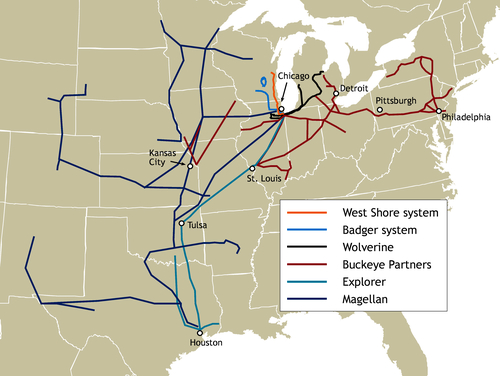
Access to price-advantaged onshore crude has allowed the US midcontinent refined products supply to outpace regional demand, leading to a push for more infrastructure to store and transport products out of the region.
Refiners in the midcontinent have enjoyed healthy margins because of their ability to access and process heavy Canadian crude, whose margins averaged $22/bl in 2017 based on Western Canadian Select (WCS). That encouraged refiners to add throughput and coking capacity earlier this decade, and operate at higher rates.
Combined operable capacity in the midcontinent has grown by 10pc since 2013 to 4.1mn b/d, data from the US Energy Information Administration (EIA) show. During the same period, regional demand grew by just 5pc to 4.7mn b/d in 2017, according to the EIA. Midcontinent weekly refinery utilization rates have outpaced those in the much larger Gulf coast for the past two years, averaging 93.9pc in 2017 compared with 90.9pc on the Gulf coast.
Expanding infrastructure
US midstream company Buckeye Partners in the upper midcontinent is expanding storage capacity in the Chicago area and seeking to advance pipeline connections deeper into Pennsylvania. In the lower midcontinent, companies are pushing south into the US Gulf coast market in a reversal of the typical arbitrage.
Buckeye said in April it will expand the Chicago Complex storage hub by 600,000 bl — which connects the 70,000 b/d Badger and West Shore pipelines going north into Wisconsin, the 90,000 b/d Wolverine pipeline going into Michigan, the 660,000 b/d Explorer pipeline coming from the Gulf coast, and other regional stub lines.
The $80mn expansion project, part of a long-term agreement with BP, will increase the storage, component blending and service capabilities at the Chicago Complex, which already serves nearly 70 customers with 6.8mn bl of storage capacity.
As the Chicago market supply grows, the extra products will need to find a home.
"You can only push so much product into Wisconsin and Illinois," a trader said. "The rest has to go to the east."
To that end, Buckeye proposed to reverse the western segment of the Philadelphia-Pittsburgh Laurel pipeline in 2016, to allow Ohio and Michigan refiners access deeper into to Pennsylvania. The Pittsburgh market traditionally has been supplied from the east coast by way of the Laurel pipeline, as well as from the west via barge deliveries on the Ohio river and, more recently, Energy Transfer Partners' (ETP) 85,000 b/d Allegheny Access pipeline.
After a judge recommended rejecting the proposal to reverse Laurel in March, Buckeye has sought to offer bi-directional service. The company now plans to ship 40,000 b/d of fuel from the midcontinent to central Pennsylvania by the end of the year. ETP's Mariner East 2 pipeline expansion from western Pennsylvania to the coast, due on stream next year, also could allow the company to move products along with natural gas liquids in that direction.
Arbitrage reversing
While refiners in Chicago are pushing east, their counterparts in the lower midcontinent are subverting the usual south-north arbitrage flow.
The draw of Gulf coast products onto the water for exports has created an opening for lower midcontinent refiners, who often found demand in the northern reaches of the Gulf coast along the reversible Magellan South pipeline.
Pipeline shipments of gasoline blending components — CBOB and RBOB — from the midcontinent to the Gulf coast rose for a fourth consecutive month to surpass 58,000 b/d in February, the second-highest level in more than 30 years of EIA data. But that still trails product flows in the other direction — which averaged 195,000 b/d.
While gasoline movement from the Gulf coast to the midcontinent has maintained a predictable seasonal pattern — peaking in the summer and waning in the winter — monthly volumes hit four-year lows from August 2017 to January 2018, until heavy refinery maintenance in February saw volumes spike again during a month-long maintenance at ExxonMobil's 240,000 b/d Joliet, Illinois, refinery.
Demand to ship refined products on the Explorer pipeline from the Gulf coast to the midcontinent dropped so low that Explorer decided to enforce penalties for not fulfilling shipment obligations last year. Shippers now have to pay a fine for unused space, which has led some to cut their nominations.
In addition, refined products shippers on Explorer have to contend with shippers of natural gasoline, which moves onto Canada for use as diluent. The seasonal pattern of natural gasoline movement on Explorer has become less pronounced as shipment has steadily increased during the traditionally low-demand summer months amid new upstream projects in Alberta.
Lower midcontinent refiners are also expanding their reach east of Oklahoma. Magellan finished a connection that can take products from Oklahoma into Memphis, Tennessee, in the fall of 2017, after expanding into Little Rock, Arkansas, in 2016.