The company plans to penetrate more challenging rural areas as demand in urban markets is pressured by natural gas grid expansions, writes Cheryl Liu
China's largest LPG importer and distributor China Gas is looking to bolster its residential sales by expanding into rural areas through the use of its new "smart micro-grid" system, as urban consumption becomes increasingly squeezed by natural gas grids.
The company's patented technology involves developing a piped LPG network connected to households that lack a natural gas grid connection. The homes will be fitted with smart meters, which allow households to buy smaller volumes of LPG as and when they need it. China Gas says this will help it more than double sales to around 10mn t/yr from 4mn t/yr over the next five years by tapping into rural communities that currently use LPG cylinders or traditional fuels such as firewood for cooking.
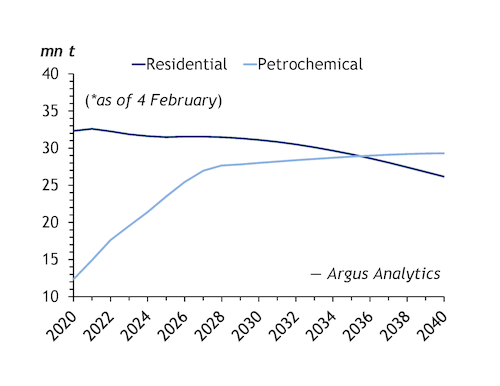
The higher sales could boost the company's gross profit by 3bn yuan/yr ($460mn/yr), it says, up from a Yn13.4bn profit in fiscal year 2019-20 ending in March. Residential LPG demand in China's urban centres is facing growing competition from an expanding natural gas network.
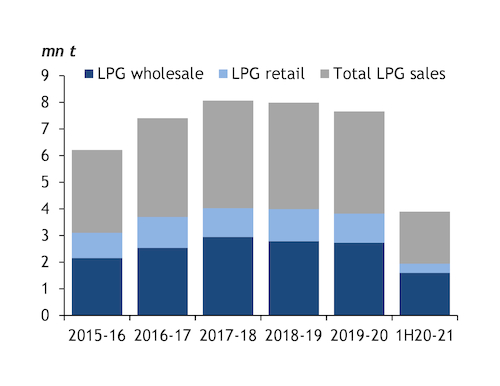
China Gas sold 1.6mn t of LPG through its wholesale business and another 350,000t through its retail arm during March-September 2020. This was an increase of 3.6pc from a year earlier for the former but a decline of 18pc for the latter owing to weaker commercial and industrial demand as a result of the Covid-19 pandemic.
The smart micro-grid system will allow the firm to pipe LPG in small communities and townships across China at a lower capital cost and shorter construction period, of around 1-3 months, compared with the development of a natural gas grid, China Gas says. The system is also cheaper and more convenient than a cylinder-based market, especially in remote locations, and smart meters will allow customers to pay for only the small incremental volumes they use. The LPG grid can also be used for emergency energy management, China Gas says.
The company hopes Beijing's plan to speed up the urbanisation of towns will help it to receive the backing it needs to expand its micro-gird network. A government commission on urbanisation in June 2020 recommended the construction of LPG supply networks be accelerated. China Gas had signed strategic agreements with 15 cities and 11 counties in 10 provinces by October last year, covering about 20mn households that could be connected to a micro-grid. The company has already accrued about 500,000 micro-grid customers and expects to add another 20mn homes over the next 10 years.
But achieving this target is likely to depend on the government removing limits on LPG storage of only 1t for storage units feeding a micro-grid system owing to safety concerns and on the installation of pumps needed to carry out necessary truck deliveries.
Smart move
China Gas estimates that there are as many as 90mn households that could feasibly be connected to a smart micro-grid network in central, south and coastal China. The grids can also be extended from rural residential zones to agricultural areas, with the farming sector consuming more than 3.2mn t/yr in developed countries, the company says.
China Gas owns seven LPG import terminals in China with 300,000m³ (177,000t) of combined storage capacity, two very large gas carriers and four inland waterway vessels. It also owns 113 distribution projects and 1,100 LPG retail outlets in 21 provinces. It imported 1.6mn t of LPG in 2019 and 1.82mn t in 2020. China Gas in early March agreed to partner with state-controlled refiner Sinopec in its domestic natural gas and LPG business.