Latin American countries have much to play for at the Cop 27 climate talks in Egypt this month
South American countries head to the UN Cop 27 climate summit in Egypt this month ready to showcase their progress on climate commitments. But with Latin America responsible for less than 10pc of global greenhouse gas (GHG) emissions, these countries see climate funding from developed countries as the key negotiation topic to help them adapt to the effects of climate change.
Ecuador
Ecuador will showcase its achievements on tackling deforestation and reducing GHG emissions with the aim of obtaining funding for the actions it must take to adapt to climate change. The country is responsible for barely 0.19pc of global GHG emissions and its priority is to adapt to the effects of climate change, Karina Barrera, the deputy secretary of climate change at the environment ministry, tells Argus.
The country is reducing deforestation gradually, working with indigenous communities, to achieve a 30pc reduction in deforestation by 2030, Barrera says. Ecuador has joined the Leaf Coalition to obtain funding of $11mn in 2023 from Norway, the UK and the US to tackle the issue. The country aims to reduce up to 21pc of GHG emissions by 2025 compared with 2010 levels.
Ecuador's first point of negotiation will be to establish financing tools so that developed countries can help other states adapt to the negative effects of climate change. The second point is to put into operation the so-called Santiago Network, an advisory panel that determines whether certain natural phenomena that cause economic losses are attributable to climate change or not. Its third priority is that the transparency reports that developing countries have to deliver — in which they show their adaption and mitigation policies — are simplified.
Peru
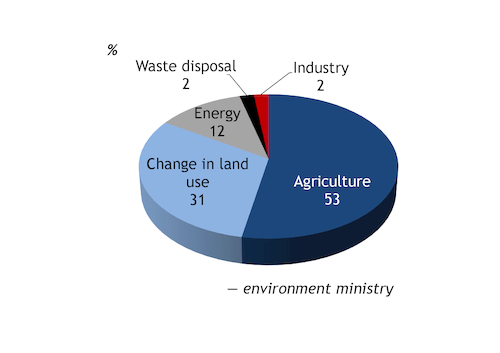
Peru has not made significant progress on slowing deforestation, its biggest source of GHG emissions, but it is working on a second bilateral co-operation agreement on carbon markets. Peru is the source of 0.38pc of global GHG emissions, 53pc of which stem from deforestation, 28pc from energy and 12pc from agriculture.
Lima has pledged to reduce its emissions by 30pc to 208.8mn t by 2030, against a business-as-usual scenario for that year, and has offered to cut an additional 10pc if international financing is available. It plans to be carbon neutral by 2050 with a future plan that envisions the forestry sector turning into a carbon sink.
Peru pledged in 2011 to reach net zero deforestation by 2021, but lost an average of 160,000 hectares/yr (ha) of forest over the ensuing decade, about twice as much as at the start of the century. Deforestation peaked at 203,272ha in 2020, amid pandemic lockdowns, reduced law enforcement and a mass migration of unemployed people to rural areas. Deforestation fell by 32pc last year to the lowest rate since 2010. But it is unclear if that momentum will hold.
Peru has long embraced projects that provide compensation for avoided emissions and is home to more than 40 REDD+ — reduced emissions from deforestation and forest degradation — projects. Norway in 2014 signed a deal with Peru and Germany to provide the former with up to $300mn to support its zero deforestation plan. The agreement was updated last year with support from the UK. Peru and Switzerland in 2020 signed the first bilateral deal under article 6 of the Paris Agreement related to carbon trading. And in April, Lima said it was holding talks with Singapore about signing a similar bilateral deal.
A "climate emergency" law was passed early this year that aims to develop a framework for adaption and mitigation measures, including a goal of raising the share of unconventional renewables to 20pc by 2030 from 5pc now and provisions for the promotion of green hydrogen and electric vehicles. It also orders the finance ministry to consider including a carbon price.
Landlocked countries
Bolivia and Paraguay are experiencing a prolonged drought that is affecting their economies. Paraguay's economy shrank by 3pc in the first half of the year because of drought, according to its central bank. Fitch Ratings in May changed the country's forecast growth for the year from 4pc to a 1pc contraction.
Drought has devastated the country's soybean crop — its primary export product — with exports of soybean products down by 56pc.
River flows have dropped by nearly a third since 2019 and power generation at the Itaipu hydroelectric dam is down by 28pc, according to the national water institute. Itaipu, shared by Paraguay and Brazil, provides 88pc of Paraguay's electricity supply. Agriculture and changes in land use accounted for 84pc of the country's CO2e emissions in 2019. Paraguay aims to reduce GHG emissions by 20pc from 1990 levels in a business-as-usual scenario.
Neighbouring Bolivia is also experiencing a prolonged drought. Nearly half of the 1.2mn ha planted in the east of the country with soybeans, sorghum, sunflowers and wheat has been affected, according to the country's largest private farmers association. The group expects a drop in output of 400,000t this year.
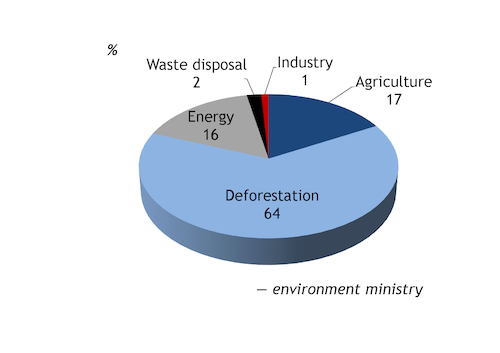
Bolivia aims to have 9pc of its power generated by non-conventional renewables by 2030, up from 2pc in 2020, while forestation will increase to 55.6mn ha from 53.3mn ha. Change in land use from deforestation is the leading cause of GHG emissions, contributing 64pc in 2017, the government says.
Caribbean
The Caribbean is caught in a dilemma, torn between its repeated commitments to decarbonisation and announcing renewables projects, while making the economic case to maintain fossil fuel production and consumption.
The Bahamas is supporting its target of 30pc of electricity to come from renewables by 2030, but the government is considering proposals for the development of an LNG-to-power complex.
The Dominican Republic is seeing an increase in investments in renewables that will deliver 30pc of the country's electricity supply by 2030. But the government is also overseeing the development of 2GW of greenfield gas-fired capacity by 2025 and maintains that it cannot abandon a coal-fired complex that supplies 30pc of the country's electricity consumption.
Jamaica is encouraging renewable electricity at the same time as it works with the island's biggest power provider towards the increased use of imported gas for generation. And Barbados plans investments of $1.75bn in renewables and storage projects over the next 10 years, while announcing the opening on 1 December of an auction for deepwater blocks to restart a stalled exploration campaign.
Guyana's low-carbon strategy is aimed at reducing fossil fuel use by 70pc by 2027 from a 2019 baseline, mainly through the development of a major hydropower plant and several small solar and hydro projects. But the heavily forested country, a net carbon sink, is about to open a tender for offshore oil blocks while awaiting proposals for the development of its first oil refinery.
Gas producer Trinidad and Tobago is maintaining its target to reduce emissions by 15pc by 2030 from a business-as-usual baseline. But with hydrocarbons accounting for 40pc of its GDP, it says it needs to exploit gas as a bridge to a greener economy.