If Mexico is to capture the fast-growing EV market it needs clean energy, but that will not be simple, writes Rebecca Conan
Growing electric vehicle (EV) production in Mexico could drive the installation of new clean power generation plants to help car manufacturers meet their net zero climate ambitions.
"A really important technological change is coming to the auto industry and that creates a great opportunity for Mexico as a recipient of investment in clean energy technologies," the president of Mexican automotive industry association Amia, Jose Zozaya, tells Argus.
Mexico is already the seventh-largest vehicle producer in the world — the car industry accounted for 3.2pc of GDP and 28.6pc of total exports last year, according to recent research by Spanish bank BBVA — and taking advantage of the boom in EV production would draw in large investments and boost employment.
US group Tesla announced plans in March to build a $5bn EV plant in Nuevo Leon, northern Mexico, while German firm BMW unveiled plans in February to invest $884mn in an EV and battery production site in San Luis Potosi.
EV production — not including the Tesla output — is expected to rise to 142,000 vehicles this year from 78,000 in 2022, according to national car parts association Ina. If Mexico is to capture the fast-growing EV market, "there needs to be a readjustment in electricity supply, particularly within clean energy, to understand who, how and where electricity will be provided not just for the current plants but for those of the future", Zozaya says.
Major car manufacturers in Mexico, including Nissan, Kia, General Motors and Volkswagen, have net zero emissions targets by 2050 at the latest, which will require them to deploy more renewable energy in their manufacturing processes as well as for the EV technology itself. While car manufacturers are currently able to secure sufficient power for their plants, having access to clean energy will become ever more important for nearshoring investment decisions, Zozaya says.
The government's state-oriented energy policy has curtailed renewable energy development and challenged self-supply permits that some companies had won to power their own plants. "The automotive industry needs sufficient clean energy at competitive prices, and it needs the government to respect the contracts of companies that have already invested in self-supply," Zozaya says.
Sonora solar
President Andres Manuel Lopez Obrador hopes that his Sonora Plan — which envisages the construction of solar parks in Sonora state — and state-owned lithium production will underpin a new electric vehicle manufacturing hub.
But Amia says it is too early to tell whether the president's plan will help. "The real impact will depend on the quantity of lithium that can be produced at economically viable prices and the number of companies that decide to install themselves in Sonora, but we are only just starting to see what might happen," Zozaya says.
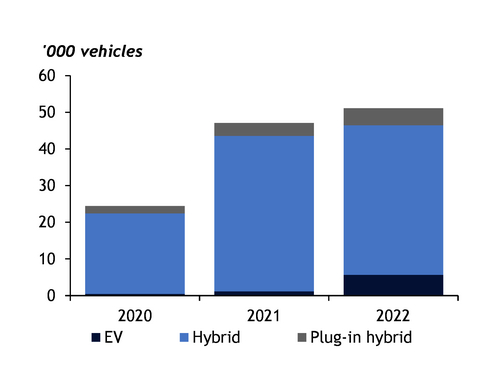
While the government pledged in July last year to ensure that half of the total vehicles manufactured in Mexico by 2030 would be either electric or hybrid, domestic sales remain marginal. EVs accounted for just 0.5pc of car sales last year, and 4.7pc including hybrids, Amia data show.
Enabling EV production as part of a drive to accelerate electromobility is a "top priority for the government", foreign minister Marcelo Ebrard says. The government hopes to work with the US to develop a plan to install EV chargers along the border. But Mexico has yet to commit to phase out gasoline-powered vehicles, and a lack of charging stations, few subsidies and the high cost of the cars are key barriers to increased sales.