CO2 emissions from vessels traveling within the EU territorial waters rose by 1.5pc to 128.22mn metric tonnes (t) in 2022 compared with 2021. The increase reflected a 1.8pc rise in marine fuel consumption to 41.28mn t in 2022, the latest EU data showed.
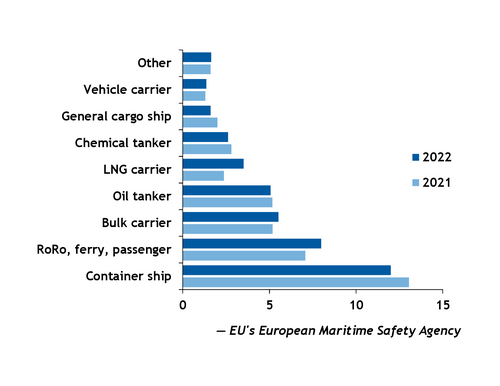
The increase was mostly driven by demand from LNG carriers, roll on roll off (RoRo) vessels, ferries and passenger ships. Demand from RoRo, ferries and passenger ships rose by 13pc or 917,207t to 7.98mn t in 2022 from the previous year (see chart). They accounted for 19pc of EU territorial waters marine fuel demand. They emitted 22.05mn t of CO2 in 2022, up 13pc. The uptick could be attributed to ferry companies gradually resuming operations in 2022, following Covid-19-related disruptions in 2021.
LNG carrier consumption rose by 48pc, or 1.14mn to 3.51mn t in 2022 from 2021. LNG carriers accounted for 8pc of total EU territorial waters bunker demand. They emitted 10.10mn t of CO2 in 2022, up 50pc. The uptick could be attributed to Russia reducing its natural gas pipeline exports to Europe, following EU sanctions on Russia after the start of the Ukraine war, and Europe increasing waterborne LNG imports from the US and Qatar, among others.
Bunker demand from container ships and oil tankers dropped. Container ships accounted the bulk of EU's bunker demand — 29pc, or 12mn t of EU territorial waters bunker demand in 2022. Their consumption declined by 8pc and they emitted 37.19mn t of CO2. Oil tankers' demand was down by 2pc to 5.07mn t.
Ships traveling in EU territorial waters will have to pay for 40pc of their CO2-equivalent emissions beginning in 2024, 70pc beginning in 2025, and 100pc beginning in 2026. EU-traded CO2 averaged at $92.5/t in June. At this level, 40pc of container ships' CO2 bill for travelling within EU territorial waters, would be $1.38bn. Vessel owners and operators are expected to pass the emissions bill to their customers, raising their freight rates.