The new president may drive renewable power growth, but LNG will remain key to energy security, writes Evelyn Lee
South Korea is on the verge of initiating a comprehensive overhaul of its energy market structure, driven by newly elected president Lee Jae-myung's aim to facilitate decarbonisation through an ambitious expansion of renewable energy.
Lee, a former leader of South Korea's liberal opposition Democratic Party (DP), secured the presidency following a snap election on 3 June. The election process began in April, when South Korea's Constitutional Court upheld the impeachment of former president Yoon Suk Yeol after his failed attempt to impose martial law in December. His administration struggled to push key legislation through the national assembly controlled by the DP, leading to months of legislative paralysis. This DP domination should now ensure that Lee has strong backing, providing momentum for the implementation of the party's policy agenda.
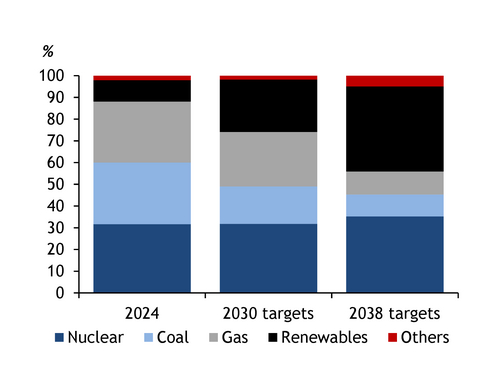
At the core of Lee's energy policy is an ambitious commitment to decarbonisation. He has reiterated a pledge to cut economy-wide emissions by 40pc by 2030, from a 2018 baseline, to be achieved through expanding the share of renewables in the power mix and phasing out coal-fired power output by 2040, 10 years earlier than pledged by former liberal president Moon Jae-In in 2021.
Lee has adopted a more cautious approach to nuclear power, pledging to "maintain the share of nuclear in the generation mix and gradually reduce it through social consensus". This could have been motivated by the need to reinforce base-load capacity, particularly given his aim of making South Korea an artificial intelligence-based society.
The new president also plans to scale up solar and wind capacities rapidly, particularly in Honam, in the southwest of the country. The region has one of the country's most congested energy grids, which Lee aims to relieve by building an "energy highway" along the west coast by 2030. "We will transmit 20GW of offshore wind power from the southwest coast to major industrial areas via offshore power grids and expand RE100 industrial complexes nationwide," Lee says. A digitally integrated "energy super grid" will be introduced to facilitate the efficient distribution of electricity across production and consumption regions, reducing volatility and enabling better load balancing, he says.
A crucial element of Lee's policy is the creation of a dedicated climate energy ministry. This new body will centralise the governance of climate and energy initiatives, addressing long-standing criticism of fragmented oversight between ministries with conflicting priorities.
Diversity drive
Along with pushing renewables to the forefront, Lee views LNG as a transitional fuel that can ensure grid reliability while renewable infrastructure is developed. South Korea's persistent grid bottleneck problems that hamper its coal-fired generation disproportionately have already entrenched the role of gas as its swing generation resource. Acknowledging this, Lee has spoken of the need to diversify LNG supply routes and sources to enhance energy security, including showing an interest in the US' proposed 20mn t/yr Alaska LNG project, after meeting with Alaska governor Mike Dunleavy.
Lee previously floated the possibility of developing a trans-Korean pipeline that would supply Russian gas through North Korea during an unsuccessful election campaign in early 2022. Regional tensions with Pyongyang and the damage that Moscow's weaponisation of its pipeline gas supplies to Europe has done to its reputation as a reliable supplier have rendered such a plan impractical. But the underlying aim of the proposal speaks to Lee's broader goal of enhancing energy security by opening new supply corridors and cutting transportation costs.