The gap between the UK's projected greenhouse gas emissions and meeting the country's sixth carbon budget has narrowed by 42mn t of CO2 equivalent (CO2e) since last year, latest government data show.
Government projections now assume a shortfall in the UK's emissions cuts of 737mn t CO2e against its sixth carbon budget of 965mn t CO2e, which covers 2033-37. This is down from a projected shortfall of 779mn t CO2e in last year's assessment.
The country is expected to meet its fourth (2023-27) and fifth (2028-32) carbon budgets comfortably, with projected headroom of 126mn t CO2e and 86mn t CO2e, respectively, against targets of 1.95bn t CO2e and 1.73bn t CO2e. This is up from surpluses of 104mn t CO2e and 83mn t CO2e in last year's projections.
The estimates stem from a projected 25pc fall in UK emissions in 2023-50, calculated on the basis of policies implemented or close to being finalised as of June 2025.
New policies included since last year's projections include the Warm Homes Local Grant, the third wave of the Social Housing Decarbonisation Fund, and collection and packaging reform policies affecting the waste sector. The new policies are projected to contribute 0.7mn t CO2e to emissions savings in the fourth budget, 9mn t CO2e in the fifth and 14mn t CO2e in the sixth.
The sixth budget is the first to include emissions from UK international aviation and shipping, adding 24mn t CO2e to the 1990 base year emissions on which carbon budget calculations are based.
The UK must set its seventh carbon budget, covering 2038-42, by June. It has a legally binding target of net zero emissions by 2050.
The government has also updated projected average carbon prices under the UK emissions trading scheme (ETS), which it used as part of its new carbon budget calculations.
The figures are not forecasts, but are designed for use for modelling purposes, and do not take into account any potential changes to the scope of the scheme or linkage to the EU ETS, negotiations on which continue.
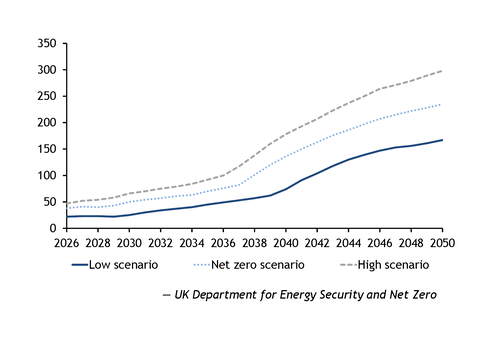
The government models four scenarios — one assuming decarbonisation in line with achieving net zero emissions by 2050; one assuming low fossil fuel prices and low economic growth; one assuming low fossil fuel prices and high economic growth; and one assuming "unobservable market factors" in the early years of the projections.
These produce a range of £22-47/t CO2e in 2026, rising to £25-66/t CO2e in 2030, £74-178/t CO2e in 2040 and £167-298/t CO2e in 2050. The trajectories become steeper over time as carbon abatement options become more expensive, the government said.
These have changed significantly from last year's ranges — £62-103/t CO2e in 2026, £50-107/t CO2e in 2030, £94-151/t CO2e in 2040 and £85-154/t CO2e in 2050 — because of adjustments to underlying business-as-usual emissions projections and corresponding marginal abatement cost curves, and assumptions relating to the power sector and interconnectors, the government said.