An LNG supply crunch due to the ongoing Iran war has dealt a blow to India's industrial gas users and could soon hit other downstream markets like fertilisers, city gas, and power generation — all of which depend on imported LNG to meet over 50pc of their gas needs.
Gujarat Gas, India's state-run city gas firm and operator of the ceramic industrial cluster in Gujarat's Morbi, has reduced the volume of daily gas supplied to customers by 50pc over 6-31 March.
The firm has informed customers to limit usage and could also suspend gas supply depending on availability, sources told Argus.
The state-run Gujarat State Petroleum Corporation (GSPC), its parent company, has cut industrial gas supply by nearly 70pc. It is currently supplying only to the domestic piped natural gas (PNG) network, which serves residential households and compressed natural gas (CNG) used in vehicles, sources added.
Market participants expect the industrial cluster to soon run out of gas supply as the availability of competing fuel propane remains under serious pressure. India may only have up to 10 days of LPG stocks to cover demand and the country is scrambling for cargoes outside of the Mideast Gulf as the Iran-US conflict has effectively dried up exports from the region.
The decline in LNG volumes has come amid the backdrop of rapidly depleting stocks of the super-chilled fuel at Indian terminals and storage tanks.
India's state-controlled Petronet LNG has issued a force majeure note to its offtakers that include Gail, IOC, and BPCL on 3 March after receiving a "notice indicating a potential event of force majeure" from upstream firm state-controlled QatarEnergy (QE) of its 77mn t/yr Ras Laffan LNG export terminal, it said in a stock exchange filing.
Petronet has issued a force majeure notice to QatarEnergy regarding its LNG tankers Disha, Raahi, and Assem, the filing showed.
Petronet LNG's tankers cannot safely transit through the strait of Hormuz, and acts of war are excluded under the company's insurance, the firm said.
Only one out of Petronet's three captive LNG tankers plying between India and the Middle East, has managed to unload LNG at the 17.5mn t/yr Dahej terminal.
The 138,000m³ Raahi unloaded 60,000t of LNG at the Dahej terminal on 1 March, while another vessel the 138,000m³ Disha, carrying a similar volume, has not been able to transit the strait and has been waiting around the Ras Laffan LNG terminal since 28 February.
The 155,000m³ Aseem has rerouted away from the strait of Hormuz while it was back on its way to Ras Laffan after unloading LNG at Dahej on 24 February, Vortexa data show.
This has left Petronet with only two days of supplies at Dahej, traders said.
State-run gas distributor Gail and GSPC issued two tenders seeking March delivery LNG cargoes on 3 March, that were heard to have been not awarded, as offers received were over $25/mn Btu at India's west coast, traders said.
Available March deliveries on water remained limited. Argus has so far determined there is about 1.056mn t of LNG loaded onto 13 vessels — but it is trapped in the Mideast Gulf west of Hormuz as of 3 March, according to data from ship-tracking firm Kpler. There are also three empty vessels potentially ready for loading whenever QE's production restarts.
Asia is likely to face LNG supply disruptions because of QE's production halt, as well as shipping restrictions in the strait of Hormuz.
The Argus-assessed prices for deliveries to west and east India for first-half April rose to $23.3/mn Btu and $23.5/mn Btu, respectively on 4 March, higher by $7.8-7.9/mn Btu from the previous session.
Sector-wise usage
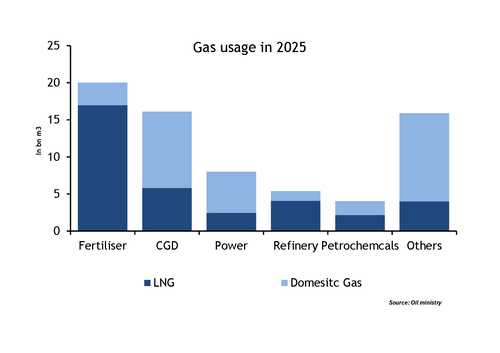
LNG is a critical component for Indian downstream industries. In 2025, LNG accounted for 80pc of gas demand from the fertiliser sector and for 36pc from city gas usage, oil ministry data show. [See graph- Gas Usage in 2025]
LNG usage in India's power sector was at 30pc, at refineries 75pc, and for petrochemicals at 54pc in 2025, the same data show.
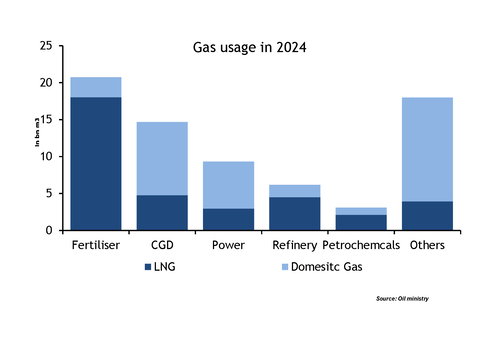
There has been an increase in reliance on imported LNG at Indian downstream units over the last two years as domestic gas production in the country has also dwindled to 34.7bn m3 in 2025, down by 3pc on the year, oil ministry data show.
India's fertiliser plants were earlier told about limited supplies and offered take-or-pay contracts on 3 March. The take-or-pay contracts require buyers to either accept goods or pay a penalty, ensuring risk-sharing between suppliers and buyers. But intervention by some officials have now restored supplies, industry executives said.
An interruption in urea production is likely to trickle down to the farming community — a politically sensitive group.
The city gas firms would be prioritised over industrial supply because domestic PNG and CNG are essential sectors, the sources added.
LNG supplies to petrochemical plants may decrease as they scale back operations, while refineries may turn to other sources.
For the power sector, India's gas-fired power plants may also limit generation soon if they fail to receive LNG supplies.
But this may have limited impact on overall power demand as gas accounts for less than 4pc of India's power generation.
India's coal-fired generation averaged just over 149GW in January, representing over 86pc of aggregate generation from non-renewable and large hydro sources, while gas-fired generation averaged just 2.43GW, the latest Central Electricity Authority (CEA) data show.
India's lack of investments in its LNG and LPG storage infrastructure have become increasingly apparent as the crisis in the Middle East unfolds.