Falling gas demand in French industry in recent years has not yet been matched by a corresponding rise in power demand, as cost, uncertainty and other factors reduce the attractiveness of electrification projects.
Industrial energy consumption evolution
Gas consumption in industry has fallen sharply in recent years.
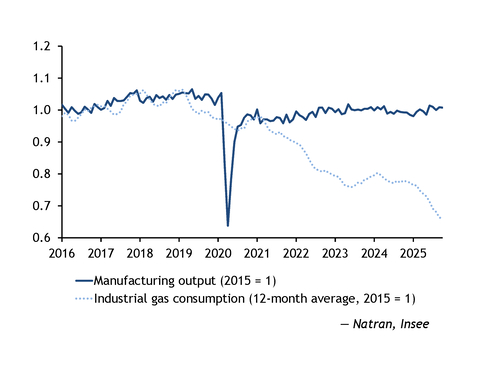
Last year, consumption in transmission system operator Natran's zone — which covers 94pc of French demand — fell to the lowest in more than 10 years at 92TWh. But the fall in gas consumption has not been accompanied by a fall in overall manufacturing output, suggesting it is because of fuel-switching, efficiency improvements or reshuffling to focus on less energy-intensive products (see gas demand vs output graph).
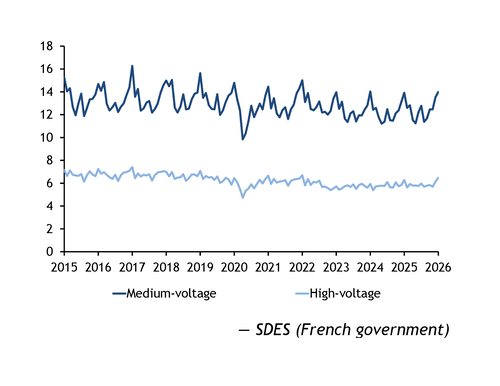
Industrial power consumption may have begun rising from energy crisis lows, although rises are currently small and not all measures show a rise. Average demand on the high-voltage and medium-voltage grids, which serve large energy-intensive industry and smaller sites, respectively, rose by 1.3pc and 1.4pc on the year in 2025, the first time that demand rose in both since 2021.
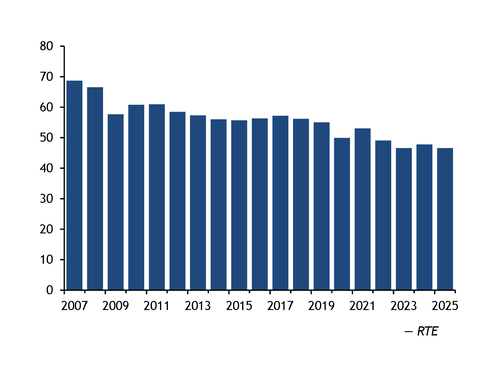
But specifically for manufacturing firms on the high-voltage network, 2025 demand marked a near-low over the past 20 years (see power demand graph).
A fall of 1.1TWh in chemical sector demand in the year outweighed small 100GWh gains in each of the food and agriculture and paper sectors.
The past few months may have seen the beginnings of a more significant upturn. High-voltage demand in January was the highest for any month since January 2022, and in December and January it was up by 6-7pc on the year after climate correction (see high-voltage and medium-voltage demand graph).
Barriers to wider industrial electrification
Retail electricity prices for industrial consumers were 2.3 times higher than gas prices in the first half of 2025, according to government data.
The higher efficiency of electricity used for producing heat can offset some of this gap, while expectations of higher carbon emissions pricing in the future under the EU emissions trading system can drive firms to electrify.
But a lack of certainty about the future price incentives is a barrier to electrification, according to consultancy Synops decarbonation project manager Louis Longhini. Some companies may hesitate to electrify for a lack of long-term visibility, especially with larger projects where capital expenditure requirements mean the payback period is longer, Longhini said. Such firms may reinvest in fossil fuel-fired processes simply because they are not sure that the investments needed to electrify will pay off in the long run. And conversion from gas to electricity in some sectors such as glass-making may be more complicated. The investments required are larger, changes to processes make the projects more complex and the sectors are already facing difficulty, he said.
Fear of a widespread blackout, in the same style as the Spanish blackout last year, makes firms hesitant to electrify. The extreme spike in French power prices during 2022 is another barrier, Longhini said. Industrial users of gas can be reassured that most of their international competitors are exposed to the same global gas price rises as they are, but power price rises specifically in France would put them at a competitive disadvantage.
Price can be a significant barrier to electrification, Frank Roubanovitch, president of Cleee, an association of large energy consumers, told a conference in September. Ceramics makers could technically shift their energy consumption mix to two-thirds electricity and one third gas from an even split today, he said. But this would increase costs, and overseas competitors are already able to produce at 20pc cheaper, even after transport costs.
More niche concerns can also make electrification more difficult, Roubanovitch said. Producers of crops in greenhouses use exhaust CO2 from fossil fuels as an input, and so would need to replace this if they electrify. And for specialist industrial cleaning firms, which currently use gas-fired equipment, manufacturers do not produce electric-powered versions, as there is only demand in Europe for such units, compared with much larger global demand for gas-fired equipment.
Subsidies driving some change
There are a host of subsidy schemes for businesses to electrify industrial applications.
Under the large industrial projects decarbonisation scheme (GPID), €1.6bn in capital and operating expenditure subsidy was last month awarded to seven firms. Smaller projects can receive subsidy from the "decarb-ind" or "decarb-flash" schemes, which since 2020 have disbursed almost €600mn. These schemes target primarily decarbonisation, which can include energy efficiency or conversion to biomass, but also includes electrification. One GPID winner, chemical producer Syensqo, is to replace two gas-fired boilers with an electric-powered one.
But the large number of different schemes could be a disadvantage. "It can be very confusing," Benedicte Genthon, general delegate of power industry association UFE, told Argus. UFE supports the implementation of a single process for firms to obtain access to subsidy.
Targeted technologies can move ahead
Some electrification of gas-consuming industrial processes can make economic sense even without subsidy, and have short payback periods.
Installing mechanical steam recompressors, which cut large amounts of gas demand but add some power demand, can be profitable within three years, according to Longhini. The units are relatively easy to install and require few other adjustments to processes, Longhini said. And heat pumps for producing hot water are an attractive option for firms, UFE told Argus, as they require few changes to processes to be made.