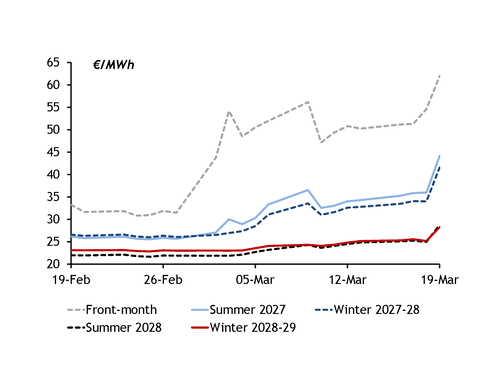
In a scenario in which the remaining 64.2mn t/yr of liquefaction capacity at QatarEnergy's (QE) Ras Laffan LNG complex returns on 1 July, European gas injections are likely to weigh because of increased competition from Asia for spot cargoes. And if disruptions persist longer, more severe demand destruction measures will be necessary in Asia and the EU.
Even if the remaining liquefaction capacity at QE's Ras Laffan LNG terminal were to return by 1 July, European LNG demand will remain elevated well into 2027, as Asia's summer demand is likely to secure cargoes that otherwise would have been destined for Europe, ultimately reducing the available gas for injection over the summer, leading to low stocks and stronger injection demand next year as well as this year.
The pause in Qatari exports will reduce supply to Asian countries, as Qatari exports made up about a quarter of Asian LNG supply over the second and third quarters last year, and Asian destinations receive about 90pc of all Qatari LNG. QE said last week that the previously 77mn t/yr Ras Laffan facility will return with just 64.2mn t/yr of capacity and repairs to the remaining capacity will take 3-5 years, as damage was sustained to two of the trains.
Optimistic scenario
Supply may not resume fully for 3-4 months, QE chief executive Saad Sherida al-Kaabi said. This means that if a resolution to the war in the Middle East occurs next week, the earliest that remaining operations could fully resume would be around 1 July.
As of 1 July, global LNG supply from the Middle East will have been reduced by about 17.3mn t, as an additional 12.4mn t of non-Middle Eastern summer LNG supply is expected, offsetting some of the 29.7mn t of lost UAE and Qatari LNG supply lost over March-June.
But Asia is more exposed to the lost Mideast Gulf volumes, given 90pc of LNG exports from the region are delivered to Asian destinations. Asian countries have already begun to pursue demand destruction measures. But even if Asia only secures half of the net loss, 8.65mn t of LNG will be removed from supply that otherwise would have previously been destined for Europe, as the inter-basin arbitrage had remained firmly shut since October.
Europe imported 54mn t of LNG in April-September, or about 26pc of global receipts in that period. If Asia absorbs half of the remaining 17.3mn t of net supply loss this summer, that would equate to 16pc less LNG entering the European grid over the summer injection season, which Europe is entering at its lowest level since 2022.
European stocks are poised to enter the coming storage year with a combined 325TWh (21mn t of LNG), or 28pc full, GIE transparency data show. If firms in Europe inject 16pc less gas into storage sites over April-September — compared with the past five-year average of 2.86 TWh/d — the EU would inject 2.4 TWh/d over the period. This would result in a 66pc fill level by 1 October — or 765TWh — and the lowest for that date since at least 2011.
This would be well below the 80pc fill level which EU member states must reach between 1 October and 1 December, which already includes 10pc leeway. Countries could potentially continue injecting into the winter, but if the season is cold from the beginning, withdrawals could begin immediately. And in the past five years, 2022 was the only year in which the EU net injected through 1 October-1 December, at 782 GWh/d.
In the event that the EU does manage to get an 80pc fill level by 1 October, whether its via government intervention or firms outbidding Asia for LNG cargoes, the EU would have to inject 3.3 TWh/d over the summer. This would remove about 603TWh of supply in Asia, which could result in further demand destruction on the continent.
Delayed return
Should Ras Laffan gas not restart until 2027, Asia and the EU will likely see more severe demand destruction.
Already severe intervention measures such as subsidising or capping gas-fired power generation prices have been proposed. And higher gas-fired prices are likely to result in extended delays to coal phase-out plans among the bloc's member states. This scenario could result in the EU entering the winter with a fill level lower than 66pc — and storage sites could be severely depleted — by the beginning of the 2027-28 winter.