Nordic data centre power consumption is expected to grow rapidly over the next decade, and Norway's government and transmission system operator (TSO) Statnett remain committed to a "technology-neutral" connections process, they told Argus, despite the region's tightening power balance and data centres often having inflexible consumption patterns.
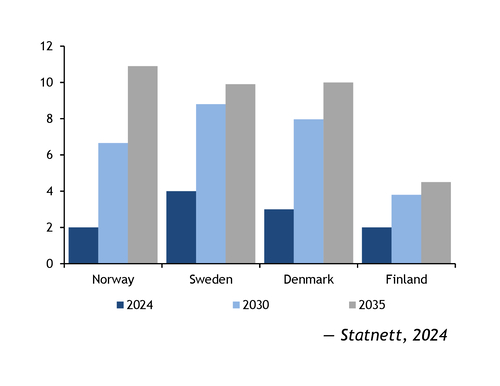
Power consumption from data centres is forecast to reach 28 TWh/yr regionally by 2030 or 5pc of total demand, up from 8TWh or 2pc of demand in 2024, according to projections by Statnett. The TSO forecasts around 4 TWh/yr of consumption in Finland by 2030, doubling compared with 2024, and 8 TWh/yr in Denmark. Norwegian and Swedish data centre consumption is forecast to total 7 TWh/yr and 9 TWh/yr, respectively, by 2030 (see graph).
But in Norway that figure could be even higher, as the country's reserved capacity for data centres has grown to 3.5GW and its capacity queue to 5.4GW since Statnett published its long-term market analysis for 2050 two years ago.
That rapid expansion in a new demand source will coincide with a sharply tightening power balance across the region.
Hanging in the balance
A tighter power balance will ultimately support higher electricity prices across the region, eroding some of the incentive for data centre operators to position themselves in the Nordics.
But the Norwegian energy ministry still expects Norwegian and Nordic prices to remain lower than in northern Europe, allowing the region to retain its competitiveness, it told Argus.
That price outlook is expected to lead to some "dampening" of demand from heavy industry and other sectors, the government added. Swedish TSO Svenska Kraftnat this month reduced its demand forecast for every high-consuming sector other than data centres.
The Nordic region's ability to meet the substantial new consumption of its data centre fleet remains to be seen over the short term, especially given the limited new production capacity expected by 2030. Svenska Kraftnat forecasts that the regional surplus will fall to 29TWh by 2030 from around 53TWh in 2026. And in Sweden alone, the power surplus is projected to fall by 65pc to 12TWh by 2030, with capacity projected to grow to just 56.1GW from around 50GW in 2026, TSO data show.
While the Norwegian government expects Norway and its neighbours to remain competitive, "there is considerable uncertainty regarding how many [queued] projects" will actually be built and when, it told Argus. This uncertainty is based in part on the precedent across all sectors that "not all projects that request or reserve grid capacity are realised", it said.
Flexibility matters
Data centre consumption is likely to make up a large part of the planned increase in electricity consumption in the coming years in Nordic markets, especially as demand growth in other sectors has slowed relative to expectations, according to Svenska Kraftnat.
The region plans to meet part of this demand growth with intermittent renewables, increasing the need for flexibility on their grids, which data centres may not be best placed to provide.
Data centres "can have different operational characteristics depending on the technology and services they provide", the Norwegian energy ministry said, acknowledging that these projects will "differ in their incentives and possibilities to react to [power price] fluctuations... and participate in balancing markets [e.g. demand-side response]".
Data centres — broadly those providing cloud computing services and capacity for artificial intelligence (AI) — operate with an "always-up" requirement, offering constant availability and demanding electricity at all times, albeit with some predictable variability, with consumption lowest around 04:00, according to Norwegian grid data provider Elhub.
That contrasts with data centres focused on cryptocurrency mining, which can be unpredictable and produce rapid swings in consumption according to the market value of their output currency.
While mainstream cloud and AI centres offer predictable consumption patterns that are easy to integrate within long-term network and system plans, according to Elhub, they also introduce a high-consuming yet inflexible and non-price responsive block of demand onto the network, at a time when network flexibility is a critical policy objective at the national, Nordic and European level.
But despite data centres having a different consumption profile to other high-consuming industrials, the Norwegian government noted that it "does not classify specific sectors as firm or interruptible load" and that the responsible authorities must assess grid connections using a "neutral and non-discriminatory framework", it told Argus. And it confirmed that there are "no plans to move away from the current principles of neutrality".
Statnett confirmed that it is "required to treat all sectors equally". At the same time, distribution system operators have "an obligation to connect customers, as long as it is socioeconomically rational", Statnett said.