The Australian government will amend the Export Finance and Insurance Corporation Act to give government agency Export Finance Australia (EFA) new authority to underwrite additional cargoes of critical imports, including fuel and fertilizer, because rising risk premiums are challenging independent importers.
The amendments would allow EFA to help firms hedge risk so they can "buy these cargoes and get them on the way to Australia as soon as possible," energy minister Chris Bowen said. The risk premium for discretionary spot purchases is increasing and "work to scope deals and secure additional fuel is already underway", he said.
Under the changes, EFA will be able to issue insurance or indemnity contracts, provide guarantees, extend loans and undertake other arrangements necessary to secure supply from international markets. The government will only intervene to support discretionary volumes considered important for national fuel security, and where private importers cannot procure them on commercial terms.
The measures are aimed at assisting independent importers that supply regional areas, some of whom have struggled to obtain extra fuel volumes because their usual suppliers have prioritised meeting the needs of contracted customers. The supply shortfall has left several regional service stations without fuel in recent weeks. The powers will "give suppliers confidence to secure additional and discretionary cargoes […] to service uncontracted demand, including regional and independent fuel suppliers", prime minister Anthony Albanese said on 28 March.
The support is intended to help firms operating in the spot market and will not replace or subsidise fuel that importers are already contracted to supply, Bowen said. Eligibility criteria will be structured to ensure additional supply can be delivered quickly by operators with the capability and networks to distribute fuel into constrained regions.
New Strategic Reserve powers
The federal government has also released details of broader powers under the Export Finance and Insurance Corporation Amendment (Strategic Reserve) Bill, which will create a strategic reserve for essential materials vulnerable to supply chain disruptions, including fuel, critical minerals and fertilizers.
The bill expands EFA's remit on the National Interest Account, giving the agency a wider commercial toolkit beyond existing debt and equity options. The legislation will allow EFA to secure supply, sell and selectively stockpile fuel, critical minerals and other strategic commodities, Bowen said.
It also gives EFA authority to construct financial arrangements such as fixed or floating offtake agreements, forward contract trading, intermediary demand and supply aggregation, physical stockpiling and contracts for difference. It also legislates the government's commitment to establish a A$1.2bn ($823mn) Critical Minerals Strategic Reserve.
The government today announced it will cut the fuel excise a tax paid on each litre of diesel and gasoline sold in the country to ease cost of living pressures for a 90-day period. The excise will drop from 52.6A¢/litre to 26.3A¢/litre for a three-month period, Albanese said following a meeting of national cabinet.
Canberra will also scrap the heavy vehicle road user charge for the next three months to reduce inflation for road freight. The tax is levied at 32.4A¢/litre and aims to recover costs for building and maintaining public roads, which carry most of Australia's freighted consumer goods.
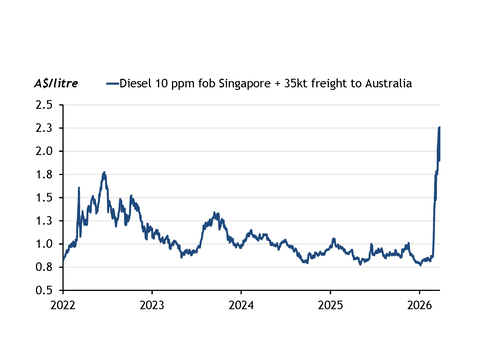
Delivered gasoil prices to the east coast of Australia have surged since the start of the US-Iran war, surpassing highs achieved during the Russian invasion of Ukraine in 2022 (see graph).
Victoria will offer free public transport until the end of April to ease pressure on fuel demand, while Tasmania will provide free travel on buses and Derwent River ferries until 1 July. Other state governments have ruled out similar policies.